
Pediatric exams are full of questions where the age of the child quietly decides the answer. A toddler needs a different explanation than a teenager, and a drug dose that is safe for a school-age child can harm an infant. Students often know the facts but miss the age clue in the first line of the question.
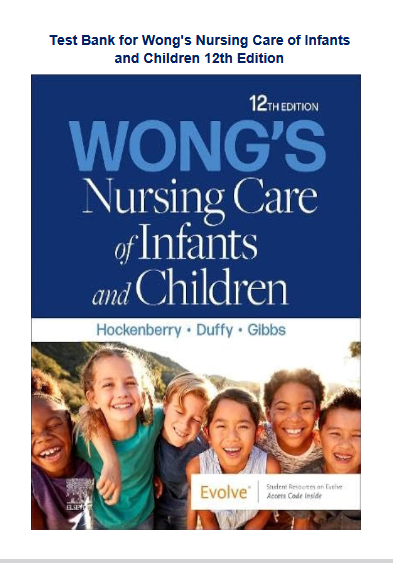
This test bank was written to help you catch those clues. It follows the chapter order of Wong’s Nursing Care of Infants and Children, 12th Edition, so each study session matches what your class is covering. It is a self-study resource and is not the publisher’s official material.
If you are taking a pediatric nursing course, getting ready for clinical on a children’s unit, or reviewing for the NCLEX-RN, this resource gives you steady practice with age-based thinking and safe decisions.
Topics Covered
The question sets follow the textbook and include:
- Growth and development from birth through the teen years
- Working with families and talking with children at each age
- Pain checks and pain relief for different ages
- Preparing children for hospital stays and procedures
- Newborn and infant care, feeding, and common early problems
- Heart, lung, and digestive conditions in children
- Brain, bone, muscle, and hormone disorders
- Blood disorders, including sickle cell disease, and childhood cancer
- Infections, vaccines, and common childhood illnesses
- Safe medicine doses and fluid needs based on weight
- Child safety, poisoning, abuse, and neglect
- Long-term illness, disability, and end-of-life care
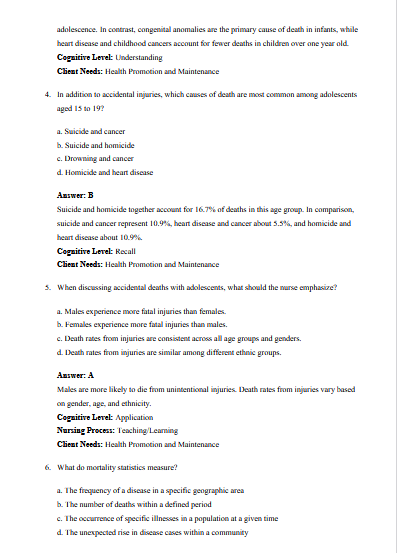
You will find multiple-choice, select-all-that-apply, and dosage questions, which are the formats pediatric courses and licensure exams use.
Why Practice Questions Help in This Course
Reading about each age group is one thing. Using that knowledge when a question changes the child’s age is another. Practice helps you:
- Match each nursing action to the child’s stage of development
- Notice early signs that a child is getting worse, since children can change fast
- Check weight-based doses with confidence
- Explain care in words that a child and a parent can understand
- Get used to how exam questions are written
Short, regular practice by chapter is much more effective than one long review the night before.
What Makes This Test Bank Different
Every question includes a full rationale. You will see why the best answer fits this child at this age and why each other option falls short. In pediatrics, wrong answers are often correct for a different age group, so learning why they fail helps you remember the age rules.
Questions are grouped by chapter and topic, so you can review one area, such as child safety, before a quiz, or work across many chapters before a final.
Sample Questions
Question 1
The parent of a 2-year-old says, “My child says ‘no’ to everything and wants to do things alone. Is something wrong?” What is the nurse’s best response?
A. “This is a sign of a behavior problem that needs treatment.”
B. “This is a normal stage of becoming independent. Offering simple choices, such as which cup to use, can help.”
C. “You should punish refusal so your child learns to obey.”
D. “Do everything for your child to avoid arguments.”
Correct Answer: B
Rationale: Toddlers are working on autonomy, which is Erikson’s stage of autonomy versus shame and doubt. Saying “no” and wanting to do things alone are normal signs of growth. Giving limited, safe choices lets the child feel in control while the parent keeps limits. Calling it a behavior problem or using punishment can lead to shame and doubt. Doing everything for the child blocks the development of independence.
Question 2
An 8-year-old with sickle cell disease has severe leg pain and is in a vaso-occlusive crisis. Which nursing action is the priority?
A. Apply ice packs to the painful legs
B. Give pain medicine on a regular schedule as ordered and make sure the child gets plenty of fluids
C. Limit fluids to reduce swelling
D. Wait until the pain is a 10 out of 10 before giving medicine
Correct Answer: B
Rationale: In a crisis, sickled red cells block small vessels and cause severe pain. Dehydration and low oxygen make sickling worse, so fluids and oxygen if needed are key. Pain is treated promptly and on a schedule, often with opioids, because waiting makes pain harder to control. Cold can narrow vessels and increase sickling, so warmth is used instead. Limiting fluids would worsen the crisis.
Question 3
A 3-year-old has had a fever for six days, red eyes without discharge, a red cracked tongue, swollen hands, and a rash. Which treatment should the nurse expect?
A. Antibiotics alone
B. Intravenous immunoglobulin (IVIG) and aspirin
C. Acetaminophen only
D. A live virus vaccine
Correct Answer: B
Rationale: These findings fit Kawasaki disease, which inflames blood vessels and can damage the coronary arteries. Early treatment with IVIG and aspirin lowers that risk. This is one of the rare times a child is given aspirin, so the nurse should also watch for signs of bleeding and tell parents to report flu or chickenpox exposure, because of the risk of Reye syndrome. Antibiotics do not treat this illness. Acetaminophen alone does not prevent heart complications. Live vaccines are delayed for months after IVIG because the antibodies can block the vaccine’s effect.
Question 4
An 8-month-old has sudden bouts of severe crying, pulls his knees up to his chest, and vomits. Between episodes he seems tired. His stool is red and jelly-like. What condition is most likely?
A. Pyloric stenosis
B. Intussusception
C. Hirschsprung disease
D. Gastroesophageal reflux
Correct Answer: B
Rationale: In intussusception, one part of the bowel slides into the part next to it, blocking the flow and cutting off blood supply. The classic signs are episodes of severe pain, vomiting, and “currant jelly” stools made of blood and mucus. It is most common in infants between 3 months and 3 years. It is an emergency. Many cases are treated with an air or contrast enema, and surgery is used if that fails. Pyloric stenosis causes projectile vomiting in younger infants without bloody stools. Hirschsprung disease causes constipation and a swollen belly. Reflux does not cause these episodes.
Question 5
A 3-month-old is brought in with a broken thigh bone. The parent says the baby fell off the couch while crawling. What should the nurse do?
A. Accept the explanation, since falls are common
B. Confront the parent and demand a confession
C. Document the story and findings in the parent’s own words and report suspected abuse to child protective services as required by law
D. Wait for more injuries before taking action
Correct Answer: C
Rationale: A 3-month-old cannot crawl, and a thigh bone fracture in a baby who cannot walk is a red flag for abuse. The explanation does not match the child’s development. Nurses are mandated reporters and must report suspected abuse. They do not need proof. The nurse should document facts and quotes objectively and keep the child safe. Accepting the story or waiting leaves the child at risk. Confronting the parent is not the nurse’s role and can make the situation less safe.
Frequently Asked Questions
Is this the same as the publisher’s official test bank?
No. This is an independently written study resource meant to help you review the topics in the 12th edition of Wong’s Nursing Care of Infants and Children. It is a self-study companion and is not distributed by the publisher.
Will it help me prepare for the NCLEX-RN?
Yes. The scenario style is similar to licensure exam questions. It focuses on safety, priorities, and age-based care.
Does it cover every chapter?
The questions follow the chapter order of the 12th edition, from growth and development through each body system and special topics.
What kinds of questions are included?
Mostly multiple-choice, plus select-all-that-apply and dosage questions.
Are there explanations?
Yes. Every question has a full rationale that explains why the best answer is correct and why the other options do not fit.
Who is it for?
Nursing students in a pediatric course, and anyone reviewing child health before an exam or the NCLEX-RN.
How should I use it?
Read the chapter first, then try the questions before looking at the answers. Study the rationales for anything you missed. Knowing why an answer fits a certain age helps more than memorizing the letter.
Can it replace the textbook?
No. It works best alongside the textbook. The book teaches pediatric care, and the test bank gives you practice applying it.
Is it useful the night before an exam?
Yes. Because it is organized by chapter, you can quickly review one area, such as dosage math or child safety, without rereading the whole book.


Muas –
Nice study material
Catli –
Good
Avas –
nice
Avas –
nice study material
Joan –
This document is so good
Diana –
Of great help
cherylduvall –
Its helpful narrowing down the possible types of questions you may encounter
natalienycole1 –
I’m truly glad the document was helpful and met my expectations
Frank –
Made my revision easy
Harry –
High-quality, detailed test bank
Mathivhathen –
Detailed explanation
Wright –
Highly recommend this test bank
Rose –
Boosted my confidence before exams.
Ann Peterk –
Perfect for quick study sessions.
Martin John –
Very convenient and informative resource.
Nelly M –
Spot-on prep for nursing school
Athena Mya –
Direct hit on exam concepts
Grace Hannah –
Perfect for last-minute review sessions
Zack Evans –
Makes studying much more organized.
Annen –
Useful practice for nursing assessments.
lefuij –
Clear, concise, and easy to follow
Joyce Silva –
Helped me feel more prepared
Briannacangro –
Improved my nursing knowledge and confidence
Jontamoore –
Fantastic collection of nursing practice questions
Katirina –
Clear answers with helpful explanations
Williams –
Makes exam revision more effective
Pato –
Great study aid for nursing students
Daniel Kip –
Helped me strengthen my nursing knowledge.
Eunice –
Reliable resource for daily exam practice.
Lemmy –
Great explanations for difficult nursing concepts.
Felix Okema –
Helpful for building exam confidence.
Max2 –
Convenient and effective nursing study resource
Janew –
Supports better understanding of nursing topics.
Vanmol –
A great addition to study materials.