

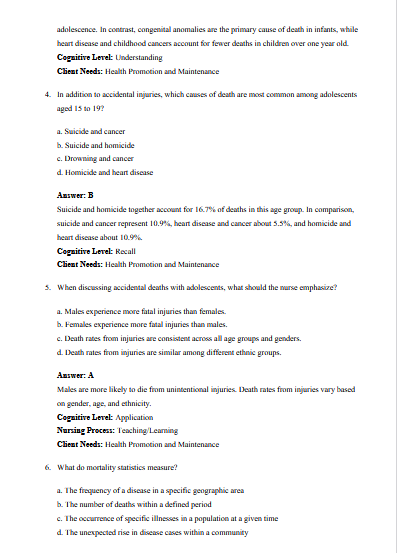
Pediatric nursing runs on one core idea: a child is never just a smaller version of an adult. Growth stage, family involvement, communication style, and medication dosing all shift depending on how old the patient is, and that shifting standard is exactly what makes this content harder to study for than it first appears. Wong’s Nursing Care of Infants and Children has long been one of the most comprehensive references for this material, and this test bank was built to reinforce it the same way the textbook teaches it, developmentally, from the newborn period through adolescence. It follows the chapter structure of the 12th edition, so your practice tracks the same age-organized approach used throughout the book.
Whether you’re in a pediatric nursing course, preparing for clinical time on a pediatric unit, or reviewing before the NCLEX-RN, this resource is designed to sharpen the age-specific clinical judgment pediatric exams consistently test.
What’s Covered
Practice sets follow the textbook’s organization, including:
- Growth and development from infancy through adolescence
- Family-centered care and communication across developmental stages
- Pain assessment and management approaches suited to a child’s age
- Preparing children for hospitalization and procedures, and reducing their anxiety
- Common newborn and infant health concerns, including congenital conditions
- Respiratory, cardiac, and GI conditions specific to pediatric patients
- Neurological, musculoskeletal, and endocrine disorders in children
- Infectious disease patterns and immunization schedules
- Pediatric oncology and hematologic conditions
- Safe medication administration and weight-based dosing considerations
- Chronic illness, disability, and end-of-life care in pediatric nursing
Question formats mix multiple-choice, select-all-that-apply, and case-based items, matching how pediatric nursing coursework and licensure-style testing are typically structured.
Why Practice Questions Help Here
Pediatric exams often expect the “right” answer to shift entirely based on a child’s age. What’s correct for a toddler might be completely wrong for an infant or a teenager, and catching that distinction is frequently the whole point of the question. Working through practice questions helps you:
- Match nursing interventions correctly to a child’s specific developmental stage
- Build comfort with pediatric pain assessment tools and age-appropriate communication
- Practice separating normal developmental variation from findings that need follow-up
- Get faster and more confident with weight-based dosing and medication safety questions
- Reduce exam anxiety by practicing the same scenario-based reasoning used on course exams and the NCLEX
Students often say pediatric nursing seems simple until they realize the correct answer depends almost entirely on a detail like the child’s age, something that’s easy to skim past under time pressure. Regular, chapter-based practice is one of the more reliable ways to build that developmental instinct before it’s tested for real.
What’s Different About This Test Bank
Every question here comes with a complete rationale, not just a letter. You’ll see why the correct answer reflects age-appropriate, family-centered pediatric care, and why each other option misses the mark, whether it’s mismatched to the child’s developmental stage, overlooks a safety concern, or doesn’t reflect current pediatric standards. That mirrors how pediatric nursing exams tend to be written, since incorrect answers often sound reasonable but miss a key developmental detail.
Questions are grouped by chapter and by developmental stage or condition, so you can zero in on exactly what you need, whether that’s toddler pain assessment before a quiz or a full comprehensive review before finals. It fits naturally alongside your assigned reading, works as prep before clinical rotations, and serves as a structured review heading into exam day.
Sample Questions
Question 1
A nurse needs to assess pain in a 2-year-old who can’t reliably self-report pain intensity. Which tool fits best for this age group?
A. Numeric rating scale, 0 to 10
B. FLACC scale, based on observed behavior
C. Visual analog scale requiring the child to mark a line
D. Adult-style verbal descriptor scale
Correct Answer: B
Rationale: The FLACC scale, covering Face, Legs, Activity, Cry, and Consolability, is designed for young or nonverbal children who can’t reliably use self-report tools, letting the nurse assess pain through observed behavior instead of asking the child to rate it directly. A numeric rating scale and visual analog scale both require cognitive and verbal skills a 2-year-old typically hasn’t developed yet. An adult-style verbal descriptor scale relies on language and abstract reasoning well beyond a toddler’s developmental stage.
Question 2
A hospitalized 4-year-old becomes visibly upset every time a parent steps out of the room, even briefly. What developmental concept explains this?
A. Stranger anxiety, typically seen in infancy
B. Separation anxiety, common in early childhood
C. Body image disturbance, more typical in adolescence
D. Regression, which only shows up in school-age children
Correct Answer: B
Rationale: Separation anxiety is a normal developmental reaction in toddlers and young children, showing up as distress when separated from a caregiver, especially in stressful situations like hospitalization, and it calls for supportive, family-centered care strategies rather than concern. Stranger anxiety is related but shows up earlier, in infancy, when a baby becomes wary of unfamiliar faces. Body image disturbance ties to adolescent identity development, not this age group. Regression can happen at various ages under stress, but it doesn’t specifically describe this reaction to caregiver separation.
Question 3
A nurse is calculating a pediatric medication dose based on a child’s weight. What’s the most important step before giving the medication?
A. Round the weight to the nearest whole number to simplify the math
B. Double-check the calculated dose against the safe range for the child’s weight
C. Give the adult standard dose if the pediatric dose looks too small
D. Skip verification since the child has received this medication before
Correct Answer: B
Rationale: Verifying the calculated dose against the safe range for the child’s specific weight is a critical safety check, since children are especially vulnerable to dosing errors given their smaller size and still-developing organ systems. Rounding weight to simplify math introduces inaccuracies that matter more in pediatric dosing than adult dosing. Giving an adult dose to a child is dangerous and could cause serious harm. Skipping verification because the medication was given before is unsafe, since every dose needs independent verification regardless of history.
Question 4
A child with a highly contagious respiratory virus is placed on droplet precautions. What does correctly implementing this look like?
A. Placing the child in a negative pressure room at all times
B. Wearing a mask when within three to six feet of the patient
C. Requiring full contact precautions, gown and gloves, for every interaction
D. No special precautions needed beyond standard hand hygiene
Correct Answer: B
Rationale: Droplet precautions call for a mask when working within roughly three to six feet of the patient, since the pathogen spreads through larger respiratory droplets that don’t travel far or linger in the air. A negative pressure room applies to airborne precautions, a different category of pathogen entirely. Full contact precautions with gown and gloves apply to pathogens spread through direct contact or surface contamination, not droplet transmission specifically. Standard hand hygiene alone isn’t enough, since droplet precautions call for added barrier protection.
Question 5
A nurse is giving anticipatory guidance to the parents of a 6-month-old. What topic fits this stage best?
A. Preparing for toilet training
B. Introducing solid foods and childproofing for growing mobility
C. Managing adolescent independence
D. Reviewing safe driving practices for a newly licensed teen
Correct Answer: B
Rationale: Around 6 months, infants are typically developing the motor skills needed to begin solids and are becoming increasingly mobile, making guidance on introducing food and childproofing developmentally timely for this visit. Toilet training guidance fits toddlers, generally starting closer to 18 months to 3 years, not a 6-month-old. Adolescent independence and driving safety belong to teenage years, far outside this infant’s developmental stage and irrelevant to this particular visit.
Frequently Asked Questions
Is this the publisher’s official test bank?
No, this is an independently written study resource built to help you review the topics covered in the 12th edition of Wong’s Nursing Care of Infants and Children. It’s meant as a self-study companion and isn’t distributed by the publisher.
Will this help with NCLEX-RN prep?
The scenario-based style mirrors licensure exam questions, with a focus on developmental stages, family-centered care, and pediatric safety, all heavily tested areas in pediatric nursing.
Is the whole textbook covered?
Yes, questions are organized by chapter and developmental stage or condition, following the 12th edition’s general topic order, from growth and development basics through system-specific pediatric conditions.
What question types show up?
Mostly multiple-choice, with some select-all-that-apply and case-based items, matching the format common in pediatric nursing courses and on licensure-style exams.
Do I get explanations, or just answer letters?
Every question includes a full rationale explaining why the correct answer reflects age-appropriate, safe pediatric care and why the other choices fall short.
Who is this built for?
Nursing students taking a pediatric nursing course, plus anyone reviewing developmental and pediatric-specific care concepts ahead of a course exam or the NCLEX-RN.
What’s the best way to use it?
Read the assigned chapter first, then work through the matching questions before checking answers. Go back through the rationales carefully for anything missed, since understanding how a child’s developmental stage shapes the right answer matters more than memorizing a letter.
Can this replace the textbook?
No, it’s meant to work alongside it. The textbook builds your foundational understanding of pediatric growth, development, and condition-specific care; the test bank gives you a way to practice applying that knowledge.
Does it match the 12th edition specifically?
Yes, it follows the topics, terminology, and chapter organization of the 12th edition.
Good for last-minute review?
Yes, since it’s organized by chapter, you can zero in on a specific developmental stage or condition quickly instead of rereading the whole book.

Muas –
Nice study material
Catli –
Good
Avas –
nice
Avas –
nice study material
Joan –
This document is so good
Diana –
Of great help
cherylduvall –
Its helpful narrowing down the possible types of questions you may encounter
natalienycole1 –
I’m truly glad the document was helpful and met my expectations
Frank –
Made my revision easy
Harry –
High-quality, detailed test bank
Mathivhathen –
Detailed explanation
Wright –
Highly recommend this test bank
Rose –
Boosted my confidence before exams.
Ann Peterk –
Perfect for quick study sessions.
Martin John –
Very convenient and informative resource.