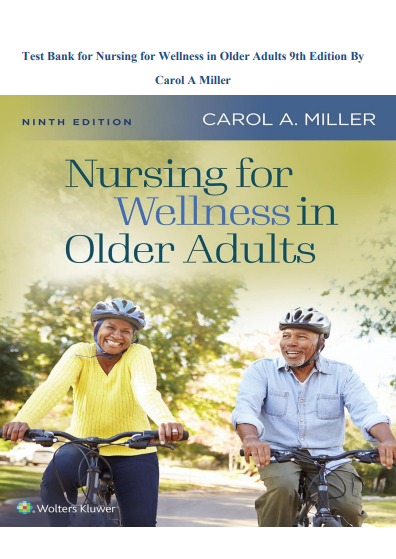
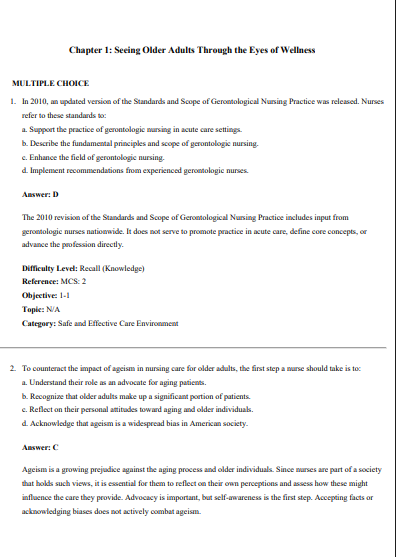
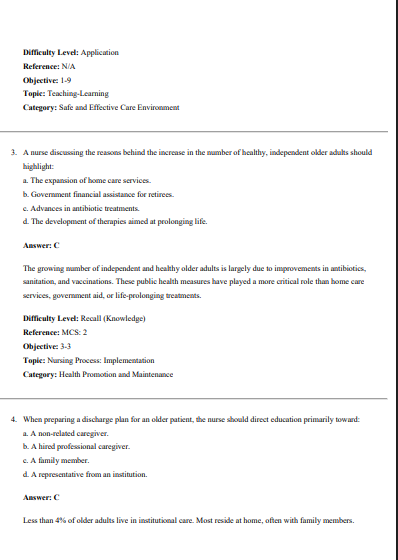
Caring for older adults isn’t just general nursing applied to someone with more birthdays behind them. Aging comes with its own physiology, its own common conditions, and its own definition of what “wellness” even means for someone in their seventies, eighties, or nineties. That wellness-first framing is the heart of this textbook, and it’s exactly what this test bank is built around. Following the chapter structure of Nursing for Wellness in Older Adults, 9th Edition, by Carol A. Miller, this resource lets you practice the aging process, common conditions, and wellness-centered nursing care in the same organized way the book presents it.
Whether you’re in a gerontological nursing course, working toward a certification in older adult care, or prepping for clinical rotations in long-term care or community settings, this test bank is built to strengthen the function-first, quality-of-life-focused thinking this specialty consistently asks for.
What’s Covered
Practice sets follow the textbook’s organization, including:
- Theories of aging and the wellness paradigm central to gerontological nursing
- Age-related changes across body systems, and how to tell normal aging apart from disease
- Functional assessment, including ADLs and instrumental ADLs
- Cognitive changes, including delirium, dementia, and depression in older adults
- Medication use and safety in older adults, including polypharmacy concerns
- Common conditions, including cardiovascular, respiratory, and musculoskeletal changes with aging
- Sensory changes, including vision and hearing loss, and their impact on safety
- Nutrition, hydration, and elimination concerns
- Falls, mobility, and environmental safety
- End-of-life care, advance directives, and ethical considerations
- Promoting wellness, independence, and quality of life across care settings
Question formats mix multiple-choice, select-all-that-apply, and scenario-based items, matching how gerontological nursing courses and licensure-style testing are typically structured.
Why Practice Questions Help Here
One of the trickier parts of this course is learning to tell a normal age-related change apart from an early warning sign. A slower gait, a bit of forgetfulness, thinner skin, these can all be expected with aging, but similar-sounding findings can also point to something that needs intervention. Working through practice questions helps you:
- Learn to distinguish normal aging changes from findings that signal illness or decline
- Get better at spotting early signs of delirium, dementia, and depression, three conditions that often get confused for each other
- Practice applying a wellness model instead of defaulting to a purely disease-focused mindset
- Build comfort with safety-focused questions around falls, medications, and cognitive changes
- Reduce exam anxiety by practicing the same scenario-based reasoning used on course exams and licensure-style testing
Many students say gerontological content is harder to master than it looks, since so many conditions in older adults present differently than they would in a younger patient. Regular, chapter-based practice is one of the more effective ways to build that specialized recognition skill.
What Makes This Different
Every question includes a full rationale, not just a letter. You’ll see why the correct answer reflects the wellness-based, age-appropriate approach this textbook teaches, and why each alternative falls short, whether it mistakes a normal change for a problem, misses a safety concern, or overlooks a key assessment finding. That mirrors how gerontological nursing exams tend to be written, since wrong answers often sound reasonable but miss one specific, age-related detail.
Questions are grouped by chapter and core topic, so you can focus exactly where you need it, whether that’s fall prevention before a quiz or a full review before a comprehensive exam. It works well alongside assigned reading, as a self-check before clinical rotations, or as a structured review before exam day.
Sample Questions
Question 1
An 82-year-old reports needing to urinate more frequently at night. What’s the most likely explanation?
A. A normal decrease in bladder capacity and changes in kidney concentrating ability
B. An untreated urinary tract infection
C. A sign of early kidney failure
D. A side effect of normal daily activity
Correct Answer: A
Rationale: Aging brings a normal decrease in bladder capacity along with a reduced ability of the kidneys to concentrate urine, which commonly leads to nocturia even without any underlying illness present. This is a normal age-related change, not a disease process. A UTI is possible, but it would typically come with additional symptoms like burning or urgency, and isn’t the most likely explanation based on age alone. Option C describes a more serious condition that would show up alongside other findings, like abnormal labs, not just nocturia by itself. Option D doesn’t accurately explain the physiological basis for this common finding in older adults.
Question 2
A patient who was oriented and alert yesterday has become acutely confused over the past several hours, with fluctuating attention and disorganized thinking. What should the nurse suspect first?
A. Early-stage dementia
B. Delirium
C. Normal age-related forgetfulness
D. Chronic depression
Correct Answer: B
Rationale: Delirium shows up as a sudden, acute onset of confusion with fluctuating attention and disorganized thinking, usually triggered by something underlying, an infection, a medication effect, a metabolic imbalance. The sudden shift from fully oriented to confused within hours is the key clue that separates delirium from other causes and calls for prompt investigation into what’s driving it. Dementia, in contrast, develops gradually over months or years, not hours. Normal age-related forgetfulness doesn’t produce this level of acute confusion or fluctuating attention. Chronic depression can affect cognition, but not in this sudden, fluctuating way.
Question 3
An older adult on several medications for multiple chronic conditions is at increased risk for which safety concern?
A. Improved medication effectiveness from combining multiple drugs
B. Adverse drug interactions and a higher risk of falls
C. Less need for medication monitoring
D. Faster drug metabolism compared to younger adults
Correct Answer: B
Rationale: Polypharmacy raises the risk of adverse drug interactions in older adults, partly because aging changes how the body metabolizes and clears medications, and side effects like dizziness or sedation from these interactions can directly increase fall risk. Combining multiple medications doesn’t automatically improve effectiveness, it more often increases risk. Polypharmacy actually calls for more monitoring, not less. And older adults typically metabolize drugs more slowly, not faster, due to age-related changes in liver and kidney function, meaning medications can stay active in the body longer than expected.
Question 4
Which nursing intervention best reflects a wellness-focused approach for an older adult with mild mobility limitations?
A. Encourage the patient to stay in bed to prevent falls
B. Assist with a supervised walking program to maintain strength and independence
C. Perform all ADLs for the patient to conserve their energy
D. Discourage physical activity until mobility fully returns to baseline
Correct Answer: B
Rationale: A wellness-focused approach prioritizes maintaining function, independence, and quality of life rather than defaulting to inactivity to avoid risk. A supervised walking program helps preserve strength, balance, and mobility while still keeping safety in mind through appropriate supervision. Keeping a patient in bed, as in option A, is overly restrictive and can actually accelerate deconditioning and raise future fall risk. Doing everything for the patient, as in option C, strips away unnecessary independence and works against the functional-maintenance goal central to wellness-based care. Waiting for mobility to fully return before allowing any activity, as in option D, isn’t current best practice, since that kind of delay tends to worsen decline rather than support recovery.
Question 5
An older adult patient documents in a legal form that they don’t want aggressive treatment if their heart or breathing stops. What does this document represent?
A. A living will
B. A power of attorney for finances
C. An informed consent form for surgery
D. A HIPAA authorization form
Correct Answer: A
Rationale: A living will is a type of advance directive that spells out a person’s wishes about specific treatments, like resuscitation or other life-sustaining measures, for situations where they might not be able to communicate those wishes themselves. That matches this scenario exactly, since the patient is documenting their preferences about aggressive treatment if their heart or breathing stops. A power of attorney for finances covers financial decisions, not medical treatment. An informed consent form applies to a specific procedure, not general treatment preferences. A HIPAA authorization form deals with releasing health information, not treatment decisions at all.
Frequently Asked Questions
Is this the publisher’s official test bank?
No, this is an independently written study resource built to help you review the material in the 9th edition of Nursing for Wellness in Older Adults. It’s meant for self-study and isn’t distributed by the publisher.
Will this help with NCLEX-RN or certification exam prep?
The scenario-based format mirrors licensure exam questions, focusing on telling normal aging apart from illness, prioritizing safety, and applying a wellness-first approach, all heavily tested areas in gerontological nursing.
Does it cover the whole textbook?
Yes, questions are organized by chapter and core topic, following the 9th edition’s structure from theories of aging through end-of-life care and ethical considerations.
What question types are included?
Mostly multiple-choice, with some select-all-that-apply and scenario-based items, matching the formats common in gerontological nursing courses and on licensure-style exams.
Are there explanations, or just answer letters?
Every question includes a full rationale explaining why the correct answer reflects appropriate, wellness-focused nursing care, and why the other options fall short.
Who’s this built for?
Nursing students taking a gerontological or older adult care course, plus anyone reviewing wellness-focused care principles ahead of a course exam or certification exam.
What’s the best way to use it?
Read the assigned chapter first, then work through the matching questions before checking answers. Go back through the rationales carefully afterward, since understanding why a finding is normal versus concerning matters more than memorizing a letter.
Can this replace the textbook?
No, it’s meant to work alongside it. The textbook builds your foundational understanding of the aging process and wellness-based care; the test bank gives you a way to practice applying that knowledge.
Is it matched to the 9th edition specifically?
Yes, it follows the topics, terminology, and chapter organization of the 9th edition.
Good for last-minute review?
Yes, since it’s organized by chapter, you can zero in on a specific topic quickly, like cognitive changes or medication safety, instead of reviewing the entire book at once.



Annie –
Good study material
James –
PERFECT
Liamm –
Great quality
vvidi –
It helped me to understand the assessment
Swagrid –
Excellent resource for exam preparation
Johy –
Clear explanations and accurate answers
Ray –
Helped me study with confidence
Ann Joyce M –
Questions closely match nursing topics.
Tonny –
Made studying much more manageable.