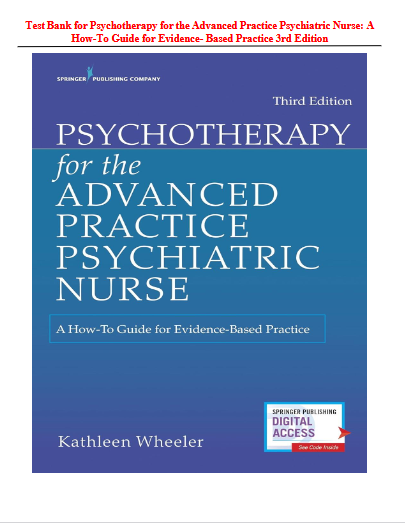
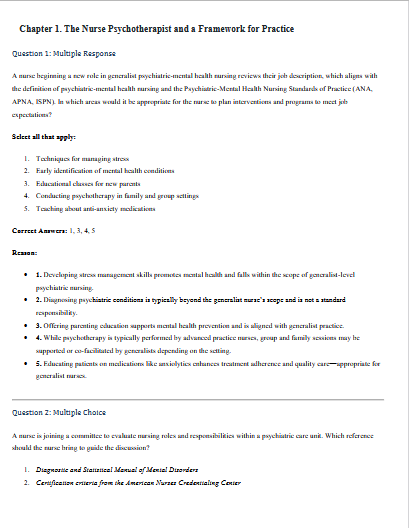
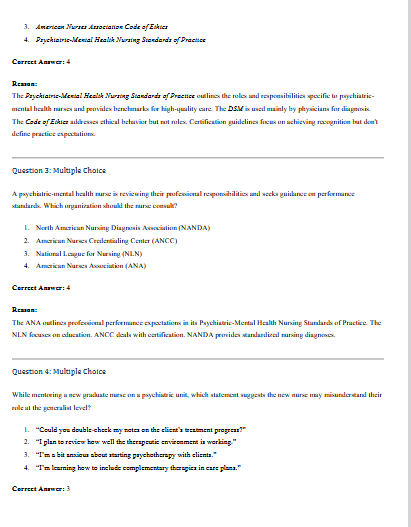
Psychiatric-mental health NP programs ask students to do something most other advanced practice specialties don’t: actually deliver psychotherapy, not just prescribe around it. That means knowing which therapeutic model fits which patient, how to structure a session, and how to recognize when a technique is working versus when it’s backfiring. This test bank was built around that exact demand. It follows the chapter structure of Psychotherapy for the Advanced Practice Psychiatric Nurse: A How-To Guide for Evidence-Based Practice, 3rd Edition, edited by Kathleen Wheeler, so your practice tracks the same evidence-based, technique-focused organization the textbook uses.
Whether you’re in a PMHNP program working through your psychotherapy coursework, preparing for the PMHNP certification exam, or reviewing before starting your own psychotherapy practice, this resource is designed to sharpen the applied clinical reasoning these exams and real sessions both demand.
What’s Covered
Practice sets follow the textbook’s organization, including:
- Foundations of psychotherapy practice for the advanced practice psychiatric nurse
- The therapeutic relationship, transference, and countertransference
- Psychodynamic and interpersonal approaches to psychotherapy
- Cognitive behavioral therapy techniques and structured session planning
- Dialectical behavior therapy skills and their application with specific patient populations
- Motivational interviewing and its use in ambivalence and behavior change
- Trauma-informed care and evidence-based trauma treatment approaches
- Group therapy principles and facilitation techniques
- Family and couples therapy approaches relevant to psychiatric practice
- Integrating psychotherapy with psychopharmacology
- Cultural considerations and adapting therapy to diverse populations
- Ethical and legal issues specific to psychotherapy practice
- Evaluating outcomes and evidence-based practice in psychotherapy
Question formats mix multiple-choice, select-all-that-apply, and case-based items, matching how PMHNP psychotherapy coursework and certification-style exams are typically structured.
Why Practice Questions Help Here
Psychotherapy exams for advanced practice nurses rarely ask you to define a technique in isolation. They give you a patient interaction and ask which technique is being used, which one should be used next, or what a specific therapeutic misstep actually represents. Working through practice questions helps you:
- Recognize a specific therapeutic technique when it shows up in a session transcript or case vignette
- Build confidence matching a treatment approach to a patient’s specific presentation and needs
- Practice identifying transference, countertransference, and other relational dynamics as they play out
- Get comfortable with questions that blend psychotherapy technique with psychopharmacology decisions
- Reduce exam anxiety by practicing the same case-based reasoning used on certification exams
Many PMHNP students say this content is harder to master than straight psychopharmacology, because psychotherapy skill is inherently relational and situational, and testing it well requires realistic scenarios rather than simple recall. Regular, chapter-based practice with case-style questions is one of the more effective ways to build that clinical instinct before you’re using it with real patients.
What Makes This Test Bank Different
This test bank is built around full explanations, not shortcut answer keys. Every question includes a complete rationale that explains why the correct technique or approach fits the scenario described, and why each incorrect option belongs to a different therapeutic model, misapplies a related concept, or represents a less appropriate clinical choice. This mirrors how psychotherapy exams are typically written, since incorrect choices are often legitimate techniques, just not the right fit for that particular patient interaction.
Questions are grouped by chapter and therapeutic approach, so you can review exactly what you need, whether that’s a single modality like DBT before a quiz or a full comparative review before a certification exam. It works well as a companion to assigned readings, a self-check before supervised practicum hours, or a structured review before exam day.
Sample Questions
Question 1
During a session, a patient becomes unusually irritated with the nurse practitioner and says, “You’re just like my father, always criticizing me.” What clinical concept does this reaction most likely represent?
A. Countertransference
B. Transference
C. Resistance
D. Splitting
Correct Answer: B
Rationale: Transference occurs when a patient unconsciously redirects feelings and reactions originally tied to a significant figure from their past, in this case a father, onto the therapist in the present. This reaction, where the patient perceives the nurse practitioner through the lens of an earlier relationship, is a classic example of transference and often provides valuable material for the therapeutic work. Countertransference describes the reverse dynamic, where the clinician’s own unconscious reactions are directed toward the patient, not what is being described here. Resistance refers to a patient’s conscious or unconscious opposition to the therapeutic process itself, not a relational projection like this one. Splitting involves viewing people as entirely good or entirely bad, which is a different dynamic than redirecting feelings from one relationship onto another.
Question 2
A PMHNP is using motivational interviewing with a patient ambivalent about reducing alcohol use. Which statement by the clinician best reflects the spirit of this approach?
A. “You really need to stop drinking before your liver gets worse.”
B. “It sounds like part of you wants to cut back, and part of you isn’t sure yet. Can you tell me more about that?”
C. “I’m going to refer you to an inpatient program today.”
D. “Let’s talk about all the reasons you should quit drinking right now.”
Correct Answer: B
Rationale: Motivational interviewing is built around exploring and resolving ambivalence collaboratively, rather than pushing the patient toward change. Reflecting both sides of the patient’s ambivalence and inviting them to elaborate respects patient autonomy and keeps the conversation open, which is central to this approach. Option A is a directive, confrontational statement that runs counter to the collaborative spirit of motivational interviewing. Option C jumps to a significant clinical action without first exploring the patient’s own motivation and readiness for change. Option D pushes an agenda onto the patient rather than helping them explore and voice their own reasons for change, which is a core distinction of this technique.
Question 3
A PMHNP is treating a patient with borderline personality disorder using dialectical behavior therapy. Which skill module specifically targets managing intense emotions in the moment without making the situation worse?
A. Mindfulness
B. Distress tolerance
C. Interpersonal effectiveness
D. Emotion regulation
Correct Answer: B
Rationale: Distress tolerance skills are specifically designed to help patients get through intense emotional crises without engaging in behaviors that make the situation worse, focusing on surviving the moment rather than solving the underlying problem right away. Mindfulness skills build present-moment awareness more broadly, rather than targeting crisis survival specifically. Interpersonal effectiveness focuses on communication and relationship skills, not managing an acute emotional crisis in the moment. Emotion regulation targets understanding and changing emotional responses over time, which is a related but distinct goal from tolerating distress during an acute crisis.
Question 4
A patient in trauma-focused therapy becomes tearful while discussing a traumatic memory and says, “I don’t think I can keep talking about this.” What is the most appropriate next step for the PMHNP?
A. Continue with the planned session content to maintain therapeutic momentum
B. Pause, assess the patient’s current level of distress, and adjust pacing as needed
C. End the session immediately without further discussion
D. Reassure the patient that the memory isn’t as bad as it feels
Correct Answer: B
Rationale: Trauma-informed care emphasizes staying attuned to a patient’s window of tolerance, and pausing to assess distress and adjust pacing helps prevent retraumatization while still allowing the therapeutic work to continue safely. Pushing forward with planned content, as in option A, risks overwhelming the patient and working against trauma-informed principles. Ending the session abruptly, as in option C, is an overcorrection that doesn’t allow for stabilization or a supportive close to the interaction. Minimizing the patient’s experience, as in option D, is invalidating and not an appropriate trauma-informed response.
Question 5
A PMHNP is deciding whether to combine psychotherapy with medication management for a patient newly diagnosed with major depressive disorder. Which statement best reflects current evidence-based practice?
A. Medication alone is always superior to combined treatment for depression
B. Psychotherapy alone is always superior to combined treatment for depression
C. Combined psychotherapy and medication often produces better outcomes than either treatment alone for many patients with depression
D. Psychotherapy and medication should never be used together due to conflicting mechanisms
Correct Answer: C
Rationale: A substantial body of evidence supports combined treatment, psychotherapy alongside medication, as often producing better outcomes than either approach alone for many patients with depression, particularly for more moderate to severe presentations. Claiming medication alone is always superior overstates the evidence and ignores the well-documented benefits of combined treatment. Claiming psychotherapy alone is always superior similarly overstates a single approach as universally best, which isn’t supported by the evidence base. The idea that psychotherapy and medication conflict and shouldn’t be combined is inaccurate, since these two treatment types are commonly and safely integrated in psychiatric practice.
Frequently Asked Questions
Is this the publisher’s official test bank?
No, this is an independently written study resource built to help you review the material in the 3rd edition of Psychotherapy for the Advanced Practice Psychiatric Nurse: A How-To Guide for Evidence-Based Practice. It’s meant for self-study and isn’t distributed by the publisher.
Will this help with PMHNP certification exam prep?
The case-based format mirrors certification exam questions, with a focus on recognizing therapeutic techniques, matching treatment approaches to patients, and integrating psychotherapy with psychopharmacology, all heavily tested areas for PMHNP certification.
Does it cover the whole textbook?
Yes, questions are organized by chapter and therapeutic approach, following the 3rd edition’s structure from foundational psychotherapy concepts through specific treatment modalities and practice considerations.
What question types are included?
Mostly multiple-choice, with some select-all-that-apply and case-based items, matching the format common in psychotherapy coursework and certification-style exams.
Are there explanations, or just answer letters?
Every question includes a full rationale explaining why the correct technique or approach fits the scenario and why the other options belong to a different therapeutic model or represent a less appropriate choice.
Who’s this built for?
PMHNP students working through psychotherapy coursework, plus anyone reviewing therapeutic technique and evidence-based practice concepts ahead of a course exam or certification exam.
What’s the best way to use it?
Read the assigned chapter first, then work through the matching questions before checking answers. Go back through the rationales carefully afterward, since recognizing why a technique fits a specific patient interaction matters more than memorizing a letter.
Can this replace the textbook?
No, it’s meant to work alongside it. The textbook builds your foundational understanding of psychotherapy models and techniques; the test bank gives you a way to practice recognizing and applying them to realistic case scenarios.
Is it matched to the 3rd edition specifically?
Yes, it follows the topics, terminology, and chapter organization of the 3rd edition.
Good for last-minute review?
Yes, since it’s organized by chapter and therapeutic approach, you can zero in on a specific modality quickly, like DBT or motivational interviewing, instead of reviewing the entire book at once.

Omqe –
I recommend it to other buyers. Very helpful. Thank you!
Swahy –
Very brief, direct notes from the lessons that have no extra structure nice test bank
Maximevanmol –
Highly relevant and easy to follow, simplified key topics and is extremely helpful for last-minute revision. Very recommendable
Swagri –
Wow this is an amazing document
Mik –
Helped reinforce key nursing concepts.
Nico –
Outstanding test bank for success.
Shelly –
Simple, effective, and highly recommended
Anita –
Clear questions with helpful answers.
Maxim –
Convenient and effective study resource
Kevin Race –
Great practice for nursing exams.
Viarose –
Clear, concise, and easy to use