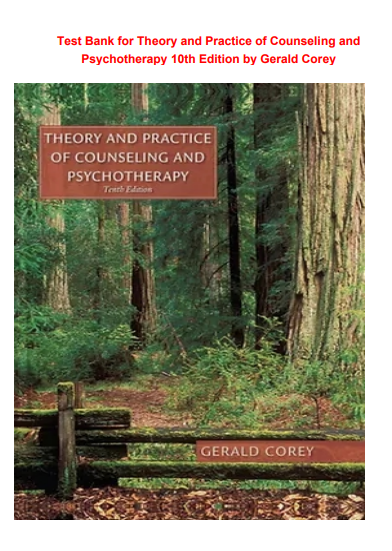
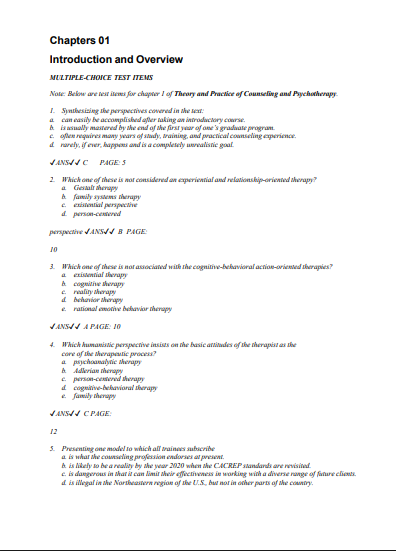
Counseling theory courses ask students to do something unusual: hold a dozen different, sometimes contradictory, therapeutic frameworks in their head at once, and know exactly which one is being described when a case scenario shows up on an exam. It’s one thing to read about person-centered therapy in isolation. It’s another to recognize it in a vignette and distinguish it from a similar-sounding humanistic approach. This test bank was built around that exact skill. It follows the chapter structure of Theory and Practice of Counseling and Psychotherapy, 10th Edition, by Gerald Corey, so your practice tracks the same theory-by-theory organization the textbook uses.
Whether you’re in a counseling, psychology, or social work program working through this course for the first time, or reviewing before a licensure or comprehensive exam, this resource is built to help you tell theories apart under exam pressure, not just recognize them individually when reading calmly at home.
What This Test Bank Covers
Question sets are organized to match the textbook’s approach, covering:
- The counselor’s own person and the role of self-awareness in effective practice
- Ethical issues in counseling practice, including boundaries and informed consent
- Psychoanalytic theory and its view of unconscious processes and early development
- Adlerian therapy and its focus on social interest and lifestyle patterns
- Existential therapy and its emphasis on meaning, freedom, and responsibility
- Person-centered therapy and the core conditions for therapeutic change
- Gestalt therapy and its focus on present-moment awareness
- Behavior therapy and its principles of learning and reinforcement
- Cognitive behavior therapy, including REBT and Beck’s cognitive therapy
- Reality therapy and choice theory
- Feminist therapy and its critique of traditional therapeutic power dynamics
- Postmodern approaches, including narrative and solution-focused therapy
- Family systems therapy and its relational view of the presenting problem
- Integrating multiple theoretical approaches into a coherent personal style
Each section mixes multiple-choice, matching, and case-based questions, since these formats reflect how counseling theory courses and comprehensive exams are typically structured.
Why Students Use a Test Bank Like This
Counseling theory exams love to describe a therapist’s specific intervention or way of talking to a client and ask which theoretical approach it reflects. That requires more than knowing definitions, it requires recognizing a theory’s fingerprint in practice. Working through practice questions helps you:
- Tell closely related theories apart, like distinguishing person-centered from existential approaches
- Recognize a theory’s core techniques when they show up in a case vignette, not just in a textbook list
- Practice matching a specific therapeutic goal or intervention to the theory it comes from
- Build familiarity with the key terminology each theory uses so it doesn’t blur together
- Reduce exam anxiety by practicing the same case-based reasoning used in comprehensive and licensure exams
Many students say this course is deceptively hard because each theory makes sense on its own, but stacking twelve of them together makes distinguishing similar ideas surprisingly tricky under time pressure. Regular, chapter-based practice is one of the most effective ways to keep each theory’s identity distinct in your memory.
What Makes This Test Bank Different
This test bank is built around full explanations, not shortcut answer keys. Every question includes a complete rationale that explains why the correct theory or concept fits the scenario described, and why each incorrect option belongs to a different theoretical framework or misapplies a related concept. This mirrors how counseling theory exams are typically written, since incorrect choices are usually real theories or real techniques, just not the one that matches the case presented.
Questions are grouped by chapter and theoretical approach, so you can review exactly the section you need, whether that’s a single theory before a quiz or a full comparative review before a comprehensive final. It works well as a companion to assigned readings, a self-check before class discussions, or a structured review before exam day.
Sample Questions
Question 1
A therapist focuses heavily on helping a client become aware of “unfinished business” from the past that is interfering with the client’s ability to be fully present, using techniques like the empty chair exercise. Which theoretical approach does this reflect?
A. Person-centered therapy
B. Gestalt therapy
C. Psychoanalytic therapy
D. Reality therapy
Correct Answer: B
Rationale: Gestalt therapy is centered on increasing present-moment awareness and resolving unfinished business, often through experiential techniques like the empty chair exercise, which allows a client to work through unresolved feelings toward another person or part of themselves. Person-centered therapy relies on core conditions like empathy and unconditional positive regard rather than structured experiential techniques like this one. Psychoanalytic therapy also addresses unresolved past material, but through interpretation of unconscious processes and defense mechanisms, not experiential exercises like the empty chair. Reality therapy focuses on present behavior and choices in relation to needs, not unfinished emotional business from the past.
Question 2
A counselor helps a client identify irrational beliefs, such as “I must be perfect or I am worthless,” and works with the client to actively dispute and replace these beliefs with more rational alternatives. Which theoretical approach does this best represent?
A. Rational emotive behavior therapy (REBT)
B. Existential therapy
C. Adlerian therapy
D. Narrative therapy
Correct Answer: A
Rationale: REBT, developed by Albert Ellis, is built around identifying irrational beliefs and actively disputing them to reduce emotional disturbance, which matches the intervention described exactly. Existential therapy focuses on themes like meaning, freedom, and mortality rather than directly disputing specific irrational beliefs. Adlerian therapy explores lifestyle patterns and social interest, using techniques different from the direct belief-disputation process central to REBT. Narrative therapy works by helping clients re-author the stories they tell about their lives, rather than disputing specific irrational cognitions.
Question 3
A therapist working from a feminist therapy perspective is most likely to focus on which of the following in working with a client?
A. Resolving unconscious conflicts from early childhood
B. Examining how gender roles and societal power structures have shaped the client’s problems
C. Reinforcing desired behaviors through a structured system of rewards
D. Interpreting the client’s dreams for symbolic unconscious content
Correct Answer: B
Rationale: Feminist therapy examines how gender, power, and societal structures contribute to a client’s difficulties, and works to help clients recognize and challenge oppressive social conditions rather than viewing problems as purely individual or internal. Resolving unconscious conflicts from childhood reflects a psychoanalytic approach, not a feminist therapy focus. Reinforcing behaviors through rewards reflects behavior therapy principles, unrelated to feminist therapy’s social and political lens. Dream interpretation for unconscious content is also a psychoanalytic technique, not a defining feature of feminist therapy.
Question 4
Which statement best reflects the core belief of person-centered therapy regarding a client’s capacity for change?
A. Clients need the therapist to actively interpret their unconscious motivations before change can occur
B. Clients possess an inherent tendency toward growth that can be facilitated through a supportive therapeutic relationship
C. Clients change primarily through structured behavioral reinforcement schedules
D. Clients must first resolve early childhood conflicts before meaningful change is possible
Correct Answer: B
Rationale: Person-centered therapy, developed by Carl Rogers, is grounded in the belief that people have an innate tendency toward growth and self-actualization, and that this natural process can be supported through a relationship built on empathy, genuineness, and unconditional positive regard, rather than through interpretation or structured intervention. Option A describes a psychoanalytic view of change, which relies heavily on the therapist’s interpretations. Option C describes a behavioral view of change through reinforcement, not the humanistic, relationship-centered approach of person-centered therapy. Option D reflects a psychoanalytic emphasis on early childhood resolution, which is not central to person-centered theory.
Question 5
A family therapist working from a systems perspective is most likely to view a child’s behavioral problem as which of the following?
A. A symptom of an unresolved individual unconscious conflict within the child
B. A reflection of dysfunctional patterns and dynamics within the broader family system
C. A result of irrational beliefs held only by the child
D. Unrelated to any relational or contextual factors within the family
Correct Answer: B
Rationale: Family systems therapy views an individual’s symptoms as connected to and often maintained by patterns within the larger family system, meaning a child’s behavioral problem is understood in the context of family relationships and dynamics rather than as an isolated individual issue. Option A reflects an individually-focused psychoanalytic interpretation, not a systemic one. Option C reflects a cognitive-behavioral framework centered on the individual’s beliefs, not the relational focus of systems theory. Option D directly contradicts the core premise of systems therapy, which is that individual symptoms are inherently connected to relational and contextual factors.
Frequently Asked Questions
Is this test bank the same as the official instructor materials from the publisher?
This test bank is an independently prepared study resource built to help students review the topics covered in the 10th edition of Theory and Practice of Counseling and Psychotherapy. It is intended as a self-study companion and is not distributed by the publisher.
Is this test bank helpful for licensure or comprehensive exam preparation?
The questions are written in a case-based style similar to licensure and comprehensive exam questions, with an emphasis on identifying theoretical approaches from client scenarios and interventions, a core skill tested across counseling licensure exams.
Does it cover every chapter of the textbook?
Yes, the questions are organized by chapter and theoretical approach, following the general topic order of the 10th edition, from the counselor’s own development through each major counseling theory and integration.
What question formats are included?
Most questions are multiple-choice, with some matching and case-based items, since these formats are common in counseling theory coursework and on comprehensive-style exams.
Do the answers include explanations, or just the correct letter?
Yes, every question includes a full rationale explaining why the correct theory or concept fits the scenario and why the other options belong to a different theoretical framework.
Who is this test bank best suited for?
It is designed for counseling, psychology, and social work students taking a theories course, as well as anyone reviewing counseling theory concepts ahead of a comprehensive or licensure exam.
How should I use this resource while studying?
A common approach is to read the assigned chapter first, then work through the related questions without checking the answers right away. Afterward, review the rationales closely, especially for missed questions, since learning to distinguish similar theories matters more than memorizing a single correct letter.
Can this replace reading the textbook?
No. This resource works best alongside the textbook, not instead of it. The textbook builds your foundational understanding of each theoretical approach, while the test bank helps you practice distinguishing and applying those theories to realistic scenarios.
Is the content aligned specifically with the 10th edition?
Yes, the material follows the topics, terminology, and chapter organization used in the 10th edition of the textbook.
Is this useful for last-minute exam review?
Yes, many students use it as a focused review tool in the days before an exam, since the chapter-based organization makes it easy to target specific theories quickly, rather than reviewing the entire book at once.



Mishie –
Quality materials
Evylin –
Completely complete and super clear
Pauline –
Helped reinforce important nursing concepts
Tonny Vady –
Convenient resource for exam preparation
Namis –
Questions closely match study topics
Teresa Vasquez –
Easy to use and understand
Tonny Peter –
Helpful for exam preparation
Tabbys –
Excellent practice before nursing exams.
Miriam –
Useful explanations make studying easier
Pauline John –
Great for reinforcing nursing fundamentals
Loise –
Very useful and easy to navigate.