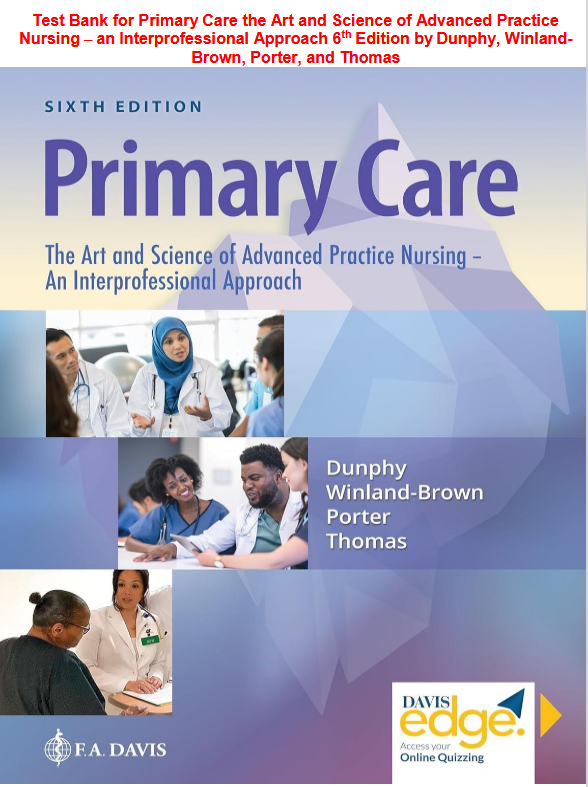
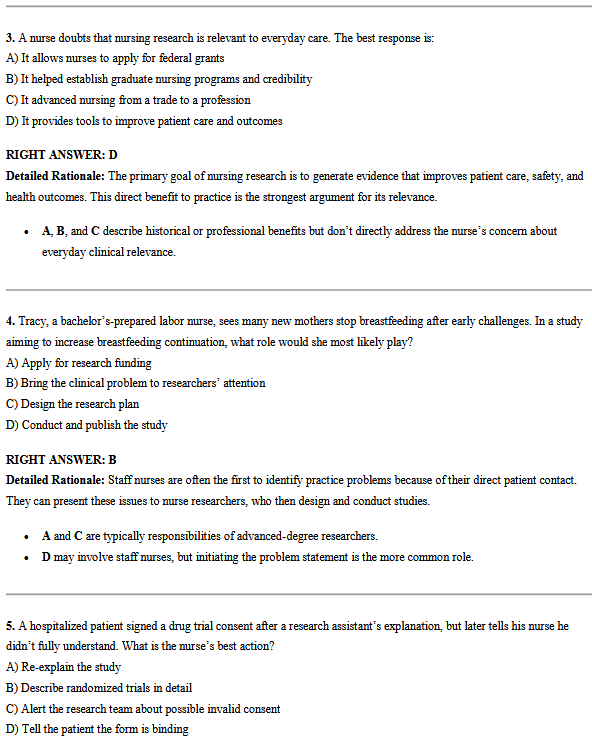
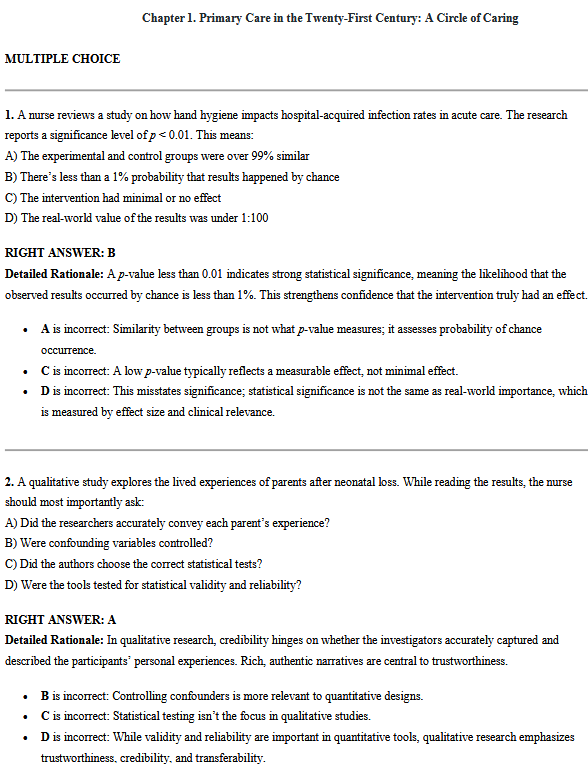
Primary care at the advanced practice level rarely hands you a diagnosis outright. You get a history, a cluster of symptoms, maybe a lab value or two, and you’re expected to narrow things down, decide what workup actually matters, and land on a treatment plan that fits the whole patient, not just the presenting complaint. That’s the entire premise behind this textbook, and it’s the focus of this test bank too. Built around the chapter structure of the 6th edition, by Lynne M. Dunphy, Jill E. Winland-Brown, Brian O. Porter, and Debera J. Thomas, this resource gives you practice with the same body-system and case-based content the book covers.
Whether you’re an NP student working through primary care coursework, studying for a national certification exam, or brushing up before clinical rotations, this test bank is built to strengthen the differential-diagnosis thinking these exams are actually built to test.
What’s Covered
Question sets track the textbook’s organization, including:
- The advanced practice role and its place within interprofessional care teams
- History-taking, physical exam technique, and diagnostic reasoning in primary care
- Common dermatology presentations, from rashes to suspicious lesions
- Eye, ear, nose, and throat conditions seen routinely in outpatient practice
- Outpatient cardiovascular and respiratory management
- GI, genitourinary, and musculoskeletal complaints
- Endocrine and metabolic conditions, especially diabetes and thyroid disease
- Mental health presentations common in primary care settings
- Women’s and men’s health topics relevant to primary care
- Pediatric and geriatric-specific considerations
- Preventive care, screening guidelines, and health promotion strategies
Formats mix multiple-choice, select-all-that-apply, and case-based questions, matching how advanced practice primary care courses and national certification exams are typically written.
Why Practice Questions Help Here
Certification-style primary care questions rarely name the diagnosis for you outright. You get the story and have to work backward to figure out what it points to. Practicing this format helps you:
- Get faster at narrowing a differential from a cluster of overlapping symptoms
- Learn which diagnostic tests actually add clinical value versus which are unnecessary
- Build a working library of first-line treatments tied to current guidelines
- Recognize red-flag findings that mean referral, not independent management
- Get comfortable with the exact case-based reasoning style certification exams use
A lot of NP students say the hardest adjustment in this course isn’t spotting a disease, it’s managing the whole patient around it, comorbidities, preferences, and follow-up logistics included. Working through cases regularly is one of the more reliable ways to build that broader judgment before you’re tested on it for real.
What Sets This Apart
Every question here comes with a complete rationale, not just a letter. You’ll see why the correct diagnosis, test, or treatment fits this specific patient, and why the other options fall short, whether that’s a symptom mismatch, a skipped diagnostic step, or an outdated standard of care. That mirrors how certification exams are actually built, since wrong answers are usually real diagnoses or real treatments, just not the right fit for this particular case.
Everything is grouped by chapter and body system, so you can drill into exactly what you need, whether that’s a quick dermatology review before a quiz or a full pass before certification. It works as a companion to your reading, a self-check before clinical rotations, or a structured review heading into exam day.
Sample Questions
Question 1
A 45-year-old presents with well-demarcated, red, scaly plaques on both elbows and knees, topped with silvery scale. What’s the most likely diagnosis?
A. Eczema
B. Psoriasis
C. Contact dermatitis
D. Tinea corporis
Correct Answer: B
Rationale: Sharply bordered, red plaques with silvery scale on extensor surfaces like elbows and knees is a textbook presentation of plaque psoriasis. Eczema usually has less defined borders and tends toward flexural areas, not extensor surfaces. Contact dermatitis typically comes with a clear exposure history and a distribution matching the contact area. Tinea corporis presents as an annular lesion with central clearing, a very different pattern from the plaque and scale described here.
Question 2
A patient reports sudden unilateral flank pain radiating to the groin, along with nausea and blood in the urine. What’s the likely diagnosis?
A. Pyelonephritis
B. Nephrolithiasis
C. Ovarian cyst
D. Appendicitis
Correct Answer: B
Rationale: Sudden, severe, unilateral flank pain radiating toward the groin, paired with hematuria and nausea, is the classic picture of a kidney stone moving through the urinary tract. Pyelonephritis usually comes with fever, chills, and CVA tenderness from infection rather than this colicky pain pattern. An ovarian cyst could cause pelvic pain, but wouldn’t explain hematuria or the flank-to-groin radiation. Appendicitis pain typically settles in the right lower quadrant, not the flank, and doesn’t usually cause hematuria.
Question 3
A patient with type 2 diabetes has an A1C of 8.2% despite lifestyle changes and maximum-tolerated metformin. What’s the appropriate next step per current guidelines?
A. Stop metformin and start insulin only
B. Add a second agent from a different medication class
C. Leave the regimen unchanged for another year
D. Discontinue all medication and rely on diet alone
Correct Answer: B
Rationale: When A1C stays above target despite maximum metformin and lifestyle changes, guidelines generally call for adding a second agent from another class, rather than replacing metformin outright, since it’s usually kept as foundational therapy unless there’s a contraindication. Jumping straight to insulin-only isn’t the standard first step when other options remain appropriate. Leaving things unchanged risks prolonged poor control and its downstream complications. And dropping all medication would almost certainly worsen glycemic control rather than improve it.
Question 4
A patient describes sudden, painless vision loss in one eye, like a curtain dropping over part of their visual field. What should you suspect, and what’s the next step?
A. Conjunctivitis — treat with topical antibiotics
B. Retinal detachment — refer immediately for emergency ophthalmologic evaluation
C. Migraine with aura — reassure and recommend rest
D. Dry eye syndrome — recommend artificial tears
Correct Answer: B
Rationale: A painless “curtain coming down” description is a classic red flag for retinal detachment, a true time-sensitive emergency where delay can mean permanent vision loss. Conjunctivitis presents with redness, discharge, and irritation, not sudden vision loss. Migraine with aura tends to cause temporary, often bilateral or shifting visual changes tied to headache, not a fixed, one-sided vision loss like this. Dry eye causes fluctuating irritation and blur, nothing close to the dramatic presentation described.
Question 5
A 68-year-old reports new bilateral hand pain and stiffness that’s worse in the morning and improves through the day, plus fatigue and low-grade fevers. What’s the most likely diagnosis?
A. Osteoarthritis
B. Rheumatoid arthritis
C. Gout
D. Fibromyalgia
Correct Answer: B
Rationale: Symmetric hand pain with morning stiffness that eases with activity, plus systemic symptoms like fatigue and low-grade fever, points strongly toward rheumatoid arthritis, an autoimmune inflammatory process. Osteoarthritis tends to do the opposite, worsening with activity and improving with rest, and it’s not typically tied to systemic symptoms like fever. Gout usually hits a single joint suddenly and severely, often the big toe, not both hands symmetrically. Fibromyalgia causes widespread pain and fatigue but doesn’t produce this specific morning-stiffness pattern seen in inflammatory arthritis.
Frequently Asked Questions
Is this the publisher’s official test bank?
No, this is an independently written study resource built to help you review the topics in the 6th edition of Primary Care: The Art and Science of Advanced Practice Nursing. It’s a self-study companion, not a publisher-distributed product.
Does it help with certification exam prep?
The case-based style mirrors national certification exam questions, focusing on differential diagnosis, appropriate workup, and evidence-based treatment, all heavily tested areas in primary care practice.
Is every chapter represented?
Yes, questions follow the 6th edition’s chapter order and body-system organization, from foundational assessment skills through system-specific conditions.
What question types show up?
Mostly multiple-choice, with some select-all-that-apply and case-based items, matching how advanced practice courses and certification exams tend to test this material.
Are there explanations, or just answer letters?
Full rationales throughout, explaining why the correct diagnosis or treatment fits and why the alternatives are a weaker match for that specific case.
Who’s this built for?
NP students working through primary care coursework, and anyone reviewing diagnostic reasoning and management principles ahead of a course exam or national certification.
How should I actually use it?
Read the chapter first, then work through the matching questions before checking answers. Spend real time on the rationales for anything you get wrong, since the reasoning behind a diagnosis matters more than memorizing a letter.
Can this replace the textbook?
No, it’s meant to sit alongside it. The book builds your foundation in assessment, diagnosis, and management; the test bank gives you a way to practice applying it to cases.
Is it aligned with the 6th edition specifically?
Yes, it follows the topics, terminology, and chapter structure of the 6th edition.
Good for last-minute review?
Yes, since it’s organized by chapter and body system, you can zero in on a specific area quickly instead of rereading the whole book before an exam.

Adams –
Nice study material
Kuii –
Perfect
Beth –
This what i needed
Waga –
Good document
Eva –
Useful document
Swagri –
A concise and effective study guide. The questions were relevant, and the clear answers helped me review key concepts quickly and confidently.
Shelly –
Very helpful study companion.
ShellyW –
Very helpful study companion, thanks
Hannah –
Outstanding practice for nursing exams.
Jane –
Helpful and well-organized content
Kairo –
Made studying much easier
Ann –
Very useful and informative resource.
SimVaul –
Helps reinforce important nursing concepts
chadc –
Great addition to study routines.
Annen Harry –
Great resource for nursing students
Tonny John –
Helpful questions and clear explanations
Martha Harry –
Questions helped reinforce concepts
Tonny –
Easy way to practice regularly
Steve G –
Helpful for identifying knowledge gaps.
Terry Ann –
Well organized and easy to navigate.