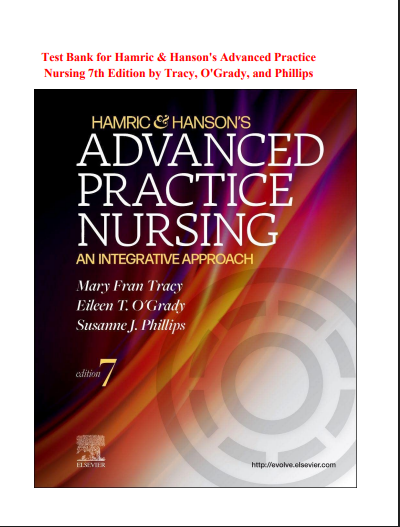
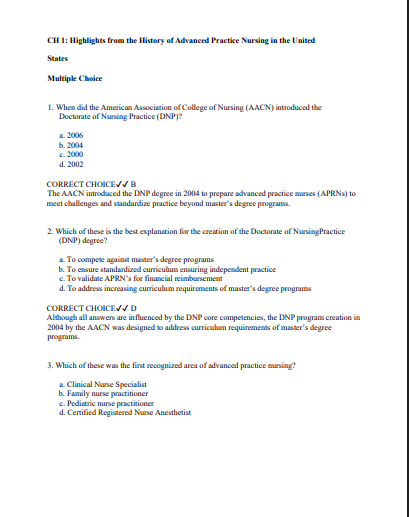
Advanced practice nursing is more than a clinical skill set, it’s a role built on leadership, evidence-based reasoning, ethical judgment, and the ability to operate across very different care settings and specialties. That wider scope is exactly what makes this course harder to study for than a typical clinical class, since exams ask you to think about the APRN role itself, not just how to treat a specific condition. This test bank was built around that reality. It follows the chapter structure of Hamric & Hanson’s Advanced Practice Nursing, 7th Edition, by Mary Fran Tracy, Eileen T. O’Grady, and Susan J. Phillips, so your review tracks the same core competencies and professional issues the textbook organizes itself around.
Whether you’re in a nurse practitioner, clinical nurse specialist, or DNP program, or prepping for a role-focused certification exam, this resource is built to help you reason through APRN practice decisions, from direct patient care all the way to leadership and policy work.
What’s Covered
Practice sets follow the textbook’s organization, including:
- How advanced practice nursing roles developed historically
- The core competencies of advanced practice, including direct clinical care and coaching
- Applying evidence-based practice to advanced nursing decisions
- Leadership, collaboration, and consultation within interprofessional teams
- Ethical decision-making and professional accountability
- Regulatory, legal, and credentialing issues shaping APRN scope of practice
- Health policy and the APRN’s role in shaping the broader healthcare system
- Business and financial considerations, including reimbursement
- Outcome evaluation and quality improvement in advanced practice
- Role transition and building professional identity as a new APRN
- Population-focused and specialty-specific applications of the core competencies
Question formats mix multiple-choice, select-all-that-apply, and scenario-based items, closely reflecting how advanced practice nursing courses and certification exams are typically structured.
Why Practice Questions Help Here
Advanced practice exams often ask you to apply a concept, evidence-based practice or ethical decision-making, to a specific professional scenario rather than just define it. You might get a workplace conflict, a policy dilemma, or a patient safety issue and be asked which core competency should guide the APRN’s response. Working through practice questions helps you:
- Connect the seven core APRN competencies to actual practice situations
- Build confidence with questions on scope of practice, credentialing, and regulation
- Practice applying ethical frameworks to messy, real-world scenarios
- Get comfortable with leadership and interprofessional collaboration questions beyond direct patient care
- Build the same competency-based reasoning tested on role-focused certification exams
Many students say this course is harder to study for than a typical clinical class simply because it’s more conceptual, covering the how and why of the APRN role rather than a specific disease process. Regular, chapter-based practice is one of the more effective ways to turn those broader concepts into the applied reasoning these exams actually test.
What Makes This Different
Every question includes a full rationale, not just a correct letter. You’ll see why the correct answer best reflects the relevant core competency, ethical principle, or professional standard, and why each alternative falls short, whether it describes a different competency, oversimplifies a complex issue, or doesn’t match current APRN practice standards. This mirrors how these exams are actually written, since wrong answers are usually related concepts, not obviously off-base choices.
Questions are grouped by chapter and by core competency area, so you can zero in on exactly what you need, whether that’s health policy the night before a quiz or a full pass before a certification exam. It works well alongside assigned reading, as prep for a role-transition course, or as a structured review before test day.
Sample Questions
Question 1
An APRN notices a colleague consistently ignoring evidence-based guidelines in favor of outdated practices, leading to inconsistent patient outcomes. Which core competency should guide the APRN’s response?
A. Direct clinical practice
B. Guidance and coaching
C. Consultation and leadership
D. Ethical decision-making
Correct Answer: C
Rationale: Addressing a colleague’s practice pattern in a way that improves outcomes for the care team falls under the leadership and consultation competency, which covers influencing practice change, mentoring peers, and advocating for evidence-based standards within a team. Ethical principles may factor in too, but the primary competency driving this specific action, addressing another provider’s practice through collaboration and influence, is leadership. Direct clinical practice refers to hands-on patient care, not peer influence. Guidance and coaching typically applies to patient and family education, not addressing a colleague’s professional practice.
Question 2
An APRN is deciding whether to implement a new clinical practice guideline in their outpatient clinic. What step reflects the actual foundation of evidence-based practice?
A. Adopting the guideline simply because it’s newly published
B. Critically appraising the evidence alongside patient preferences and clinical expertise
C. Implementing it only if it matches current clinic policy exactly
D. Relying entirely on personal clinical experience
Correct Answer: B
Rationale: Evidence-based practice integrates the best available evidence with clinical expertise and patient preferences and values, rather than leaning on any single source alone. Critically appraising the evidence, instead of adopting something just because it’s new, reflects that principle directly. Option A assumes recency equals quality, which isn’t a reliable basis for adoption. Option C is too rigid and skips the individualized, appraisal-based process central to evidence-based practice. Option D leaves out two of the three essential components, since clinical expertise alone isn’t sufficient without current evidence and patient values factored in.
Question 3
A newly certified NP feels unsure about billing and reimbursement processes in their new role. What area of APRN practice does this concern fall under?
A. Direct clinical practice
B. Business and financial competency
C. Guidance and coaching
D. Scope of practice regulation
Correct Answer: B
Rationale: Understanding billing, coding, and reimbursement falls under business and financial competency, an area increasingly recognized as essential for APRNs managing patient panels and practice sustainability. That’s distinct from direct clinical practice, which is hands-on patient care, and from guidance and coaching, which centers on supporting patients and families. Reimbursement can intersect with scope of practice regulations in some cases, but the concern here, understanding billing and reimbursement itself, aligns more directly with business and financial competency than with regulatory scope of practice.
Question 4
An APRN is asked to help develop a new hospital policy on telehealth visits. What core competency does this best represent?
A. Direct clinical practice
B. Health policy involvement
C. Guidance and coaching
D. Consultation limited to individual patient cases
Correct Answer: B
Rationale: Helping develop an institutional or organizational policy reflects the APRN’s role in health policy, shaping systems and practices that affect care beyond any single patient encounter. This recognizes that APRNs are positioned to influence care delivery at a broader, systems level. Direct clinical practice refers specifically to individual patient care activities, not policy work. Guidance and coaching applies to patient and family education, not organizational policy. Consultation limited to individual patient cases is too narrow and case-specific to capture the broader, systems-level nature of policy development described here.
Question 5
An APRN is unsure whether a specific procedure falls within their legal scope of practice in their state. What’s the most appropriate first step?
A. Perform the procedure since it was covered during graduate training
B. Review the state’s nurse practice act and relevant regulations before proceeding
C. Ask a physician colleague for informal verbal permission
D. Assume it’s permitted unless told otherwise
Correct Answer: B
Rationale: APRN scope of practice is defined by state-specific regulation, primarily the nurse practice act, and it varies significantly from state to state. When there’s uncertainty, the right first step is reviewing these formal regulatory sources directly, rather than assuming or relying on informal guidance, to make sure the APRN is practicing within their legal authority. Option A isn’t enough, since graduate education alone doesn’t determine legal scope of practice, that’s governed by state regulation. Option C doesn’t carry the same legal weight as consulting official regulatory sources. Option D is risky, and could result in a scope-of-practice violation if the assumption turns out to be wrong.
Frequently Asked Questions
Is this the publisher’s official test bank?
No, this is an independently written study resource built to help you review the material in the 7th edition of Hamric & Hanson’s Advanced Practice Nursing. It’s meant for self-study and isn’t distributed by the publisher.
Will this help with APRN certification exam prep?
The competency-based, scenario-driven format mirrors certification exam questions, with a focus on applying the core APRN competencies, ethical reasoning, and professional practice standards to real situations.
Does it cover the whole book?
Yes, questions are organized by chapter and core competency area, following the 7th edition’s structure from the history of advanced practice through health policy, leadership, and role transition.
What question types are included?
Mostly multiple-choice, with some select-all-that-apply and scenario-based items, matching the format common in advanced practice nursing courses and certification-style exams.
Are there explanations, or just answer letters?
Every question includes a full rationale explaining why the correct answer best reflects the relevant APRN competency or professional standard, and why the alternatives are a weaker match.
Who’s this built for?
Students in nurse practitioner, clinical nurse specialist, and DNP programs, plus anyone reviewing the core competencies and professional issues of advanced practice ahead of a course exam or certification exam.
What’s the best way to use it?
Read the chapter first, then work through the matching questions before checking answers. Go back through the rationales carefully afterward, since understanding which competency applies to a given scenario matters more than memorizing a single answer.
Can this replace the textbook?
No, it’s meant to work alongside it. The textbook builds your foundational understanding of the APRN core competencies and professional practice issues; the test bank gives you a way to practice applying that knowledge.
Does it match the 7th edition specifically?
Yes, it follows the topics, terminology, and chapter organization of the 7th edition.
Good for last-minute review?
Yes, since it’s organized by chapter, you can zero in on a specific competency area quickly instead of rereading the whole book before an exam.


Kyler –
Helpful
Melis –
Nice one
Fredy –
Usefully document
Luyandamadayile –
Perfect copy!!
liseliddell –
Clearly arranged, all information is included with each item
Brenda –
Good! Thank you!
MEGY –
I just definitely appreciate, thank you
Maximeva –
Well-organized and informative. The content covered key areas thoroughly and provided excellent preparation for certification success
Vuaghan –
Very useful. Highly recommended!!
PrepMart –
This is awesome
Nyahn82 –
Great resource for exam revision.
Wangy –
Well-organized and easy to use.
kekuzniasz –
Simplifies difficult nursing concepts
Chloe Bray –
Simple, helpful, and effective
Annen Harry –
Really useful for nursing exams
Liam G –
Easy to use and well organized.
Vanessa Charles –
Strong resource for nursing test preparation.