Biochemistry exams rarely ask you to repeat a fact from the book. They ask what happens next. What happens to a pathway if one enzyme is blocked? Why does one mutation ruin a protein while another does nothing? Why does a poison cause heat instead of energy? You have to reason through the chemistry, one step at a time, and keep the whole pathway in mind while you do it.
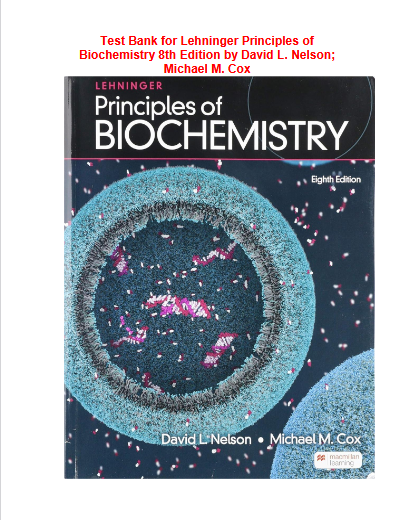
This test bank was written to give you practice with that kind of reasoning. It follows the chapter order of Lehninger Principles of Biochemistry, 8th Edition, by David L. Nelson and Michael M. Cox, so each study session matches what your class is covering. It is a self-study resource and is not the publisher’s official material.
If you are a biochemistry major, a pre-med or pre-health student, or taking this course for a life science degree, this resource gives you steady practice with structure, energy, and information flow in the cell.
Topics Covered
The question sets follow the textbook and include:
- Water, weak bonds, pH, and buffers
- Amino acids, peptides, and protein structure and function
- Enzymes, how they speed up reactions, and how they are controlled
- Carbohydrates, lipids, and nucleic acids
- Membrane structure and the movement of molecules across membranes
- Cell signaling and hormone action
- Bioenergetics, ATP, and how cells handle energy
- Glycolysis, gluconeogenesis, and the pentose phosphate pathway
- Glycogen breakdown and storage
- The citric acid cycle
- Fatty acid breakdown and ketone bodies
- Amino acid breakdown and the urea cycle
- Electron transport and ATP synthesis
- Photosynthesis
- Building carbohydrates, lipids, amino acids, and nucleotides
- Hormones and the regulation of metabolism
- DNA structure, replication, and repair
- RNA synthesis and processing
- Protein synthesis and the genetic code
- Regulation of gene expression
You will find multiple-choice, matching, and short problem-style questions, including simple calculations, which are the formats biochemistry courses use most.
Why Practice Questions Help in This Course
Reading a pathway diagram is easy. Using it to predict what happens when something changes is hard. Practice helps you:
- Predict the effect of an inhibitor, a mutation, or a missing nutrient
- Follow carbon, electrons, and energy through a pathway
- Keep the control points of each pathway straight
- Do buffer, energy, and kinetics calculations without panic
- Get used to the way exam questions are worded
Many students say they understand each step of a pathway but freeze when a question changes one condition. Short, regular practice by chapter builds the habit of reasoning through the change.
What Makes This Test Bank Different
Every question includes a full rationale. You will see the chemistry behind the right answer and why each wrong option does not fit. In biochemistry, wrong answers are usually true statements about a different enzyme, pathway, or condition, so understanding why they fail teaches you how the system really works.
Questions are grouped by chapter and topic. Review one area, such as enzyme kinetics, before a quiz, or work across several chapters before a final. Use it beside your reading, before a problem set, or as a structured review before an exam.
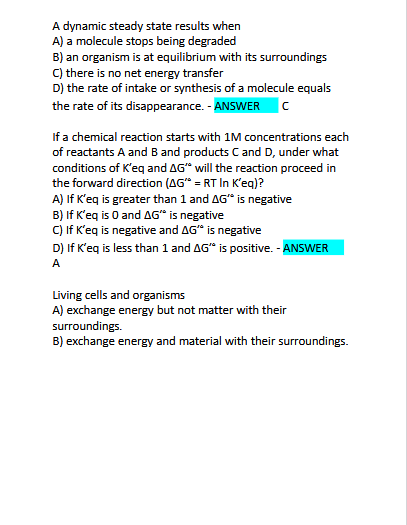
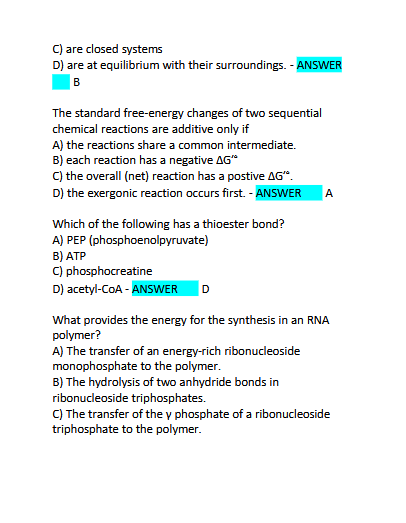
Sample Questions
Question 1
An enzyme is studied with and without a competitive inhibitor. How do the apparent Km and Vmax change in the presence of the inhibitor?
A. Km increases and Vmax stays the same
B. Km stays the same and Vmax decreases
C. Both Km and Vmax decrease
D. Km decreases and Vmax stays the same
Correct Answer: A
Rationale: A competitive inhibitor competes with the substrate for the active site. Adding more substrate can outcompete the inhibitor, so the same maximum rate (Vmax) is still reached. More substrate is needed to reach half of that rate, so the apparent Km goes up. A noncompetitive inhibitor lowers Vmax and leaves Km unchanged, which is option B. An uncompetitive inhibitor lowers both, which is option C. Option D describes an effect that would make the enzyme look like it binds the substrate more tightly, which a competitive inhibitor does not do.
Question 2
In the liver, glucagon is released during fasting. Which change in glycolysis and gluconeogenesis results?
A. Fructose 2,6-bisphosphate rises, which speeds up glycolysis
B. Protein kinase A phosphorylates the bifunctional PFK-2/FBPase-2 enzyme, fructose 2,6-bisphosphate falls, glycolysis slows, and gluconeogenesis is favored
C. Insulin levels rise, which activates glycolysis
D. Glycogen synthesis is stimulated
Correct Answer: B
Rationale: Glucagon raises cyclic AMP, which activates protein kinase A. The kinase phosphorylates the bifunctional enzyme so that its phosphatase activity (FBPase-2) is on and its kinase activity (PFK-2) is off. Fructose 2,6-bisphosphate then falls. This molecule normally activates PFK-1 and inhibits fructose 1,6-bisphosphatase, so a drop in its level slows glycolysis and favors gluconeogenesis, which helps the liver release glucose during fasting. Option A is the opposite. Insulin and glycogen synthesis belong to the fed state.
Question 3
An acetate buffer is made with acetic acid (pKa 4.76). The concentration of acetate is ten times the concentration of acetic acid. What is the pH?
A. 3.76
B. 4.76
C. 5.76
D. 6.76
Correct Answer: C
Rationale: Use the Henderson-Hasselbalch equation: pH = pKa + log([A−]/[HA]). With a 10:1 ratio, log(10) = 1, so pH = 4.76 + 1 = 5.76. A pH of 4.76 would mean equal amounts of acid and base. A pH of 3.76 would mean the acid is ten times more concentrated than the base. A pH of 6.76 would need a ratio of 100:1.
Question 4
2,4-Dinitrophenol is an uncoupler of oxidative phosphorylation. What happens when it is added to actively respiring mitochondria that have plenty of substrate and oxygen?
A. Oxygen use stops and ATP production stops
B. Oxygen use increases, ATP synthesis falls, and more energy is released as heat
C. Oxygen use falls and ATP synthesis rises
D. The proton gradient grows larger
Correct Answer: B
Rationale: An uncoupler carries protons back across the inner mitochondrial membrane, which removes the proton gradient without passing through ATP synthase. The electron transport chain no longer has a gradient to push against, so it runs faster and consumes more oxygen. Little ATP is made because the gradient is gone, and the energy of the electrons is released as heat. Option A describes the effect of a chain inhibitor such as cyanide. Options C and D describe the opposite of what happens.
Question 5
Which molecule prevents newly made fatty acids from being immediately burned in the mitochondria, by inhibiting carnitine acyltransferase I?
A. Acetyl-CoA
B. Malonyl-CoA
C. Citrate
D. NADH
Correct Answer: B
Rationale: Malonyl-CoA is the first committed intermediate of fatty acid synthesis. It also inhibits carnitine acyltransferase I, the enzyme that moves long-chain fatty acids into the mitochondrial matrix for beta-oxidation. This blocks a wasteful cycle in which the cell makes fatty acids in the cytosol and breaks them down at the same time. Acetyl-CoA, citrate, and NADH are related to metabolism, but they are not the inhibitor of this transport step.
Frequently Asked Questions
Is this the same as the publisher’s official test bank?
No. This is an independently written study resource meant to help you review the topics in the 8th edition of Lehninger Principles of Biochemistry. It is a self-study companion and is not distributed by the publisher.
Will it help me prepare for the MCAT?
The reasoning style is similar to the biochemistry questions on the MCAT, especially for enzymes, metabolism, and protein structure. It works best as extra practice alongside MCAT study materials.
Does it cover every chapter?
The questions are organized by chapter and topic, following the order of the 8th edition from water and biomolecules through metabolism and gene expression.
What kinds of questions are included?
Mostly multiple-choice, plus matching and short problem-style questions.
Are there explanations?
Yes. Every question has a full rationale that explains the chemistry behind the best answer and why the other options do not fit.
Who is it for?
Biochemistry majors, pre-health students, and anyone taking a biochemistry course built around this textbook.
How should I use it?
Read the chapter first, then try the questions before looking at the answers. Study the rationales for anything you missed. Understanding why a pathway responds the way it does helps more than memorizing the letter.
Can it replace the textbook?
No. It works best alongside the textbook. The book teaches the chemistry and the pathways, and the test bank gives you practice using them.
Is it matched to the 8th edition?
Yes. It follows the topics and chapter structure of the 8th edition.
Is it useful the night before an exam?
Yes. Because it is organized by chapter and topic, you can quickly review one area, such as glycolysis or oxidative phosphorylation, without rereading the whole book.



Julie41 –
I haven’t read it all the way through yet, but the structure and the way are really great!
assuahkabenla –
Nice to practice with
Zackk –
It has everything i need
Frank –
Great resource for nursing students
Trev –
Easy to understand and use
Johnk –
Excellent nursing questions and answers
Ann –
Really improved my exam preparation
Carrick Tony –
Super helpful for nursing exam prep.
Alexander Belinda –
Great questions for practicing daily.
Viarose –
Good variety of nursing practice questions.
Susan Conroy –
Very helpful for exam preparation.
Frank Palmon –
Great questions and detailed answers.
Jimmy Vavy –
Boosted my test scores significantly.
Blessings Agi –
Comprehensive coverage of all topics.
Ivans –
Great resource for nursing students.
Seyie Burajolo –
Helpful questions and clear explanations.
Zack Evans –
Convenient for reviewing material anytime
Annen Wags –
Helpful addition to my nursing studies.
leslie Salinas. –
Questions closely matched course material.
Paul J –
Great resource for building confidence
Vivian –
Helpful explanations and well-written questions.
Pauline Ann –
Simple explanations that make learning easier
Swagrid Gladys –
Great resource for nursing test preparation
Anne Mabelli –
Helpful explanations for difficult concepts
Eva –
Great value for nursing students
Felix Okema –
Great questions with clear explanations.
Faravan Denberg –
Helps make nursing studies easier
Nauyomahna Elizabeth –
A reliable tool for exam preparation
Max –
Fantastic resource for nursing students