
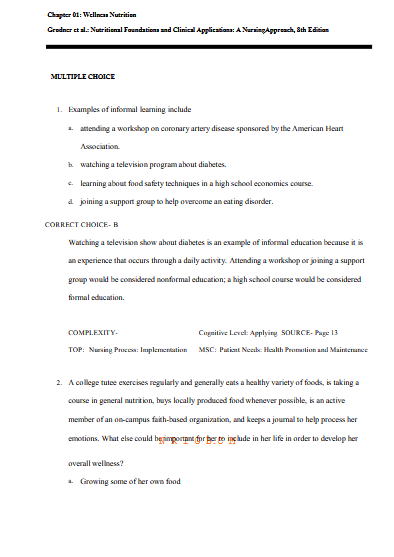
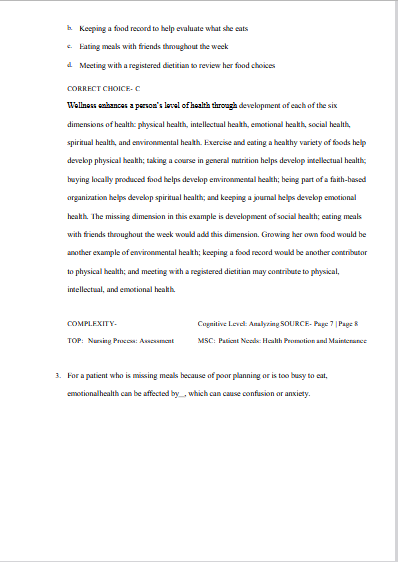
Nutrition courses cover an unusual mix of subjects. One week you are learning biochemistry, the next you are working through a patient case involving diabetes or kidney disease, and the week after that you are studying how culture and psychology shape eating habits. It is a lot of ground to cover, and it is easy to feel confident about a chapter while reading it, only to blank on the same material during an exam.
This test bank is written to accompany the 8th edition of Nutritional Foundations and Clinical Applications, a textbook known for its “nutrition care process” approach that connects basic nutrition science directly to real patient scenarios. The test bank follows that same approach, pairing conceptual questions with applied, case-style items so that studying from it feels closer to the way the material will actually be tested.
What This Test Bank Offers
Rather than isolated facts, this collection is built around the type of thinking nutrition instructors tend to test: understanding how a nutrient functions in the body, recognizing signs of a deficiency or excess, and applying that knowledge to a specific patient or life-stage scenario. It is meant to help you connect the science to its clinical use, not just memorize a definition.
Question formats include:
- Multiple choice questions with four answer options
- True or false statements that test precise conceptual understanding
- Fill-in-the-blank items for key terms, values, and calculations
- Matching sets for nutrients, functions, and deficiency signs
- Short case-based questions built around a specific patient or life stage
Every question is labeled by chapter and topic, so you can focus your review on a specific area, such as carbohydrate metabolism, maternal nutrition, or nutrition support for chronic kidney disease, without sorting through unrelated content.
Topics Covered
- Foundations of nutrition and dietary guidelines
- Digestion, absorption, and metabolism
- Carbohydrates, proteins, and lipids
- Vitamins and minerals
- Energy balance and weight management
- Nutrition across the lifespan, from pregnancy through older adulthood
- Nutrition for physical activity and sports performance
- Food safety and food security
- Nutritional assessment and the nutrition care process
- Clinical nutrition for cardiovascular disease, diabetes, and metabolic conditions
- Nutrition support for gastrointestinal, renal, and oncology patients
- Cultural, psychological, and socioeconomic influences on eating behavior
Why Use a Test Bank Alongside Your Textbook
Nutrition science builds on itself. Understanding how the body absorbs and uses a nutrient in an early chapter becomes the foundation for understanding, later on, why a deficiency or a disease state produces certain symptoms. A test bank is a practical way to check whether that foundation is solid before you reach the more applied, clinical chapters that depend on it.
For instructors, this test bank offers a ready-made starting point for building quizzes, homework assignments, or exams that already reflect the organization and emphasis of the assigned textbook.
Format and Delivery
The test bank is provided as an editable document, so questions can be imported into a learning management system, printed for in-class testing, or rearranged into custom quizzes. Every question comes with a verified correct answer and a written rationale.
Five Sample Questions
Question 1
Which of the following best explains why complex carbohydrates generally cause a slower rise in blood glucose than simple sugars?
A. Complex carbohydrates contain no glucose molecules
B. Complex carbohydrates require more steps of digestion before absorption
C. Complex carbohydrates are absorbed directly into the bloodstream unchanged
D. Complex carbohydrates are not broken down by digestive enzymes
Correct Answer: B
Rationale: Complex carbohydrates are made of long chains of glucose units that must be broken down by digestive enzymes into simpler sugars before they can be absorbed, slowing the rate at which glucose enters the bloodstream.
Question 2
A client presents with fatigue, pale skin, and a lab report showing microcytic, hypochromic red blood cells. Which nutrient deficiency is most consistent with these findings?
A. Vitamin B12
B. Iron
C. Vitamin C
D. Folate
Correct Answer: B
Rationale: Iron is essential for hemoglobin production; deficiency results in smaller, paler red blood cells. B12 and folate deficiencies instead cause macrocytic anemia.
Question 3
Which nutritional recommendation is most appropriate for a client in the third trimester of pregnancy?
A. Decrease overall caloric intake
B. Increase intake of foods high in folate and iron
C. Eliminate all dietary fat
D. Restrict fluid intake
Correct Answer: B
Rationale: Iron needs rise substantially in pregnancy for increased blood volume and fetal development, and folate remains important throughout.
Question 4
A client with chronic kidney disease is advised to limit dietary potassium. Which food needs to be limited?
A. Apple slices
B. White bread
C. Baked potato with skin
D. Cooked white rice
Correct Answer: C
Rationale: Potatoes, especially with skin, are concentrated potassium sources, risky for impaired kidney excretion.
Question 5
Which statement best reflects appropriate use of the nutrition care process?
A. Selecting an intervention before collecting data
B. Gathering data, then identifying a diagnosis before planning intervention
C. Assuming identical plans for identical diagnoses
D. Skipping monitoring after intervention
Correct Answer: B
Rationale: The nutrition care process follows assessment, diagnosis, intervention, then monitoring/evaluation, in that order.
FAQs
1. Does it match the 8th edition chapter structure? Yes.
2. Is this the official instructor test bank? No, it’s an independently developed supplementary resource.
3. Conceptual or case-based? Both.
4. Can instructors edit it? Yes, fully editable.
5. Good for self-study? Yes, includes rationales.
6. Covers lifespan nutrition? Yes, pregnancy through older adulthood.
7. Difficulty level? Undergraduate nutrition course level.
8. LMS compatible? Yes.

Tonnyjakes16 –
Excellent study material! The document was exactly as described, well-organized, easy to follow, and very accurate. It helped me understand the course better and saved me a lot of study time.
Swagrid12 –
Great study material
Maximevan –
Extremely helpful in preparing for my exams thank you
Maxim –
Well-organized and easy to use.
Ivy –
Accurate, challenging, and very helpful.
Cosmas –
Boosted my confidence before exams.
Nico –
Worth every minute of studying.
Hannah –
Excellent explanations with every question
Alex –
Accurate, reliable, and informative
Mercy –
Made studying more productive
Neema –
Highly effective learning tool
Dian –
Effective tool for exam readiness.
Scoty –
Great value and excellent quality
Tom –
Very helpful study material
Peter –
Perfect for reviewing key concepts
Jim –
Very useful for test preparation
Johnson –
Simple, effective, and easy to use
MaryK –
Excellent supplement to nursing coursework
Maxim9 –
Really helpful for reviewing material
Vanessa Charles –
Practical questions for focused studying.
Tonny Peter6 –
Great supplement to nursing coursework.
Victoria Mahnam –
Great resource for nursing students.
Terrysnyder –
Questions are clear and helpful.