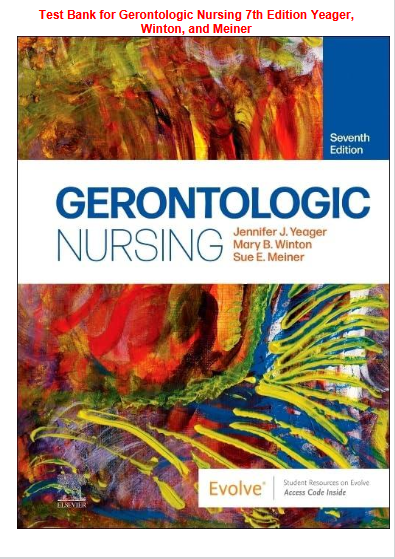
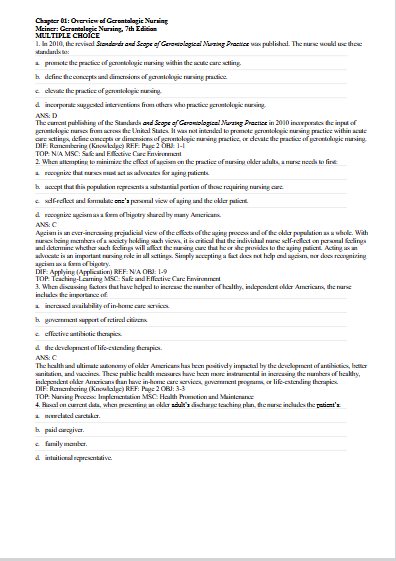
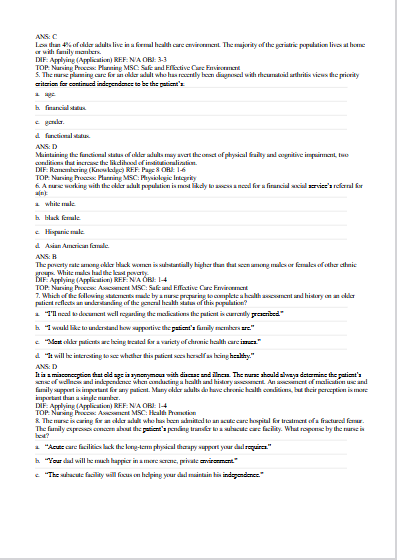
Older adults don’t just present with the same conditions younger patients do, only slower. Aging changes how disease shows up, how medications behave in the body, and what “normal” even looks like on assessment, and missing that shift is exactly where a lot of exam questions catch students off guard. Gerontologic Nursing was written to build that age-specific lens, and this test bank was designed to reinforce it the same way. It follows the chapter structure of the 7th edition, by Kristen L. Yeager, Meredith Wallace Kazer, and Sue E. Meiner, so your practice tracks the same organized, aging-focused approach used throughout the book.
Whether you’re in a gerontological nursing course, prepping for clinical rotations in long-term care or a geriatric unit, or reviewing before a certification exam, this resource is built to sharpen the recognition and clinical judgment aging-focused care consistently demands.
What’s Covered
Practice sets follow the textbook’s organization, including:
- Theories of aging and demographic trends in the older adult population
- Physiologic changes of aging across body systems and how they differ from disease
- Health assessment considerations specific to older adults
- Pharmacology and medication safety in older adults, including polypharmacy
- Cognitive changes, including delirium, dementia, and depression
- Common chronic conditions, including cardiovascular, respiratory, and musculoskeletal changes
- Sensory changes and their impact on safety and quality of life
- Nutrition, hydration, and elimination concerns specific to older adults
- Falls, mobility, and environmental safety considerations
- Elder mistreatment, abuse, and neglect recognition
- End-of-life care, advance directives, and palliative care principles
- Care coordination across settings, including long-term care and community-based care
Question formats mix multiple-choice, select-all-that-apply, and scenario-based items, matching how gerontological nursing courses and licensure-style testing are typically structured.
Why Practice Questions Help Here
A lot of gerontological nursing exam questions hinge on telling a normal age-related change apart from a genuine red flag. Slower reflexes, thinner skin, changes in sleep pattern, these can all be expected with aging, but similar-sounding findings can also point to something that actually needs follow-up. Working through practice questions helps you:
- Practice distinguishing normal aging changes from findings that signal illness or decline
- Get sharper at recognizing early signs of delirium, dementia, and depression, three conditions that frequently get confused for each other
- Build confidence with medication safety questions specific to how aging affects drug metabolism and clearance
- Strengthen your ability to recognize signs of elder abuse or neglect
- Reduce exam anxiety by practicing the same scenario-based reasoning used on course exams and licensure-style testing
Many students say gerontological content is trickier than it first appears, since so many conditions in older adults present atypically compared to how they’d show up in a younger patient. Regular, chapter-based practice is one of the more effective ways to build that specialized recognition before it’s tested for real.
What Makes This Test Bank Different
Every question includes a full rationale, not just a letter. You’ll see why the correct answer reflects age-appropriate, safe gerontological care, and why each alternative falls short, whether it mistakes a normal change for a problem, misses a safety concern, or overlooks a key assessment finding. That mirrors how gerontological nursing exams tend to be written, since wrong answers often sound reasonable but miss one specific, age-related detail.
Questions are grouped by chapter and core topic, so you can focus exactly where you need it, whether that’s medication safety before a quiz or a full review before a comprehensive exam. It works well alongside assigned reading, as a self-check before clinical rotations, or as a structured review before exam day.
Sample Questions
Question 1
An 84-year-old patient is prescribed a new medication. Which age-related physiologic change is most important for the nurse to consider regarding how this drug will be metabolized?
A. Increased hepatic blood flow and enzyme activity
B. Decreased hepatic blood flow and reduced metabolic enzyme activity
C. No significant change in liver function with normal aging
D. Increased renal clearance of medications
Correct Answer: B
Rationale: Aging is generally associated with decreased hepatic blood flow and reduced activity of liver enzymes responsible for drug metabolism, which can cause medications to stay active in the body longer and increase the risk of accumulation and toxicity. Option A describes the opposite of what typically happens with aging. Option C is inaccurate, since liver function does change meaningfully with age in ways relevant to drug metabolism. Option D is also inaccurate, since renal clearance of medications generally decreases with age due to declining kidney function, not increases, which further compounds the risk of drug accumulation when combined with reduced hepatic metabolism.
Question 2
A nurse is assessing an older adult in a long-term care facility and notices unexplained bruising in various stages of healing, along with the patient appearing fearful around a particular staff member. What should the nurse suspect?
A. Normal skin fragility associated with aging
B. Possible elder abuse requiring further investigation and reporting
C. A medication side effect unrelated to any safety concern
D. A normal reaction to being in an unfamiliar care setting
Correct Answer: B
Rationale: Unexplained bruising in multiple stages of healing, combined with fearfulness directed at a specific individual, are recognized warning signs of possible elder abuse that require further investigation and mandatory reporting according to facility and legal protocols. While older adults do have more fragile skin that bruises more easily, the specific combination of multiple-stage bruising and fear toward a particular staff member goes beyond what normal skin fragility alone would explain. A medication side effect wouldn’t typically explain the fearful behavior toward a specific person. Framing this as a normal reaction to an unfamiliar setting dismisses a combination of findings that specifically points toward a safety concern needing further evaluation.
Question 3
An older adult reports feeling dizzy and lightheaded when standing up quickly from a seated position. What is the most likely explanation for this finding?
A. Normal blood pressure regulation with no age-related changes
B. Orthostatic hypotension related to age-related changes in cardiovascular regulation
C. A sign of dehydration only, unrelated to aging
D. An expected and harmless part of standing up quickly at any age
Correct Answer: B
Rationale: Orthostatic hypotension, a drop in blood pressure upon standing that causes dizziness or lightheadedness, becomes more common with aging due to changes in baroreceptor sensitivity and overall cardiovascular regulation, making older adults more vulnerable to this finding and the fall risk that comes with it. Option A incorrectly assumes no age-related change occurs in blood pressure regulation. Option C oversimplifies the cause, since while dehydration can contribute to orthostatic symptoms, age-related cardiovascular changes are a significant factor independent of hydration status. Option D minimizes a finding that carries real clinical significance in older adults, particularly given the associated fall risk, rather than being a universally harmless occurrence at any age.
Question 4
A nurse is caring for a patient recovering from surgery who develops sudden confusion, disorientation, and fluctuating attention over several hours. The patient was alert and oriented the day before. What should the nurse suspect first?
A. Early-stage dementia
B. Postoperative delirium
C. Normal aging-related forgetfulness
D. Chronic depression
Correct Answer: B
Rationale: Postoperative delirium is common in older adults and presents as an acute, fluctuating change in attention and orientation, often triggered by factors like anesthesia, infection, pain, or metabolic changes following surgery. The sudden onset within hours, following a day of normal alertness, is the key clue pointing to delirium rather than a slower, more gradual process. Dementia develops gradually over months or years, not suddenly overnight. Normal age-related forgetfulness doesn’t cause this level of acute confusion or fluctuating attention. Chronic depression can affect cognition, but not with this sudden, fluctuating presentation tied closely to a recent surgical event.
Question 5
Which nursing approach best reflects a wellness-focused, function-preserving philosophy when caring for an older adult with mild cognitive impairment?
A. Take over all decision-making to reduce the patient’s stress
B. Encourage the patient to remain involved in decisions and activities within their current capabilities
C. Restrict the patient’s independent activities to prevent any possible errors
D. Assume the patient cannot participate meaningfully in their own care planning
Correct Answer: B
Rationale: A function-preserving, wellness-focused approach encourages older adults to stay involved in decisions and activities that match their current abilities, supporting independence and self-esteem rather than assuming incapacity based on a diagnosis alone. Taking over all decision-making, as in option A, unnecessarily strips away autonomy the patient may still be capable of exercising. Restricting independent activities broadly, as in option C, can accelerate functional decline rather than protect the patient. Assuming the patient can’t participate meaningfully in care planning, as in option D, overgeneralizes the impact of mild cognitive impairment and disregards the patient’s remaining capabilities.
Frequently Asked Questions
Is this the publisher’s official test bank?
No, this is an independently written study resource built to help you review the material in the 7th edition of Gerontologic Nursing. It’s meant for self-study and isn’t distributed by the publisher.
Will this help with NCLEX-RN or certification exam prep?
The scenario-based format mirrors licensure exam questions, focusing on distinguishing normal aging from illness, medication safety, and recognizing elder abuse or neglect, all heavily tested areas in gerontological nursing.
Does it cover the whole textbook?
Yes, questions are organized by chapter and core topic, following the 7th edition’s structure from theories of aging through end-of-life care and care coordination.
What question types are included?
Mostly multiple-choice, with some select-all-that-apply and scenario-based items, matching the formats common in gerontological nursing courses and on licensure-style exams.
Are there explanations, or just answer letters?
Every question includes a full rationale explaining why the correct answer reflects appropriate, age-specific nursing care, and why the other options fall short.
Who’s this built for?
Nursing students taking a gerontological nursing course, plus anyone reviewing older adult care principles ahead of a course exam or certification exam.
What’s the best way to use it?
Read the assigned chapter first, then work through the matching questions before checking answers. Go back through the rationales carefully afterward, since understanding why a finding is normal versus concerning matters more than memorizing a letter.
Can this replace the textbook?
No, it’s meant to work alongside it. The textbook builds your foundational understanding of aging physiology and gerontological care; the test bank gives you a way to practice applying that knowledge.
Is it matched to the 7th edition specifically?
Yes, it follows the topics, terminology, and chapter organization of the 7th edition.
Good for last-minute review?
Yes, since it’s organized by chapter, you can zero in on a specific topic quickly, like medication safety or elder abuse recognition, instead of reviewing the entire book at once.

Pauline –
Great way to test your knowledge.
Kevin Race –
Very useful before major exams.
Viarose –
Easy to use and highly practical