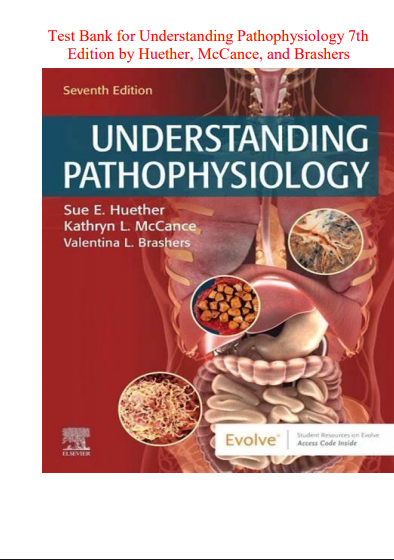
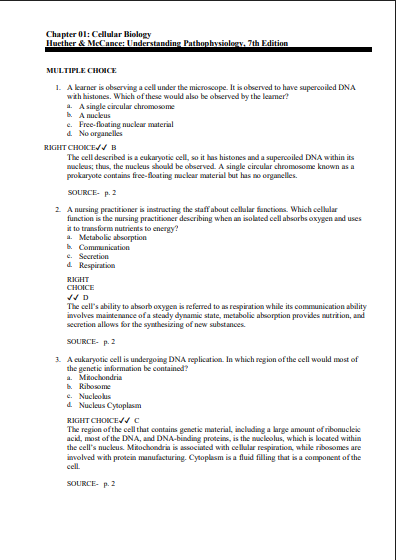
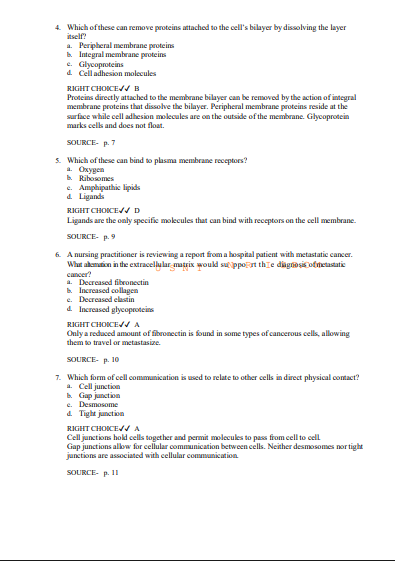
There’s a moment in most pathophysiology courses where memorizing symptoms stops being enough. You have to understand why those symptoms happen, tracing a disease process from what’s going wrong at the cellular level all the way up to what the patient actually feels. That shift, from “what” to “why,” is the whole point of pathophysiology, and it’s also what makes it genuinely difficult to study for. This test bank was built around that shift. It follows the chapter structure of Understanding Pathophysiology, 7th Edition, by Sue E. Huether, Kathryn L. McCance, and Valentina L. Brashers, so your practice tracks each disease process the same mechanism-to-manifestation way the textbook builds it.
Whether you’re in a nursing program, a PA program, or any health science course using this text as its pathophysiology foundation, this resource is designed to strengthen the disease-mechanism reasoning these exams are built to test.
What’s Covered
Practice sets follow the textbook’s organization, including:
- Cellular biology, cellular injury, and how cells adapt to stress
- Genetics and the mechanisms behind genetic disease
- Fluid, electrolyte, and acid-base imbalances
- Innate and adaptive immunity, and what happens when immune function breaks down
- Infection, inflammation, and the body’s response to injury
- Neoplasia and the biology behind cancer development
- The stress response and its effects across body systems
- Neurological disorders, including stroke, seizures, and neurodegenerative disease
- Cardiovascular disorders, including heart failure and coronary artery disease
- Respiratory, renal, and gastrointestinal system disorders
- Endocrine and reproductive system disorders
- Pathophysiology across the lifespan, including pediatric and older adult considerations
Formats mix multiple-choice, matching, and case-based questions, matching how pathophysiology courses using this text are typically taught and tested.
Why Practice Questions Help Here
Pathophysiology exams tend to ask for the mechanism behind a clinical picture, not just the name of the disease. You might get a set of lab values and symptoms and have to identify what’s actually driving them, or predict what happens next if a process goes untreated. Working through practice questions helps you:
- Trace a disease process from its cellular or molecular starting point through to what shows up clinically
- Build confidence connecting lab values and vital sign changes to the mechanism causing them
- Practice telling apart conditions that share symptoms but come from completely different processes
- Get comfortable with case-based questions that require stringing several steps of reasoning together
- Reduce exam anxiety by practicing the same mechanism-first thinking these exams consistently reward
Many students say pathophysiology is one of the harder courses to cram for, since understanding a disease process isn’t something you can memorize the way you’d memorize a list of facts. Regular, chapter-based practice is a much better way to build that mechanism-level understanding over time than trying to absorb it all the week before an exam.
What Makes This Different
Every question comes with a real explanation, not a bare answer key. You’ll see the disease mechanism behind the correct answer, and why each incorrect option describes a different process, an unrelated condition, or only part of the picture. This mirrors how pathophysiology exams are actually written, since wrong answers usually describe a real disease process, just not the one that matches the scenario given.
Questions are grouped by chapter and body system, so you can focus wherever you need it, whether that’s a single topic like inflammation before a quiz or a full-body review before a comprehensive final. It works well alongside assigned reading, as a self-check before exams, or as a structured review before a licensure or certification exam.
Sample Questions
Question 1
A patient develops localized redness, warmth, swelling, and pain after a minor skin injury. What process is primarily driving these findings?
A. Chronic inflammation
B. Acute inflammation
C. Cellular necrosis without inflammation
D. Immune tolerance
Correct Answer: B
Rationale: Acute inflammation is the body’s immediate response to injury, and the redness, warmth, swelling, and pain all come from increased blood flow and vascular permeability at the injury site, appearing quickly after the injury occurs, exactly as described here. Chronic inflammation unfolds over a longer timeframe and involves different cellular changes like tissue remodeling, not this acute presentation. Cellular necrosis without inflammation wouldn’t produce the redness, warmth, or swelling described, since those signs are specifically caused by inflammation. Immune tolerance refers to the immune system avoiding a reaction to certain antigens, which has nothing to do with this acute injury response.
Question 2
A patient with long-standing hypertension develops left ventricular hypertrophy. What process explains this cardiac change?
A. The heart muscle atrophies due to decreased workload
B. The heart muscle thickens in response to chronically increased afterload
C. The heart chambers dilate due to decreased blood volume
D. The heart valves calcify from increased venous pressure
Correct Answer: B
Rationale: Chronic hypertension raises the resistance the left ventricle has to pump against, known as afterload. Over time, the heart compensates by thickening, a process called hypertrophy, to generate enough force against that resistance. This compensation helps initially but can eventually lead to heart failure if the hypertension goes uncontrolled. Option A describes the opposite of what actually happens, since increased workload drives thickening, not atrophy. Option C describes a different structural change tied to volume overload, not the pressure overload happening here. Option D describes a valve-related process, not the muscular hypertrophy of the ventricular wall caused by chronic hypertension.
Question 3
A patient with type 1 diabetes develops fruity-smelling breath, deep rapid breathing, and altered mental status. What’s driving these findings?
A. Excess insulin causing hypoglycemia
B. Ketoacidosis from insufficient insulin and fat breakdown for energy
C. Excess glucose being stored as glycogen
D. A normal response to increased carbohydrate intake
Correct Answer: B
Rationale: Without enough insulin, cells can’t use glucose for energy, so the body turns to breaking down fat instead, producing ketones as a byproduct. That leads to metabolic acidosis, which the body partly compensates for through Kussmaul respirations, deep and rapid breathing, along with the characteristic fruity breath odor from the ketones themselves. Option A describes the opposite metabolic state, which wouldn’t cause these findings. Option C is inaccurate, since insufficient insulin actually prevents normal glucose storage rather than promoting it. Option D mislabels a genuine medical emergency as a normal response, when this presentation actually needs prompt treatment.
Question 4
A patient experiences temporary weakness on one side of the body that fully resolves within an hour, consistent with a transient ischemic attack (TIA). What underlying process explains this?
A. Permanent death of brain tissue from prolonged lack of blood flow
B. A brief, temporary interruption in blood flow to part of the brain
C. A structural malformation present since birth
D. A chronic, progressive degeneration of neurons over years
Correct Answer: B
Rationale: A TIA happens when blood flow to part of the brain is briefly cut off, causing temporary neurological symptoms that resolve once flow returns, typically within minutes to a few hours, without permanent tissue damage. That temporary, fully-resolving nature is exactly what separates a TIA from a full stroke. Option A describes an ischemic stroke with permanent damage, not the temporary presentation described here. Option C describes a congenital issue, unrelated to a sudden, brief episode like this. Option D describes a gradual neurodegenerative process, not a sudden event that resolves completely.
Question 5
What key characteristic classifies a tumor as malignant?
A. It grows slowly and stays confined to its original location
B. It invades surrounding tissue and can metastasize to distant sites
C. It’s surrounded by a well-defined capsule preventing spread
D. It causes no changes to surrounding normal tissue
Correct Answer: B
Rationale: Malignant tumors are defined by their ability to invade nearby tissue and metastasize to distant parts of the body through the blood or lymphatic system, and that invasive, spreading potential is central to how cancer causes widespread disease. Options A and C describe traits more typical of benign tumors, which tend to grow slowly, stay localized, and are often encapsulated. Option D is inaccurate, since malignant tumors commonly disrupt and damage surrounding tissue as they grow and invade.
Frequently Asked Questions
Is this the publisher’s official test bank?
No, this is an independently written study resource built to help you review the material in the 7th edition of Understanding Pathophysiology. It’s meant for self-study and isn’t distributed by the publisher.
Will this help with NCLEX or certification exam prep?
The mechanism-focused, scenario-based format mirrors licensure exam questions, with a heavy emphasis on connecting disease processes to clinical findings, a skill tested consistently across nursing and health science licensure exams.
Does it cover the whole textbook?
Yes, questions are organized by chapter and body system, following the 7th edition’s structure from cellular biology and immunity through system-specific disease processes.
What question types are included?
Mostly multiple-choice, with some matching and case-based items, matching the formats common in pathophysiology courses and on licensure-style exams.
Are there explanations, or just answer letters?
Every question includes a full rationale explaining the disease mechanism behind the correct answer and why the other options describe a different or unrelated process.
Who’s this built for?
Nursing students, PA students, and anyone taking a pathophysiology course built around this textbook, plus students reviewing disease mechanisms ahead of an exam.
What’s the best way to use it?
Read the assigned chapter first, then work through the matching questions before checking answers. Go back through the rationales carefully afterward, since understanding the mechanism behind a finding matters more than memorizing the correct letter.
Can this replace the textbook?
No, it’s meant to work alongside it. The textbook builds your foundational understanding of disease mechanisms and their clinical manifestations; the test bank gives you a way to practice applying that knowledge.
Is it matched to the 7th edition specifically?
Yes, it follows the topics, terminology, and chapter organization of the 7th edition.
Good for last-minute review?
Yes, since it’s organized by chapter and body system, it’s easy to target a specific area quickly, like inflammation or cardiovascular disorders, rather than reviewing the entire book at once.

Jean –
Awesome
Cails –
great thanks
Gabril –
nice document
Jimmy –
Excellent resource for nursing revision
Racheal –
Questions are relevant and practical
Bridget Williams –
Excellent study tool for exams.
Ann Joyce –
Very useful for test preparation.
Kelvin –
Helped me prepare confidently.
Jeff –
Excellent practice for nursing exams.