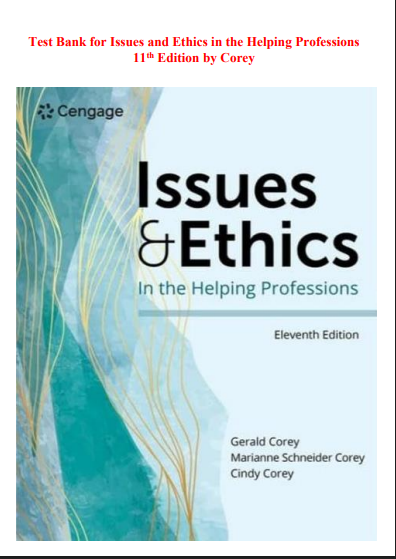
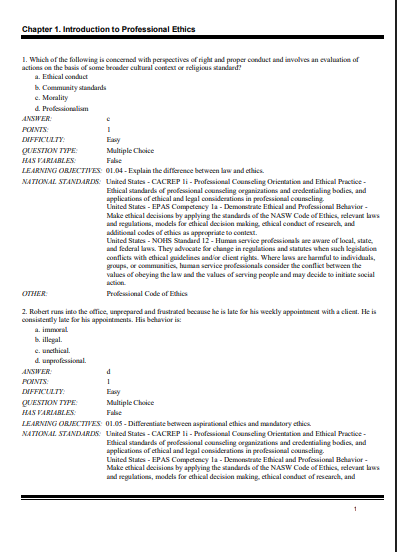
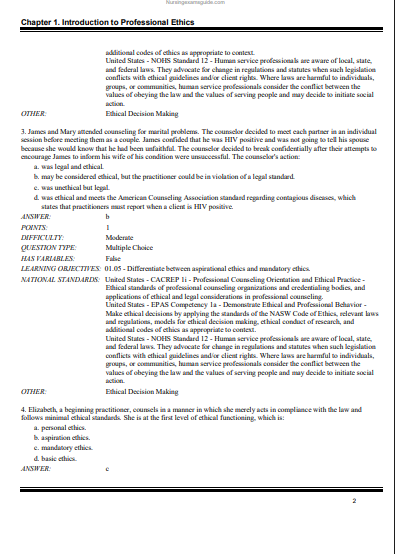
Ethics courses in counseling and helping-profession programs are unlike most other classes you’ll take, because there’s rarely one clean, obviously correct answer. Instead, you’re weighing competing values, client welfare against professional boundaries, confidentiality against duty to warn, autonomy against protection, and figuring out which principle should win in a specific situation. That kind of applied ethical reasoning is exactly what Issues and Ethics in the Helping Professions teaches, and it’s exactly what this test bank was built to reinforce. It follows the chapter structure of the 11th edition, by Gerald Corey, Marianne Schneider Corey, and Cindy Corey, so your practice tracks the same case-based, principle-driven approach the textbook uses.
Whether you’re in a counseling, psychology, social work, or marriage and family therapy program, or reviewing before a licensure exam that tests ethics content, this resource is designed to sharpen the applied reasoning these exams consistently require.
What’s Covered
Practice sets follow the textbook’s organization, including:
- The counselor’s own values and how personal beliefs intersect with professional ethics
- Ethical decision-making models and frameworks for working through dilemmas
- Client rights, informed consent, and the therapeutic relationship
- Confidentiality, privileged communication, and legal exceptions like duty to warn
- Boundaries and multiple relationships in counseling practice
- Professional competence and scope of practice issues
- Ethical issues in assessment, diagnosis, and record keeping
- Managing crises, danger to self or others, and mandatory reporting
- Ethical issues in group, couples, and family therapy
- Legal issues, malpractice, and professional liability
- Ethics in community, school, and organizational settings
- Values, diversity, and multicultural considerations in ethical practice
Each section mixes multiple-choice, matching, and case-based questions, since these formats reflect how ethics courses and licensure-style exams are typically structured.
Why Students Use a Test Bank Like This
Ethics exams almost always describe a specific situation, a client disclosure, a dual relationship, a records request, and ask what the counselor should do and why. That’s a very different skill than reciting the ACA or APA code of ethics from memory. Practicing with well-written questions helps you:
- Apply ethical codes and legal standards to messy, realistic client scenarios
- Practice weighing competing ethical principles when they conflict, like autonomy versus beneficence
- Build confidence recognizing when confidentiality must be broken and when it must be protected
- Get comfortable identifying boundary crossings versus more serious boundary violations
- Reduce exam anxiety by practicing the same case-based reasoning used on licensure and comprehensive exams
Many students say ethics content is harder to study for than it initially seems, since the “correct” answer often depends on specific facts in the scenario, not a rule that applies the same way every time. Regular, chapter-based practice with realistic cases is one of the more effective ways to sharpen that judgment before it’s tested for real.
What Makes This Test Bank Different
This test bank is built around complete reasoning, not shortcut answer keys. Every question includes a full rationale that explains why the correct action reflects sound ethical and legal practice, and why each incorrect option falls short, whether it violates confidentiality inappropriately, oversteps scope of practice, or misapplies an ethical principle to the wrong situation. This mirrors how ethics exams are typically written, since incorrect choices are often reasonable-sounding responses that miss one key detail in the case.
Questions are grouped by chapter and ethical topic, so you can focus your review exactly where you need it, whether that’s a single area like confidentiality before a quiz, or a full comparative review before a comprehensive or licensure exam. It works well as a companion to assigned readings, a self-check before class discussions, or a structured review before exam day.
Sample Questions
Question 1
A client discloses to their counselor a specific, credible plan to seriously harm a named third party. What is the counselor’s most appropriate action?
A. Maintain strict confidentiality, since all client disclosures are protected
B. Take reasonable steps to warn the identified potential victim and notify appropriate authorities
C. Refuse to discuss the disclosure further and end the session
D. Wait until the next scheduled session to address the disclosure
Correct Answer: B
Rationale: When a client makes a credible, specific threat against an identifiable third party, most jurisdictions and professional codes recognize a duty to warn or protect, which can require breaking confidentiality to notify the potential victim and appropriate authorities. This exception exists specifically because protecting an identifiable person from serious harm outweighs the general obligation to maintain confidentiality in this circumstance. Option A misapplies confidentiality, since it is not absolute and has recognized legal and ethical exceptions for exactly this kind of situation. Option C fails to address a serious safety concern that requires action, not avoidance. Option D delays a response that needs to happen promptly, given the immediacy of the threat described.
Question 2
A counselor is asked by a former client to attend the client’s wedding six months after termination of a brief, non-intensive therapeutic relationship. What is the most important ethical consideration in deciding how to respond?
A. Whether the counselor personally wants to attend
B. Whether attending could create a risk of harm or exploitation given the nature and length of the prior relationship
C. Whether the client is likely to become upset if the counselor declines
D. Whether other counselors in the practice have attended similar events
Correct Answer: B
Rationale: Ethical codes governing post-termination relationships generally require the counselor to evaluate potential risk of harm, exploitation, or influence based on factors like the length, intensity, and nature of the therapeutic relationship, rather than applying a blanket rule. A brief, non-intensive relationship carries a different risk profile than long-term, intensive therapy, and this evaluation is central to responsible decision-making. The counselor’s personal preference, in option A, is not the ethical standard driving this decision. The client’s potential emotional reaction, in option C, does not outweigh the need to assess actual risk of harm. What other counselors have done, in option D, does not substitute for the individualized ethical evaluation this situation requires.
Question 3
A therapist realizes partway through an initial session that a new client’s presenting concern falls outside the therapist’s area of clinical competence. What is the most appropriate action?
A. Continue treatment and learn the necessary skills as therapy progresses
B. Refer the client to a more qualified provider or seek appropriate supervision and consultation
C. Terminate the session immediately without further discussion
D. Proceed with treatment without informing the client of the concern
Correct Answer: B
Rationale: Practicing within one’s scope of competence is a core ethical obligation, and when a presenting concern falls outside a therapist’s expertise, the appropriate response is either referring the client to a qualified provider or obtaining proper supervision and consultation to ensure competent care. Continuing to treat the client while learning on the job, as in option A, risks providing inadequate or even harmful care. Abruptly terminating the session without explanation, as in option C, is not a respectful or appropriately handled response to this situation. Proceeding without disclosing the concern, as in option D, withholds information the client needs to make an informed decision about their care.
Question 4
A counselor working in a small rural community discovers that a new client is a member of the same social and religious community the counselor also belongs to. Which ethical concept is most directly relevant to how the counselor should handle this situation?
A. Informed consent regarding fees
B. Multiple relationships and the need to manage potential boundary issues
C. Mandatory reporting requirements
D. Termination procedures
Correct Answer: B
Rationale: Overlapping social, religious, or community connections between a counselor and client create a multiple relationship, which requires careful ethical management to prevent role confusion, loss of objectivity, or harm to the client, even when the overlap wasn’t intentionally sought out. This is a particularly common and important issue in small or rural communities, where some degree of overlap may be unavoidable. Informed consent about fees, in option A, is unrelated to this specific concern. Mandatory reporting, in option C, applies to disclosures of abuse or danger, not overlapping community membership. Termination procedures, in option D, are not the central ethical issue raised by this scenario.
Question 5
A counselor wants to use anonymized case material from a former client’s therapy sessions in a professional training presentation. What is the most appropriate ethical step to take first?
A. Assume that removing the client’s name is sufficient to protect confidentiality
B. Obtain informed consent from the client, even with identifying details removed, when feasible
C. Use the material without concern, since the client is no longer in treatment
D. Only use the material if it reflects positively on the treatment outcome
Correct Answer: B
Rationale: Ethical guidelines generally call for obtaining client consent before using case material for teaching or presentation purposes whenever it’s feasible to do so, even when identifying details have been removed, since anonymization alone doesn’t always fully protect a client’s privacy or address their right to control how their information is used. Assuming that removing a name is automatically sufficient, as in option A, underestimates the risk of a client still being identifiable through other details in the case. The end of the treatment relationship, referenced in option C, does not eliminate the counselor’s ongoing confidentiality obligations. Basing the decision on whether the outcome reflects well on treatment, as in option D, is an irrelevant and inappropriate standard for this ethical decision.
Frequently Asked Questions
Is this the publisher’s official test bank?
No, this is an independently written study resource built to help you review the material in the 11th edition of Issues and Ethics in the Helping Professions. It’s meant for self-study and isn’t distributed by the publisher.
Will this help with licensure exam preparation?
The case-based format mirrors how ethics content is typically tested on counseling, psychology, and social work licensure exams, with an emphasis on applying ethical principles to realistic client scenarios.
Does it cover the whole textbook?
Yes, questions are organized by chapter and ethical topic, following the 11th edition’s structure from foundational ethical decision-making through specific practice areas like group therapy, assessment, and multicultural considerations.
What question types are included?
Mostly multiple-choice, with some matching and case-based items, matching the format common in ethics coursework and on licensure-style exams.
Are there explanations, or just answer letters?
Every question includes a full rationale explaining why the correct action reflects sound ethical and legal practice, and why the other options fall short in that specific scenario.
Who’s this built for?
Counseling, psychology, social work, and marriage and family therapy students taking an ethics course, plus anyone reviewing ethical decision-making ahead of a comprehensive or licensure exam.
What’s the best way to use it?
Read the assigned chapter first, then work through the matching questions before checking answers. Go back through the rationales carefully afterward, since understanding why a specific ethical principle applies matters more than memorizing a single correct letter.
Can this replace the textbook?
No, it’s meant to work alongside it. The textbook builds your foundational understanding of ethical codes, legal standards, and decision-making models; the test bank gives you a way to practice applying those concepts to realistic cases.
Is it matched to the 11th edition specifically?
Yes, it follows the topics, terminology, and chapter organization of the 11th edition.
Good for last-minute review?
Yes, since it’s organized by chapter and ethical topic, you can zero in on a specific area quickly, like confidentiality or multiple relationships, instead of reviewing the entire book at once.

Swagridy –
Good to use as a guide for my own studies.
Annen Harry –
Excellent variety of practice questions.
Martha Harry –
Easy to navigate and understand.
Tonny –
Really helpful for nursing school.