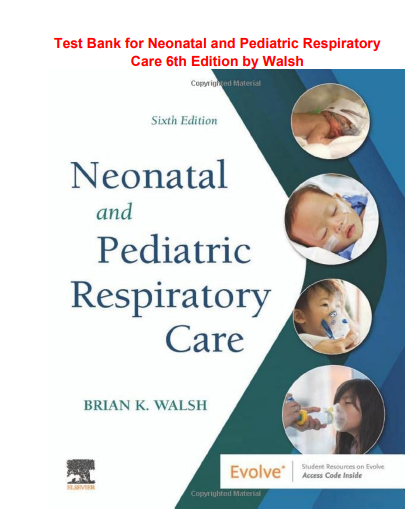
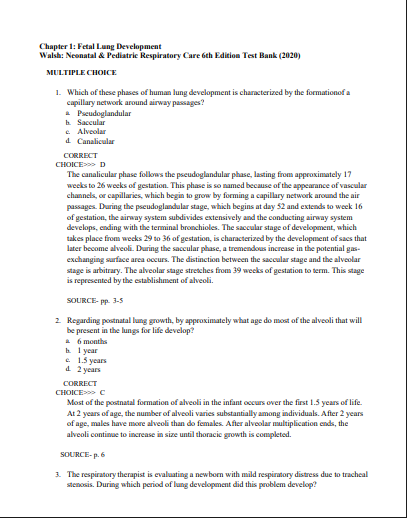
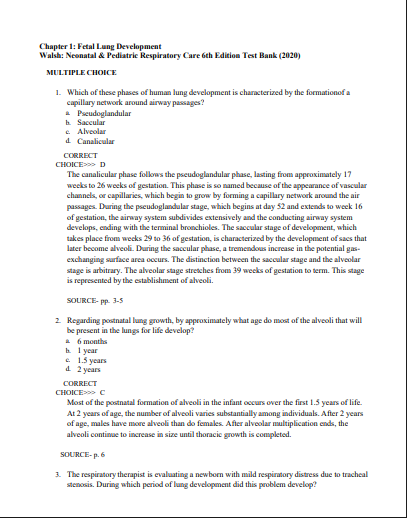
A newborn’s lungs are not just smaller versions of an adult’s. They are still developing, the airways are narrow, and a small change can cause a big problem. Most respiratory therapy training focuses on adults, so neonatal and pediatric content can feel like a different subject. Exams treat it that way too. They ask what a finding means in a baby of a certain age and weight, and what you should do about it.
This test bank was built to give you practice with that kind of thinking. It follows the chapter order of Neonatal and Pediatric Respiratory Care, 6th Edition, by Brian K. Walsh, so each study session matches what your class is covering.
If you are in a respiratory therapy program, preparing for NICU or PICU clinical time, or studying for a neonatal-pediatric specialty exam, this resource gives you steady practice with age-based decisions.
Topics Covered
The question sets follow the textbook and include:
- How the lungs grow before birth and change at birth
- Neonatal resuscitation and delivery room care
- Assessing newborns, including breathing, color, and blood gases
- Respiratory distress syndrome, surfactant, and other newborn lung problems
- Meconium aspiration, transient tachypnea, and persistent pulmonary hypertension
- Bronchopulmonary dysplasia and long-term lung problems in premature infants
- Oxygen therapy, CPAP, and high-flow support for small patients
- Mechanical ventilation, including settings for newborns and children
- Airway care, suctioning, and tube placement
- Croup, epiglottitis, bronchiolitis, asthma, and pneumonia in children
- Birth defects that affect breathing
- Monitoring, including pulse oximetry and blood gases
- Transport, home care, and talking with families
You will find multiple-choice, matching, and short case questions, the formats respiratory therapy courses and specialty exams use most.
Why Practice Questions Help in This Course
Many students know the adult version of a skill and lose points when the question shifts to a baby. Practicing with short cases helps you:
- Match each finding to the age group where it makes sense
- Connect a baby’s signs, such as grunting or retractions, to the likely cause
- Choose safe oxygen and ventilator settings for small lungs
- Tell conditions apart that look alike, such as croup and epiglottitis
- Get used to how specialty exam questions are worded
Students often say the hardest part is remembering that small lungs are easily injured. Short, regular practice by chapter helps you build habits that protect them.
What Makes This Test Bank Different
Every question includes a full rationale. You will see why the best answer fits this patient and why each other option falls short. In neonatal and pediatric care, wrong answers are often right for an adult or an older child, so learning why they fail helps you remember the age differences.
Questions are grouped by chapter and topic. Review one area, such as newborn resuscitation, before a quiz, or work across several chapters before a final. Use it beside your reading, before NICU or PICU clinical days, or as a structured review before an exam.
Sample Questions
Question 1
A premature infant has grunting, flaring, and retractions. Which chest x-ray finding is most typical of respiratory distress syndrome?
A. Ground-glass appearance with air bronchograms and low lung volumes
B. Fluid in the lung fissures with streaks around the heart
C. A steeple sign in the neck
D. Bowel loops seen in the chest
Correct Answer: A
Rationale: Without enough surfactant, the air sacs collapse, which gives the lungs a fine ground-glass look. The larger airways stay open and show up as dark branches, called air bronchograms. Fluid in the fissures and streaks around the heart suggest transient tachypnea of the newborn. A steeple sign is a narrowing of the airway seen in croup. Bowel loops in the chest suggest a diaphragmatic hernia.
Question 2
A 2-year-old has a barky cough, hoarse voice, and stridor when resting. Oxygen saturation is 95 percent on room air. Which treatment is most appropriate?
A. Nebulized racemic epinephrine and a dose of dexamethasone
B. IV antibiotics
C. Albuterol alone
D. A cough suppressant at bedtime
Correct Answer: A
Rationale: Croup is a viral swelling of the airway below the vocal cords. Stridor at rest means the airway is narrowed enough to need treatment. Racemic epinephrine shrinks the swelling quickly, and dexamethasone reduces inflammation for a longer time. Antibiotics do not help a viral illness. Albuterol relaxes lower airway muscles and does not treat swelling in the upper airway. A cough suppressant does not treat the cause and may not help breathing.
Question 3
A term newborn is gasping after drying and stimulation. The heart rate is 80 beats per minute. What is the next step?
A. Continue to dry and stimulate
B. Start positive-pressure ventilation with room air (21 percent oxygen)
C. Start chest compressions
D. Give epinephrine
Correct Answer: B
Rationale: Gasping or a heart rate below 100 after the first steps means the baby needs help breathing. Positive-pressure ventilation is started, and term infants begin with 21 percent oxygen because high oxygen levels can be harmful. Drying and stimulation have already been tried. Chest compressions are added only if the heart rate stays below 60 after 30 seconds of effective ventilation. Epinephrine is used later if the heart rate remains below 60 despite good ventilation and compressions.
Question 4
A 3-month-old with RSV bronchiolitis has a stuffy nose, fast breathing, and is feeding poorly. Oxygen saturation is 94 percent. Which action is most appropriate?
A. Start scheduled albuterol and oral steroids
B. Suction the nose, support feeding and fluids, and watch for worsening
C. Start antibiotics
D. Apply chest percussion every 2 hours
Correct Answer: B
Rationale: Bronchiolitis is a viral infection, and care is mainly supportive. Clearing the nose helps these babies breathe and feed because infants breathe mostly through the nose. Hydration is important, and oxygen is added only if saturation falls too low. Routine bronchodilators and steroids have not been shown to help most infants. Antibiotics do not treat a virus. Chest percussion has not been shown to help and can tire the baby.
Question 5
A baby born at 27 weeks still needs supplemental oxygen at 36 weeks postmenstrual age. What is this condition called?
A. Respiratory distress syndrome
B. Bronchopulmonary dysplasia
C. Transient tachypnea of the newborn
D. Apnea of prematurity
Correct Answer: B
Rationale: Bronchopulmonary dysplasia is a long-term lung problem in premature infants who needed oxygen or ventilator support early in life. It is diagnosed when the baby still needs oxygen at 36 weeks postmenstrual age. Respiratory distress syndrome is the early surfactant problem. Transient tachypnea clears in a day or two. Apnea of prematurity is a breathing control problem with pauses in breathing, not a lasting lung disease.
Frequently Asked Questions
Is this the same as the publisher’s official test bank?
No. This is an independently written study resource meant to help you review the topics in the 6th edition of Neonatal and Pediatric Respiratory Care. It is a self-study companion and is not distributed by the publisher.
Will it help with neonatal-pediatric specialty exams?
The case style is similar to specialty exam questions. It focuses on assessing babies and children, choosing therapies, and knowing how care differs from adults.
Does it cover every chapter?
Yes. The questions follow the chapter order of the 6th edition, from lung development and resuscitation through newborn and childhood lung diseases.
What kinds of questions are included?
Mostly multiple-choice, plus matching and short case questions.
Are there explanations?
Yes. Every question has a full rationale that explains why the best answer is correct and why the other options do not fit.
Who is it for?
Respiratory therapy students, especially those preparing for NICU or PICU clinical work, and anyone reviewing neonatal and pediatric respiratory care.
How should I use it?
Read the chapter first, then try the questions before looking at the answers. Study the rationales for anything you missed. Knowing why an answer fits a certain age helps more than memorizing the letter.
Can it replace the textbook?
No. It works best alongside the textbook. The book teaches the material, and the test bank gives you practice applying it.
Is it matched to the 6th edition?
Yes. It follows the topics and chapter structure of the 6th edition.
Is it useful the night before an exam?
Yes. Because it is organized by chapter and topic, you can quickly review one area, such as newborn resuscitation or croup, without rereading the whole book.


Sipol –
great stuff
Melisa –
Good
Linn –
Nice study material
Maggie –
A must-have nursing study tool
Nakiteso –
Improved my test-taking skills.
Sade5k –
Great for nursing exam preparation.
Felixokema –
Clear, concise, and informative
linadahlia –
Makes studying much easier
Ann Peter –
Made studying much easier
Maggie –
Great tool for test preparation
Annen Wags –
Great addition to my study materials.
Mathivhathen –
Very useful for exam revision.
Mathivhathen –
Very useful for exam revision. thanks
Irene Ann –
Great resource for nursing preparation.
Lampard –
Great resource for nursing revision
Sharon Keen –
Excellent content and useful explanations
Daniel –
Great revision material
Moses –
GOOD
Isabelpool –
Excellent resource for nursing students.
kamilahjackson –
Very helpful and easy to use.
Julie linhvo –
Great nursing study materials