In earlier courses, a pharmacology question asked what a drug does. In a prescribing course, the question changes. It gives you a patient with a kidney problem, a second medicine, and maybe a pregnancy, and asks which drug you would choose and what you would watch for. The drug facts are the same. The job is different, because you are now the one making the decision.
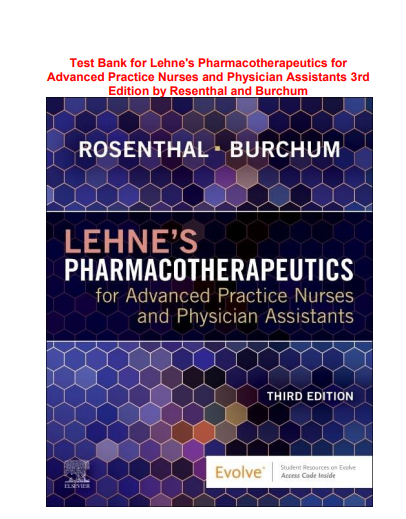
This test bank was built to give you practice with that decision. It follows the chapter order of Lehne’s Pharmacotherapeutics for Advanced Practice Nurses and Physician Assistants, 3rd Edition, by Jacqueline Rosenthal and Laura Burchum, so each study session matches what your class is covering.
If you are in an NP or PA program, preparing for a certification exam, or getting ready for supervised prescribing, this resource gives you steady practice choosing the right drug for the right patient.
Topics Covered
The question sets follow the textbook and include:
- How drugs move through the body, and how kidney and liver problems change dosing
- Drug interactions, including those that raise or lower drug levels
- Prescribing for children, pregnant patients, and older adults
- High blood pressure, heart failure, and cholesterol treatment
- Blood thinners and anti-platelet drugs
- Diabetes and thyroid medicines
- Asthma and COPD treatment
- Antibiotics, antivirals, and antifungals, including choosing the right drug and avoiding resistance
- Pain treatment, including safe opioid prescribing and naloxone
- Depression, anxiety, bipolar disorder, and psychosis medicines
- Seizure, Parkinson, and migraine medicines
- Stomach, bowel, urinary, and women’s health medicines
- Safe prescribing rules, monitoring, and patient teaching
You will find multiple-choice, select-all-that-apply, and short case questions, the formats advanced practice courses and certification exams use.
Why Practice Questions Help in This Course
Prescribing questions rarely have one silly wrong answer. Usually every option is a real drug, and only one fits the patient. Practicing with cases helps you:
- Check the patient’s kidney function, age, pregnancy status, and other medicines before you choose
- Spot dangerous drug combinations before they reach the patient
- Remember which drug is first-line and why
- Know which lab tests or symptoms to follow after you start a drug
- Get used to the case-based style of certification exams
Many students say the biggest change is moving from knowing a drug to choosing it for one person. That skill grows with repeated cases, not with rereading a chapter.
What Makes This Test Bank Different
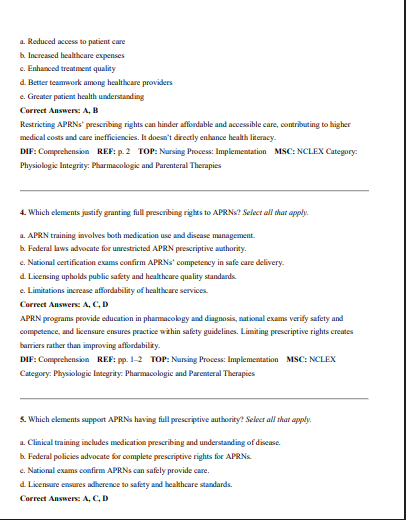
Every question includes a full rationale. You will see why the best answer fits the patient and why each other option is unsafe, less effective, or not first-line. The wrong answers are usually good drugs for a different patient, so learning why they fail here helps you avoid mistakes in real practice.
Questions are grouped by chapter and drug class. Review one area, such as antibiotics, before a quiz, or work across several chapters before a certification exam. Use it beside your reading, before clinical, or as a structured review.
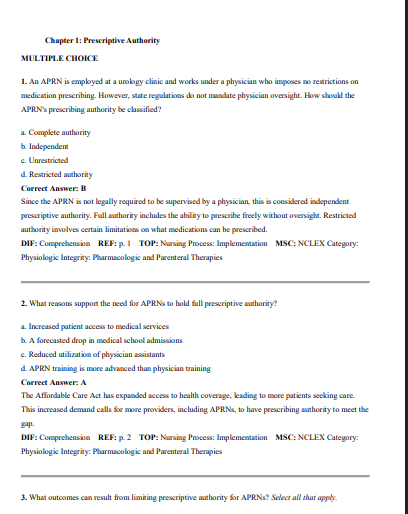
Sample Questions
Question 1
A 58-year-old man takes simvastatin 40 mg daily. He needs treatment for a sinus infection, and clarithromycin is being considered. What is the best prescribing decision?
A. Prescribe clarithromycin and keep the same simvastatin dose
B. Choose a different antibiotic, such as azithromycin, that has less effect on simvastatin levels
C. Double the simvastatin dose to protect against infection
D. Advise grapefruit juice with each dose of simvastatin
Correct Answer: B
Rationale: Clarithromycin strongly blocks CYP3A4, an enzyme that clears simvastatin. Higher simvastatin levels raise the risk of muscle damage, including rhabdomyolysis. The safer plan is to use an antibiotic that has little effect on this enzyme, such as azithromycin, or to hold the statin during a short course if the macrolide is needed. Keeping the same doses is unsafe. Doubling the statin adds more risk. Grapefruit juice also blocks CYP3A4 and would raise simvastatin levels further.
Question 2
A woman at 24 weeks of pregnancy has a blood pressure of 158/102 mm Hg on two visits. Which drug is the best first choice?
A. Lisinopril
B. Labetalol
C. Losartan
D. Spironolactone
Correct Answer: B
Rationale: Labetalol is a preferred drug for high blood pressure in pregnancy, along with nifedipine and methyldopa. ACE inhibitors and ARBs, such as lisinopril and losartan, can harm the fetal kidneys and should be avoided in pregnancy. Spironolactone has anti-androgen effects and is not recommended for use in pregnancy. The goal is to lower blood pressure safely for both the patient and the fetus.
Question 3
A 78-year-old woman has uncomplicated cystitis. Her estimated creatinine clearance is 25 mL/min. Which choice is least appropriate?
A. Cephalexin with the dose adjusted for kidney function
B. Fosfomycin as a single dose
C. Nitrofurantoin
D. Cefpodoxime with a dose adjusted for kidney function
Correct Answer: C
Rationale: Nitrofurantoin relies on the kidneys to reach a high level in the urine. When creatinine clearance falls below about 30 mL/min, it may not work well, and the risk of side effects, such as nerve and lung problems, goes up. Older adult safety lists advise avoiding it in this setting. Cephalexin and cefpodoxime can be used with a lower dose or longer interval. Fosfomycin as a single dose is also an option for uncomplicated cystitis.
Question 4
A 64-year-old patient with chronic back pain takes long-acting morphine equal to 90 morphine milligram equivalents (MME) per day and sometimes takes lorazepam for anxiety. Which step is most important?
A. Increase the opioid dose for better pain control
B. Prescribe naloxone and teach the patient and family how to use it
C. Add a second opioid for breakthrough pain
D. Stop the opioid suddenly
Correct Answer: B
Rationale: The patient is at higher risk of overdose because the dose is above 50 MME per day and a benzodiazepine is also being used, which increases breathing depression. Guidelines advise offering naloxone in this situation and teaching the patient and family to use it. The prescriber should also review whether the benefit still outweighs the risk and consider a safe plan to lower the dose over time. Raising the dose or adding another opioid adds more risk. Stopping suddenly can cause withdrawal and worsen pain.
Question 5
A 25-year-old with asthma uses albuterol about four days a week and wakes at night once a month. She takes no controller drug. What is the best treatment change?
A. Start a daily low-dose inhaled corticosteroid, or an as-needed combination of an inhaled steroid and formoterol
B. Add a long-acting beta agonist inhaler alone
C. Start daily oral prednisone
D. Switch to montelukast alone as the only controller
Correct Answer: A
Rationale: Using a rescue inhaler more than two days a week points to persistent asthma that needs anti-inflammatory treatment. A low-dose inhaled corticosteroid is the basis of treatment, and an as-needed inhaled steroid with formoterol is an accepted option. A long-acting beta agonist alone should not be used in asthma because it raises the risk of serious events. Daily oral steroids cause too many side effects for this level of asthma. Montelukast is less effective than inhaled steroids and carries a warning about mood and behavior changes.
Frequently Asked Questions
Is this the same as the publisher’s official test bank?
No. This is an independently written study resource meant to help you review the topics in the 3rd edition of Lehne’s Pharmacotherapeutics for Advanced Practice Nurses and Physician Assistants. It is a self-study companion and is not distributed by the publisher.
Will it help with NP or PA certification exams?
The case style is similar to certification questions. It focuses on choosing a drug, checking for interactions, and adjusting for kidney function, age, and pregnancy.
Does it cover every chapter?
Yes. The questions follow the chapter order of the 3rd edition, from basic drug principles through each major drug class and special groups.
What kinds of questions are included?
Mostly multiple-choice, plus select-all-that-apply and short case questions.
Are there explanations?
Yes. Every question has a full rationale that explains why the best answer fits the patient and why the other options are less suitable.
Who is it for?
NP and PA students, and anyone reviewing prescribing before a course exam or certification.
How should I use it?
Read the chapter first, then try the questions before looking at the answers. Study the rationales for anything you missed. Knowing why one drug beats another helps more than memorizing the letter.
Can it replace the textbook?
No. It works best alongside the textbook. The book teaches the pharmacology, and the test bank gives you practice applying it to patients.
Is it matched to the 3rd edition?
Yes. It follows the topics and chapter structure of the 3rd edition.
Is it useful the night before an exam?
Yes. Because it is organized by chapter and drug class, you can quickly review one area, such as antibiotics or pain medicines, without rereading the whole book.



Stevo –
Great revision material
Joy –
Nice one
Leen –
Awesome
Sofia –
Thanks for this. Its really helpful study tool
Leken –
Very comprehensive and clear
Valn –
Well organized, easy to read and understand.
anitamartin –
Good document
Ramnush –
Perfect
Mikell –
making learning effectively and easy thanks
Swagrid –
Excellent resource for exam preparation.
SimVault –
Clear explanations and quality questions
Annen –
Helped me pass with confidence
Joel –
Practical questions with clear answers
Joane –
Great investment for exam success
Wright –
Perfect for quick revision sessions
Kevintoonen –
Excellent resource for nursing students.
Dais350 –
Very helpful study material.
Maggy –
Covers important nursing topics well.
Namis –
Great resource for reinforcing knowledge
Annen Harry –
Excellent study tool for exams
Tonny Jakes1 –
Made studying much more manageable
Maggy James –
Useful practice for nursing tests
Wellbek J –
Helped me practice effectively
Tonny Peter6 –
Great resource for nursing students
Eva –
Very helpful for exam preparation
Fiona –
Is very helpful
lebogang Pretty –
Excellent study tool for nursing students.
Sharon@yahoo.com –
Helpful practice for difficult nursing topics.
Liz –
Excellent resource for nursing students.
Mary Evan –
Exactly what I needed to pass.
Pauline Ivan –
Must-have resource for top exam scores!
Sam –
Made studying more focused and efficient.
Zack Evans –
Explanations make difficult topics easier.
Vasdy John –
Useful for reinforcing nursing knowledge
Amarilletam8 –
Excellent resource for exam preparation.
leslie Salinas –
Helped me study more effectively.
Ann Hannah –
Easy to navigate and understand
Eunice –
Helped improve my exam confidence
Brerna Dat –
Easy to use and understand
Martha Harry –
Highly recommended for nursing exams
Sheeki –
Great questions for nursing students
Sifa Zaria –
Makes studying much more effective
Dan Joan –
Perfect document
Nichola Sabraico –
Highly useful for exam preparation
Annen Benta –
Amazing resource for nursing learners
Nichola Sabraico –
Clear, concise, and informative content.