Database courses seem easy at first. A table is just rows and columns. Then the exam asks you to fix a badly designed table, draw a model from a short business story, or write a query that returns exactly the right rows. Knowing a definition is no longer enough. You have to apply it, and one small mistake, such as a missing key or the wrong join, changes the whole answer.
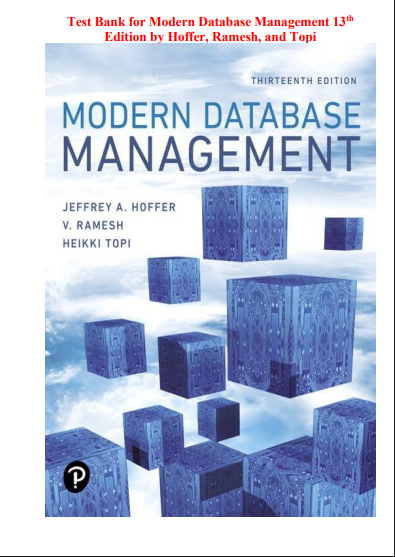
This test bank was built to give you practice with that kind of thinking. It follows the chapter order of Modern Database Management, 13th Edition, by Jeffrey A. Hoffer, V. Ramesh, and Heikki Topi, so each study session lines up with what your class is covering.
If you are in an information systems, computer science, or business analytics course, or getting ready for a database exam, this resource gives you steady practice with design, SQL, and database management.
Topics Covered
The question sets follow the textbook and include:
- Why organizations use databases, and how they differ from file systems
- Data modeling with entity-relationship diagrams
- Enhanced modeling, including subtypes and supertypes
- The relational model, keys, and rules that protect data accuracy
- Turning a data model into tables
- Normalization and the normal forms
- Physical design, indexes, and ways to improve speed
- SQL basics, including SELECT, WHERE, GROUP BY, and joins
- Advanced SQL, including subqueries, views, and procedures
- Transactions, locking, and recovery
- Database applications, including web and cloud use
- Data warehouses and star schemas
- Data quality, data integration, and data governance
- Big data, NoSQL, and analytics
- Database administration, security, and backup
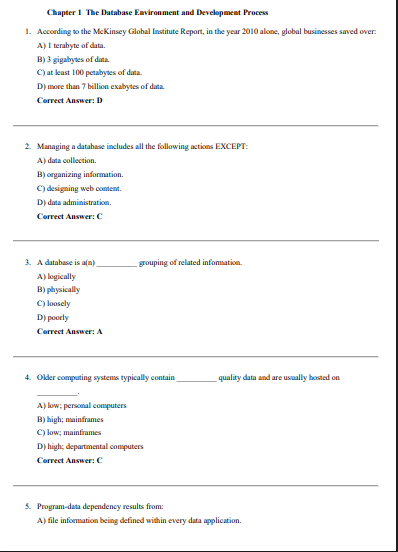
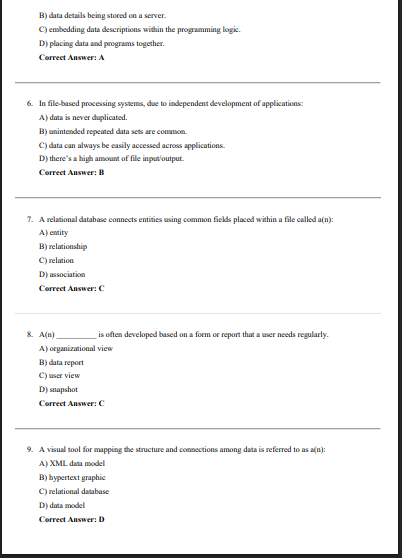
You will find multiple-choice, matching, and short scenario questions, which are the formats database courses use most.
Why Practice Questions Help in This Course
Database exams often hand you a short business story and ask for the right design or query. Practicing with scenarios helps you:
- Read a description and decide which things are entities, which are relationships, and how many of each
- Decide whether a table is properly normalized, and find the problem if it is not
- Choose the right kind of join or clause without guessing
- Understand why a rule exists, such as why keys and constraints protect the data
- Get used to how exam questions are worded
Many students say they can follow the lecture but get stuck when a question changes one detail. Short, regular practice by chapter helps you handle those changes with confidence.
What Makes This Test Bank Different
Every question includes a full rationale. You will see why the best answer is correct and why each other option fails. In database questions, wrong answers are usually valid ideas used in the wrong place, such as the right join for a different task, so understanding why they do not fit teaches you how each tool works.
Questions are grouped by chapter and topic. Review one area, such as normalization, before a quiz, or work across several chapters before a final. Use it beside your reading, before a lab or project, or as a structured review before an exam.
Sample Questions
Question 1
An ORDER table has a CustomerID column that is a foreign key to the CUSTOMER table. A user tries to delete a customer who still has orders. No cascade rule has been set. What will the DBMS most likely do?
A. Delete the customer and leave the orders pointing to nothing
B. Reject the delete to protect referential integrity
C. Delete the customer and quietly delete all related orders
D. Change the CustomerID in each order to zero
Correct Answer: B
Rationale: Referential integrity means every foreign key value must match an existing primary key value, or be null where allowed. If the customer is removed while orders still point to that customer, those orders would refer to a customer who no longer exists. By default, the DBMS blocks the delete. Deleting the orders as well would happen only if a cascade rule were defined. Leaving orphan rows or changing the value to zero would break the integrity rule.
Question 2
A manager wants a list of all customers and the number of orders each has placed, including customers who have never ordered. Which approach is best?
A. INNER JOIN from CUSTOMER to ORDER
B. LEFT OUTER JOIN from CUSTOMER to ORDER, then count the order IDs
C. CROSS JOIN of CUSTOMER and ORDER
D. UNION of CUSTOMER and ORDER
Correct Answer: B
Rationale: A left outer join keeps every row from the left table, here CUSTOMER, and fills in nulls when there is no matching order. Counting the order ID column, not all rows, gives zero for customers with no orders. An inner join would drop customers without orders. A cross join pairs every customer with every order, which gives meaningless results. A union stacks rows from two queries and does not match customers to orders.
Question 3
A table has the composite primary key (StudentID, CourseID) and the columns Grade and StudentName. StudentName depends only on StudentID. Which normal form is violated?
A. First normal form
B. Second normal form
C. Third normal form
D. The table is fully normalized
Correct Answer: B
Rationale: Second normal form requires that every non-key column depend on the whole primary key. StudentName depends on only part of the key, StudentID, so there is a partial dependency. This causes repeated student names and update problems. The fix is to move StudentName into a separate STUDENT table. First normal form is about repeating groups and is already met. Third normal form deals with dependencies between non-key columns, which is not the problem here.
Question 4
In an ER model, a many-to-many relationship between STUDENT and COURSE also needs to store a Grade for each pairing. How should this be modeled?
A. Put Grade in the STUDENT entity
B. Put Grade in the COURSE entity
C. Create an associative entity, such as ENROLLMENT, that holds Grade and links the two entities
D. Remove the relationship
Correct Answer: C
Rationale: A grade belongs to one student in one course, not to the student or the course alone. An associative entity represents the relationship itself, so it can carry its own attributes. In the relational design, it becomes a table with a composite key made of both foreign keys, plus Grade. Putting Grade in STUDENT would allow only one grade per student. Putting it in COURSE would allow only one grade per course. Removing the relationship loses needed information.
Question 5
Two users read the same account balance of $500 at the same time. Each adds $100 and saves. The final balance is $600 instead of $700. Which problem occurred, and which ACID property protects against it?
A. A lost update, prevented by isolation
B. A dirty read, prevented by durability
C. A deadlock, prevented by atomicity
D. A phantom read, prevented by consistency
Correct Answer: A
Rationale: This is a lost update. One transaction overwrote the result of the other because they ran at the same time without protection. Isolation makes concurrent transactions behave as if they ran one after another, usually using locks or similar methods. Durability means committed data survives a crash. Atomicity means a transaction completes fully or not at all. Consistency means a transaction moves the database from one valid state to another. None of these alone prevents this overwrite.
Frequently Asked Questions
Is this the same as the publisher’s official test bank?
No. This is an independently written study resource meant to help you review the topics in the 13th edition of Modern Database Management. It is a self-study companion and is not distributed by the publisher.
Does it include SQL practice?
Yes. The questions cover basic and advanced SQL, including joins, grouping, subqueries, and views.
Does it cover every chapter?
The questions are organized by chapter and topic, following the order of the 13th edition from database basics and data modeling through SQL, design, data warehousing, and administration.
What kinds of questions are included?
Mostly multiple-choice, plus matching and short scenario questions.
Are there explanations?
Yes. Every question has a full rationale that explains why the best answer is correct and why the other options do not fit.
Who is it for?
Students in information systems, computer science, and business analytics courses that use this textbook, and anyone reviewing database concepts before an exam.
How should I use it?
Read the chapter first, then try the questions before checking the answers. Study the rationales for anything you missed. Knowing why a design or query works helps more than memorizing the letter.
Can it replace the textbook?
No. It works best alongside the textbook and your lab practice. The book teaches the concepts, and the test bank gives you practice applying them.
Is it matched to the 13th edition?
Yes. It follows the topics and chapter structure of the 13th edition.
Is it useful the night before an exam?
Yes. Because it is organized by chapter and topic, you can quickly review one area, such as normalization or SQL joins, without rereading the whole book.

Rozzy –
Good study material
Johnson –
Helpful study guide
Patrick –
Good
Annie –
A very good to use as a guide for my own study.
Swag –
making learning effectively
Maxiy –
It helped me understand the course better and saved me a lot of study time
Camila –
Comprehensive and easy to understand
Davy –
Fantastic questions with detailed rationales
Jessy –
Made studying much more effective.
SimVault –
Excellent nursing study support.
Maryenyi5 –
Helpful content for nursing students
Harry k –
Convenient and well-organized resource
Chloebray –
Good variety of practice questions
Suzzy –
Helpful explanations after every question.
Mercy –
Reliable and valuable study resource.
Grace Hannah –
Perfect for last-minute review sessions
Jonhson –
Boosted my overall grade point average
Joseph –
Convenient resource for studying efficiently
lefuij –
Lots of helpful practice questions
Zack Evans –
A valuable study resource.
Eve Eva –
Worthwhile investment for nursing students
joel G –
Great support for nursing exam revision
Eve Eva –
Excellent resource for nursing exam preparation.
Mary John –
Very helpful and easy to understand
Nichola Sabraico –
Very reliable and helpful resource
Mirelah Mukhtari –
Helpful questions with clear answers