

Surgical technology and perioperative nursing programs demand a kind of precision that few other health science courses require. There is no room for “close enough” when it comes to sterile technique, instrument identification, or counting sponges before a body cavity is closed. On top of the technical skill, students also have to understand the reasoning behind every step, because knowing what to do only gets you so far if you do not understand why a break in protocol matters.
This test bank is written to accompany the 17th edition of Alexander’s Care of the Patient in Surgery, a text considered a cornerstone resource in perioperative education because of how thoroughly it walks through the entire surgical experience, from preoperative preparation through postoperative recovery, procedure by procedure. The test bank mirrors that structure, pairing foundational questions on sterile technique and instrumentation with applied, scenario-based items tied to specific surgical procedures and patient safety situations.
What This Test Bank Offers
Rather than disconnected facts, this collection is built around the kind of reasoning perioperative exams and certification-style questions actually test: recognizing a break in sterile technique, identifying the correct instrument or supply for a given step of a procedure, understanding the surgical team’s roles and responsibilities, and applying patient safety principles specific to the operating room. It is designed to help you think through a surgical case from start to finish, not just memorize a list of instrument names.
Question formats include:
- Multiple choice questions with four answer options
- True or false statements that test precise understanding of sterile technique and protocol
- Fill-in-the-blank items for key terms, instruments, and procedural steps
- Matching sets for instruments, supplies, and their surgical uses
- Short scenario-based questions built around a specific surgical procedure or safety situation
Every question is labeled by chapter and topic, so it is easy to focus review on a specific area, such as aseptic technique, general surgery procedures, or anesthesia considerations, without sorting through unrelated material.
Topics Covered
The test bank spans the major content areas found in the textbook, including:
- Foundations of perioperative nursing and surgical technology
- Sterile technique and infection prevention
- Surgical instrumentation, equipment, and supplies
- Preoperative patient preparation and positioning
- Anesthesia and pain management in the surgical setting
- Wound healing and surgical dressings
- General surgery procedures
- Cardiothoracic, vascular, and neurosurgical procedures
- Orthopedic and reconstructive surgical procedures
- Obstetric, gynecologic, and genitourinary procedures
- Ophthalmic, otorhinolaryngologic, and oral-maxillofacial procedures
- Pediatric and trauma surgery considerations
- Patient safety, legal, and ethical issues in the operating room
Because coverage spans the full text, the test bank works well for weekly unit quizzes as well as comprehensive final exam and certification exam review.
Why Use a Test Bank Alongside Your Textbook
Perioperative content has to be automatic by the time you are in a real operating room, because there is rarely time to stop and think through a concept from scratch in the middle of a case. A test bank gives you a way to practice recognizing sterile field breaks, correct instrument use, and procedural sequencing repeatedly, until the reasoning becomes second nature rather than something you have to work out under pressure. Reviewing a detailed rationale after each question also reinforces why a particular action protects the patient, which is the kind of understanding that carries over directly into clinical performance.
For instructors, this test bank offers a practical starting point for building quizzes, homework, or exams that already reflect the procedural depth and patient safety emphasis of the assigned textbook, with full flexibility to edit or reorganize the material for a specific course or program.
Format and Delivery
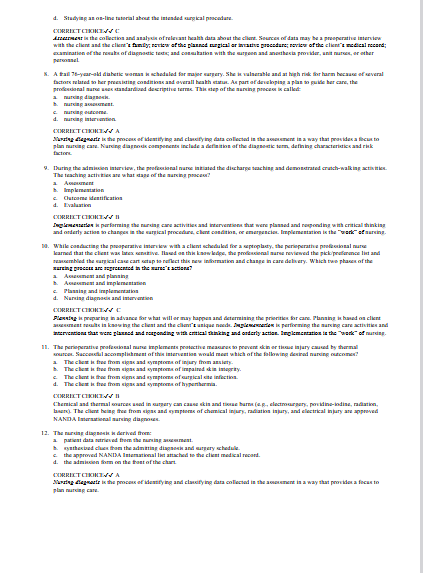
The test bank is delivered as an editable document, making it simple to import into a learning management system, print for in-class or skills-lab testing, or rearrange into custom quizzes. Every question includes a verified correct answer and a written rationale, so it also functions well as an independent study and certification exam-prep tool.
Five Sample Questions
Below are five original sample questions written in the style and difficulty level found throughout the full test bank, along with the correct answer and a rationale explaining why that answer is correct.
Question 1
During a surgical procedure, a scrub person notices that the cuff of their sterile gown has become wet from prolonged contact with a saline-soaked drape. What is the appropriate action?
A. Continue the procedure since the outer glove remains sterile
B. Dry the area with a sterile towel and continue
C. Consider the gown cuff contaminated and change the gown and gloves
D. Cover the wet area with an additional sterile towel and proceed
Correct Answer: C. Consider the gown cuff contaminated and change the gown and gloves
Rationale: Moisture that penetrates a sterile gown allows bacteria to wick through the fabric via capillary action, compromising the sterile barrier even if the surface appears intact. Once strike-through contamination is suspected, the gown and gloves must be changed rather than dried, covered, or ignored, since none of those actions restore sterility to the compromised area.
Question 2
Which member of the surgical team is primarily responsible for maintaining the sterile field and passing instruments to the surgeon during the procedure?
A. Circulating nurse
B. Scrub person
C. Anesthesia provider
D. Surgical first assistant
Correct Answer: B. Scrub person
Rationale: The scrub person works directly within the sterile field, preparing and organizing instruments and supplies, and passing them to the surgeon and assistants throughout the procedure. The circulating nurse remains outside the sterile field to manage documentation, supplies, and communication with the broader team, the anesthesia provider manages the patient’s anesthesia and vital signs, and the surgical first assistant helps directly with the operative task itself but does not hold primary responsibility for managing the sterile field and instrument passing.
Question 3
Before the final closure of a surgical incision, the scrub person and circulating nurse perform a count of instruments, sponges, and sharps. What is the primary purpose of this count?
A. To verify billing information for the procedure
B. To prevent a foreign object from being unintentionally left inside the patient
C. To confirm that all instruments have been sterilized correctly
D. To determine how long the surgical procedure took
Correct Answer: B. To prevent a foreign object from being unintentionally left inside the patient
Rationale: Surgical counts are a critical patient safety measure designed to ensure that every sponge, instrument, and sharp item brought onto the sterile field is accounted for before the incision is closed, preventing a retained foreign object, which can cause serious harm. This process is unrelated to billing, sterilization verification, which occurs before the procedure, or tracking procedure duration.
Question 4
A patient is being positioned in the lithotomy position for a gynecologic procedure. Which nursing consideration is most important to prevent injury during this positioning?
A. Leaving the legs unsupported to allow natural movement
B. Raising and lowering both legs simultaneously and padding pressure points
C. Positioning the legs at different times without coordination
D. Applying tight, non-padded straps directly against the skin
Correct Answer: B. Raising and lowering both legs simultaneously and padding pressure points
Rationale: Raising and lowering the legs simultaneously helps prevent uneven strain on the hips and lower back, while padding bony prominences and pressure points reduces the risk of nerve injury and pressure ulcers during a procedure that may last an extended period. Leaving the legs unsupported or moving them at uncoordinated times increases the risk of musculoskeletal injury, and applying tight, non-padded straps directly to the skin increases the risk of nerve compression and skin breakdown.
Question 5
A patient is diagnosed with malignant hyperthermia during general anesthesia. Which finding would the surgical team expect to see first?
A. Decreased body temperature
B. Sudden increase in end-tidal carbon dioxide and muscle rigidity
C. Slow, regular heart rate
D. Decreased oxygen consumption
Correct Answer: B. Sudden increase in end-tidal carbon dioxide and muscle rigidity
Rationale: Malignant hyperthermia is a life-threatening hypermetabolic reaction to certain anesthetic agents, and one of the earliest and most reliable warning signs is a sudden, unexplained rise in end-tidal carbon dioxide along with muscle rigidity, reflecting a dramatic increase in metabolic activity. This condition causes an increase, not a decrease, in body temperature and oxygen consumption, and it is typically associated with tachycardia rather than a slow heart rate, making early recognition of these initial signs critical for prompt treatment.
Frequently Asked Questions
1. Does this test bank match the exact chapter structure of the 17th edition?
Yes. Questions are organized to follow the chapter order and major topic divisions of the 17th edition of Alexander’s Care of the Patient in Surgery, making it easy to align practice questions with your current unit of study.
2. Is this the official instructor’s test bank distributed with the textbook?
No. This is an independently developed study and teaching resource written to align with the concepts covered in the textbook. It is intended as a supplementary resource, not a reproduction of publisher-issued instructor materials.
3. Is this test bank written for surgical technology students, perioperative nursing students, or both?
Both. Since the textbook is widely used across surgical technology and perioperative nursing programs, the test bank covers the shared foundational content relevant to both fields, including sterile technique, instrumentation, and procedural knowledge.
4. Does the test bank include procedure-specific questions, or only general perioperative principles?
Both. The collection includes foundational questions on sterile technique and patient safety, as well as procedure-specific questions organized by surgical specialty, such as general, orthopedic, and cardiothoracic surgery.
5. Can instructors edit the questions before using them in a course?
Yes. The file is provided in an editable format, allowing instructors to adjust wording, change answer order, or combine questions from different chapters into custom quizzes and exams.
6. Is this suitable for self-study without an instructor?
Yes. Every question includes a verified answer and a written rationale, so students can use the material independently to check their understanding and pinpoint areas that need further review.
7. How difficult are the questions compared to a certification exam?
The questions are written at a level consistent with an undergraduate surgical technology or perioperative nursing course, blending recall-based questions with applied, scenario-based items similar in style to certification exam preparation material.
8. Can this test bank be imported into a learning management system?
Yes. The clear question and answer formatting is designed to transfer easily into common learning management systems for online quizzes, homework assignments, and exam banks.


Mathiv –
Excellent resource with thorough coverage of topics. The explanations were clear and helped reinforce important reporting and identification procedures
Maximevan –
A concise and effective study guide. The questions were relevant, and the clear answers helped me review key concepts quickly and confidently.
Tonnyjakes –
Exactly what I was looking for clean structures
Anne –
Awesome layout