Microbiology can feel abstract when you are learning it as pure science, full of organism names and metabolic pathways that seem disconnected from anything you will actually do in a clinic or lab. That disconnect tends to disappear the moment the same content is framed around real healthcare work, which is exactly what makes this course different from a traditional biology-department microbiology class. Even so, the volume of organisms, transmission routes, and infection control procedures to keep straight can feel overwhelming without a way to check your understanding along the way.
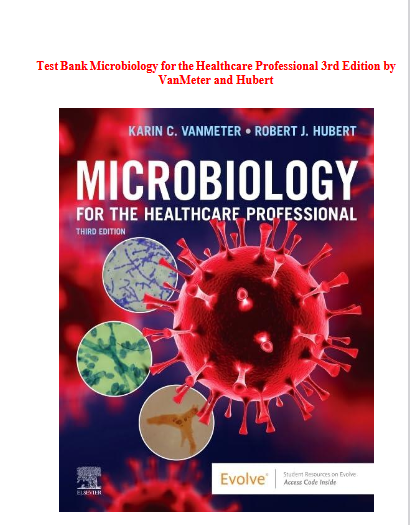
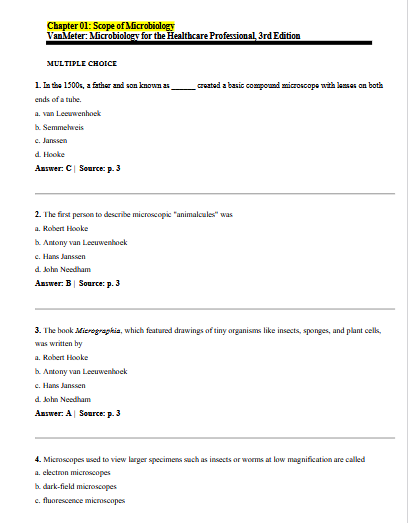
This test bank is written to accompany the 3rd edition of Microbiology for the Healthcare Professional, a textbook designed specifically for students entering clinical and allied health fields, with a strong emphasis on infection control, disease transmission, and the practical skills used in a healthcare or laboratory setting. The test bank follows that same practical orientation, pairing core microbiology concepts with applied questions tied to patient care, specimen handling, and infection prevention.
What This Test Bank Offers
Rather than abstract trivia, this collection is built around the kind of understanding healthcare-focused microbiology courses actually test: identifying how a pathogen is transmitted, recognizing appropriate infection control precautions, understanding how the body’s immune system responds to different organisms, and applying safe laboratory and specimen-handling practices. It is designed to help you connect microbiology directly to the healthcare setting, not just memorize organism names.
Question formats include:
- Multiple choice questions with four answer options
- True or false statements that test precise conceptual understanding
- Fill-in-the-blank items for key terms and classifications
- Matching sets for organisms, diseases, and transmission routes
- Short scenario-based questions involving patient care or laboratory situations
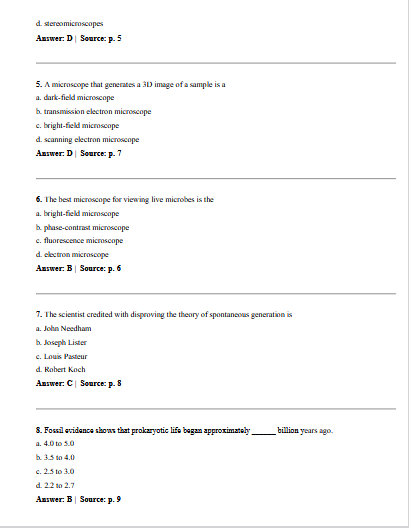
Every question is labeled by chapter and topic, so it is easy to focus review on a specific area, such as bacterial classification, healthcare-associated infections, or standard precautions, without sorting through unrelated material.
Topics Covered
The test bank spans the major content areas found in the textbook, including:
- Introduction to microbiology and the healthcare setting
- Microscopy and laboratory techniques
- Cell structure of bacteria, fungi, protozoa, and viruses
- Microbial growth, control, and sterilization methods
- Infection, disease transmission, and the chain of infection
- Innate and adaptive immunity
- Antimicrobial agents and resistance
- Healthcare-associated infections and infection control practices
- Standard and transmission-based precautions
- Bacterial pathogens organized by body system
- Viral, fungal, and parasitic diseases
- Epidemiology and public health considerations
Because coverage spans the full text, the test bank works well for weekly chapter quizzes as well as comprehensive final exam review.
Why Use a Test Bank Alongside Your Textbook
In a healthcare-focused microbiology course, understanding a concept is not the end goal, applying it safely is. Knowing that a pathogen spreads through airborne transmission only matters if you also know which precautions to use in response. A test bank gives you a low-stakes way to practice that connection repeatedly, moving from the “what” of a topic to the “so what does this mean for patient safety,” which is exactly the kind of reasoning this type of exam tends to reward. Reviewing a written rationale after each question also reinforces why a particular precaution or intervention applies to a specific organism, rather than just the correct answer choice.
For instructors, this test bank offers a ready-made starting point for building quizzes, homework, or exams that already reflect the applied, patient-care-oriented structure of the assigned textbook, with full flexibility to edit or reorganize the material for a specific course.
Format and Delivery
The test bank is provided as an editable document, so questions can be imported into a learning management system, printed for in-class testing, or rearranged into custom quizzes. Every question includes a verified correct answer and a written rationale, allowing the material to also function as a self-study resource.
Five Sample Questions
Below are five original sample questions written in the style and difficulty level found throughout the full test bank, along with the correct answer and a rationale explaining why that answer is correct.
Question 1
A patient is diagnosed with a healthcare-associated infection caused by a pathogen transmitted primarily through airborne droplet nuclei. Which precaution should the healthcare team implement?
A. Standard precautions only
B. Contact precautions
C. Airborne precautions, including a negative pressure room
D. Droplet precautions with a surgical mask only
Correct Answer: C. Airborne precautions, including a negative pressure room
Rationale: Pathogens spread through small airborne droplet nuclei can remain suspended in the air and travel over longer distances, requiring airborne precautions, which include placing the patient in a negative pressure room and having healthcare workers wear a fitted N95 respirator. Standard precautions alone are insufficient for airborne pathogens, contact precautions address organisms spread through direct or indirect touch, and a surgical mask under droplet precautions does not provide the filtration needed for airborne transmission.
Question 2
Which characteristic distinguishes a virus from a bacterium in terms of its ability to reproduce?
A. Viruses can reproduce independently outside of a host cell
B. Viruses require a host cell’s machinery to reproduce
C. Bacteria require a host cell to reproduce, while viruses do not
D. Both viruses and bacteria reproduce only through binary fission
Correct Answer: B. Viruses require a host cell’s machinery to reproduce
Rationale: Viruses lack the cellular machinery, such as ribosomes, needed to reproduce on their own, so they must invade a host cell and hijack its machinery to replicate. Bacteria, in contrast, are independent, single-celled organisms capable of reproducing on their own through binary fission. This fundamental difference explains why antibiotics, which typically target bacterial cell structures, are not effective against viruses.
Question 3
A laboratory technician accidentally sustains a needlestick injury while drawing blood from a patient. What is the priority action following this exposure?
A. Continue working and report the incident at the end of the shift
B. Immediately wash the area and follow the facility’s exposure protocol
C. Apply a bandage and monitor for symptoms without further action
D. Wait to see if the patient develops symptoms before taking action
Correct Answer: B. Immediately wash the area and follow the facility’s exposure protocol
Rationale: A needlestick injury is a potential bloodborne pathogen exposure, and the priority response is to immediately wash the affected area and initiate the facility’s established exposure protocol, which typically includes reporting the incident, testing, and possible post-exposure treatment. Delaying the report, treating it as a minor injury without further action, or waiting for the patient to show symptoms all increase the risk of missing a critical window for effective post-exposure management.
Question 4
Which type of immunity develops after a person receives a vaccine containing a weakened or inactivated form of a pathogen?
A. Naturally acquired passive immunity
B. Artificially acquired active immunity
C. Naturally acquired active immunity
D. Artificially acquired passive immunity
Correct Answer: B. Artificially acquired active immunity
Rationale: A vaccine deliberately introduces a weakened or inactivated antigen into the body, prompting the immune system to actively produce its own antibodies and memory cells. Because this immune response is triggered intentionally through medical intervention rather than by natural infection, and because the person’s own immune system does the work of producing antibodies, this is classified as artificially acquired active immunity.
Question 5
A stool specimen is being collected from a patient with suspected parasitic infection. Which action by the healthcare worker best supports specimen integrity and infection control?
A. Store the specimen at room temperature indefinitely before transport
B. Wear appropriate personal protective equipment and label the specimen immediately
C. Transfer the specimen into an open, uncovered container for easier viewing
D. Delay labeling the specimen until after all other tasks are completed
Correct Answer: B. Wear appropriate personal protective equipment and label the specimen immediately
Rationale: Proper personal protective equipment protects the healthcare worker from exposure to potential pathogens in the specimen, while immediate, accurate labeling prevents mix-ups and ensures the specimen can be properly identified and processed. Storing a specimen improperly, leaving it uncovered, or delaying labeling all increase the risk of specimen degradation, contamination, or misidentification, which can compromise diagnostic accuracy and safety.
Frequently Asked Questions
1. Does this test bank match the exact chapter structure of the 3rd edition?
Yes. Questions are organized to follow the chapter order and major topic divisions of the 3rd edition of Microbiology for the Healthcare Professional, making it easy to align practice questions with your current unit of study.
2. Is this the official instructor’s test bank distributed with the textbook?
No. This is an independently developed study and teaching resource written to align with the concepts covered in the textbook. It is intended as a supplementary resource, not a reproduction of publisher-issued instructor materials.
3. Is this test bank appropriate for allied health students, or only for microbiology majors?
It is written specifically for allied health and healthcare-focused programs, matching the applied, clinically oriented approach of the textbook, which emphasizes infection control and patient safety alongside core microbiology concepts.
4. Does the test bank include infection control and laboratory safety questions, or only organism-based content?
Both. The collection includes substantial coverage of infection control practices, standard and transmission-based precautions, and laboratory safety, in addition to standard organism-based microbiology content.
5. Can instructors edit the questions before using them in a course?
Yes. The file is provided in an editable format, allowing instructors to adjust wording, change answer order, or combine questions from different chapters into custom quizzes and exams.
6. Is this suitable for self-study without an instructor?
Yes. Every question includes a verified answer and a written rationale, so students can use the material independently to check their understanding and pinpoint areas that need further review.
7. How difficult are the questions compared to a college-level exam?
The questions are written at a level consistent with an introductory microbiology course for allied health and healthcare programs, blending straightforward recall items with applied, scenario-based questions tied to clinical and laboratory practice.
8. Can this test bank be imported into a learning management system?
Yes. The clear question and answer formatting is designed to transfer easily into common learning management systems for online quizzes, homework assignments, and exam banks.


Anadiaz –
Excellent resource with thorough coverage of topics. The explanations were clear and helped reinforce important reporting and identification procedures.
Maximeva –
A concise and effective study guide. The questions were relevant, and the clear answers helped me review key concepts quickly and confidently
Ann –
Exactly what I was looking for
Tjakes2 –
Good study material