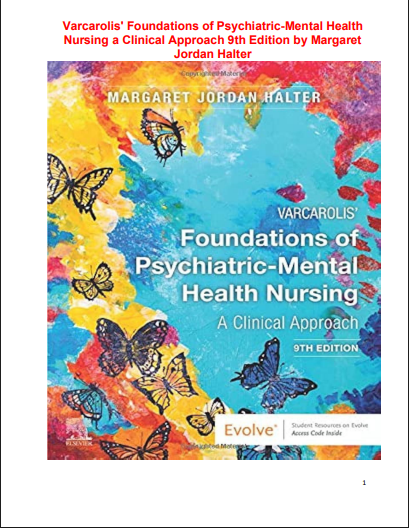
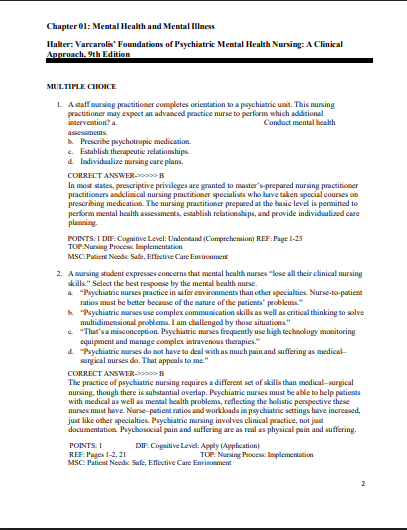
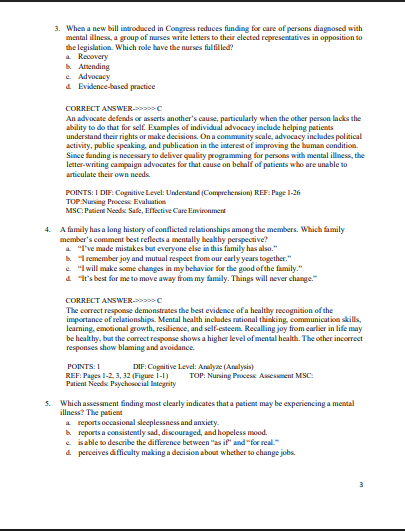
Most nursing subjects give you something concrete to hold onto, a lab value, a vital sign, a wound assessment. Psychiatric nursing doesn’t work that way. Your main tools are conversation, observation, and a relationship you build carefully over time, which is exactly why this subject trips up students who are used to studying for more clinical, measurable content. This test bank was built around that reality. It follows the chapter structure of Varcarolis’ Foundations of Psychiatric-Mental Health Nursing: A Clinical Approach, 9th Edition, by Margaret Jordan Halter, giving you a structured way to practice the communication and judgment-based reasoning this course consistently demands.
Whether you’re in the middle of a psych-mental health rotation, studying for a unit exam, or reviewing psychiatric content before the NCLEX, this resource is built around one goal: helping you pick the best response, not just a reasonable-sounding one.
What’s Covered
Practice sets follow the textbook’s chapter layout, including:
- The therapeutic relationship and core principles of psychiatric-mental health nursing
- Therapeutic versus non-therapeutic communication techniques
- Legal and ethical considerations, including patient rights and involuntary treatment
- Basic neurobiology and psychopharmacology as they relate to psychiatric illness
- Anxiety disorders, OCD, and trauma- and stressor-related conditions
- Mood disorders, including major depressive disorder and bipolar disorder
- Schizophrenia spectrum and other psychotic disorders
- Personality disorders and their impact on the nurse-patient relationship
- Substance use disorders and co-occurring conditions
- Suicide risk assessment, crisis intervention, and de-escalation
- Eating disorders and somatic symptom disorders
- Psychiatric care across the lifespan, including children, adolescents, and older adults
Question formats include multiple-choice, select-all-that-apply, and prioritization-style items, matching how psychiatric nursing courses and licensure-style exams are typically written.
Why This Kind of Practice Actually Helps
The tricky part of psychiatric nursing exams isn’t the vocabulary, it’s telling apart several answer choices that all sound caring or reasonable, when only one is actually therapeutic. Working through scenario-based practice helps you:
- Train your eye to spot the genuinely therapeutic response among several tempting distractors
- Recognize subtle non-therapeutic patterns, like false reassurance or unsolicited advice, before they trip you up on an exam
- Build real confidence with suicide risk and safety-prioritization questions
- Practice applying textbook concepts to messy, realistic patient interactions
- Get used to the exact question style you’ll face on course exams and the NCLEX
Students frequently say this subject is deceptively hard to cram, since it rewards understanding patient dynamics over memorizing a symptom list. Repeated practice with scenarios, not just rereading the chapter, is what actually builds that instinct.
What Makes This Test Bank Different
Every question comes with a full explanation, not a bare answer key. You’ll see exactly why the correct choice is the safest and most therapeutic option, and why each alternative misses, whether it’s unsafe, dismissive, or simply not the priority in that moment. That’s deliberate, since psychiatric nursing exams are notorious for the “almost right” answer being the wrong one.
Everything is organized by chapter, so you can go straight to whatever you’re covering that week instead of digging through unrelated material. Use it alongside your reading, as a pre-clinical warm-up, or as a focused review before a unit exam.
Sample Questions
Question 1
A patient on the unit says, “None of you actually care about me, you’re just doing your job.” What’s the most therapeutic nursing response?
A. “That’s not true, we really do care about you.”
B. “It sounds like you’re feeling like people around you aren’t genuine. Can you tell me more?”
C. “I understand, but I do have a job to do.”
D. “A lot of patients feel that way when they first get here.”
Correct Answer: B
Rationale: Reflecting the feeling behind the statement, and inviting the patient to elaborate, keeps the conversation open without arguing with or dismissing what they’ve said. Option A directly contradicts the patient’s stated feeling, which can come across as invalidating rather than therapeutic. Option C is a defensive, factual statement that sidesteps the emotional content entirely. Option D offers a generic reassurance that minimizes the patient’s individual experience rather than exploring it.
Question 2
A patient reports hearing voices commanding them to harm themselves. What’s the nurse’s priority action?
A. Chart the hallucination and continue with scheduled rounds
B. Ask directly about the content of the voices and assess immediate safety risk
C. Tell the patient the voices they’re hearing aren’t real
D. Note it for discussion at the next treatment team meeting
Correct Answer: B
Rationale: Command hallucinations involving self-harm demand an immediate, direct safety assessment, specifically what the voices are saying and whether the patient feels any urge to comply. That assessment determines what level of monitoring or intervention is needed right now. Charting and moving on delays a safety check that can’t wait. Telling the patient the voices “aren’t real” dismisses their lived experience and doesn’t accomplish anything clinically useful. Waiting for a treatment team meeting ignores the urgency a command hallucination like this actually requires.
Question 3
A patient on lithium develops confusion, slurred speech, and a coarse hand tremor. How should the nurse interpret this?
A. A normal, expected side effect that needs no action
B. A sign of lithium toxicity requiring immediate provider notification
C. A symptom unrelated to the lithium therapy
D. An indication the dose should be increased
Correct Answer: B
Rationale: Confusion, slurred speech, and a coarse tremor together point to lithium toxicity, a serious complication that needs prompt provider notification and typically a lithium level check. This combination goes well beyond the mild tremor sometimes seen at therapeutic doses, so it can’t be brushed off as expected. It’s directly tied to the lithium therapy, not an unrelated finding. And increasing the dose would make toxicity worse, not better, making that option dangerously wrong.
Question 4
Six months into recovery from alcohol use disorder, a patient tells the nurse, “I think I could handle just one drink at a party now.” What’s the best nursing response?
A. “That’s great, one drink is probably fine at this point.”
B. “For a lot of people in recovery, even one drink can trigger a relapse, so complete abstinence tends to be the safest path.”
C. “That’s really your call to make.”
D. “You should check with your sponsor before deciding.”
Correct Answer: B
Rationale: This response gives honest, evidence-based information, complete abstinence is generally the safest approach in recovery, without shaming the patient for bringing it up. Option A inappropriately signs off on a risky plan. Option C sidesteps the clinical guidance this moment actually calls for. Option D shifts the nurse’s own responsibility to educate the patient onto someone else entirely, rather than addressing the concern directly.
Question 5
A medically stable but significantly underweight patient with anorexia nervosa is admitted to the unit. Which nursing approach is most appropriate?
A. Center conversations mainly on the patient’s weight and caloric intake
B. Help the patient explore feelings and issues beyond food and weight
C. Let the patient fully control meal planning with no structure
D. Avoid bringing up eating patterns at all to prevent upsetting the patient
Correct Answer: B
Rationale: Eating disorders are often tied to deeper issues like control, anxiety, or self-worth, so effective care means helping the patient work through those underlying issues rather than fixating on numbers. Focusing mainly on weight and calories, as in option A, tends to increase anxiety and reinforce the disorder’s own numeric fixation. Giving a patient with an eating disorder complete, unstructured control over meals, as in option C, is inappropriate and can worsen disordered eating patterns. Avoiding the topic entirely, as in option D, isn’t therapeutic and prevents the nurse from addressing something directly connected to the patient’s diagnosis and safety.
Frequently Asked Questions
Is this the official test bank from the publisher?
No, this is an independently written study resource built to help you review the material in the 9th edition of Varcarolis’ Foundations of Psychiatric-Mental Health Nursing. It’s meant for self-study and isn’t distributed by the publisher.
Does this line up with NCLEX-style questions?
The scenario-based format mirrors licensure exam questions, leaning into therapeutic communication, safety prioritization, and clinical judgment, all heavily tested areas in psychiatric-mental health nursing.
Is the entire textbook covered?
Yes, questions follow the 9th edition’s chapter sequence, from foundational communication and legal concepts through specific psychiatric disorders and specialized populations.
What kinds of questions are in it?
Mostly multiple-choice, with some select-all-that-apply and prioritization-style items, matching the formats typically used in psychiatric nursing courses and licensure exams.
Do the answers come with explanations?
Yes, every question includes a full rationale explaining why the correct answer is safest and most therapeutic, and why the other options fall short.
Who’s this built for?
Nursing students in a psychiatric-mental health course, plus anyone reviewing psychiatric content ahead of the NCLEX or a certification exam.
What’s a good way to actually use this?
Read the chapter first, then work through the matching questions before checking answers. Spend real time on the rationales afterward, especially for anything missed, since understanding why an answer works sticks with you longer than memorizing the letter.
Can this replace the textbook?
No, it’s meant to sit alongside it. The textbook builds your understanding of psychiatric concepts, neurobiology, and communication technique; the test bank gives you a place to practice applying that knowledge.
Is it matched to the 9th edition specifically?
Yes, it follows the topics, terminology, and chapter organization of the 9th edition.
Good for last-minute review?
Yes, many students use it as a focused pass in the days before an exam, since the chapter-based setup makes it easy to zero in on a specific topic, like suicide risk assessment or psychopharmacology, quickly.


Regg –
Excellent service. thank you
tify –
very good document
Ken –
Complete and clear
Eva. –
Nice study document
edwin350d –
Very nice to get this.
Joani –
Nice and useful study material
Magy –
Helpful
Winnie –
I’m very happy with my recent purchase. The product arrived on time, matched the description perfectly, and the quality exceeded my expectations. Everything worked as expected, and I would definitely recommend it to others looking for a reliable option.
Brendah –
Clear, accurate, and extremely helpful for exam preparation
Carrick Tony –
Great resource for nursing students.
Alexander Belinda –
Helpful questions and clear explanations.