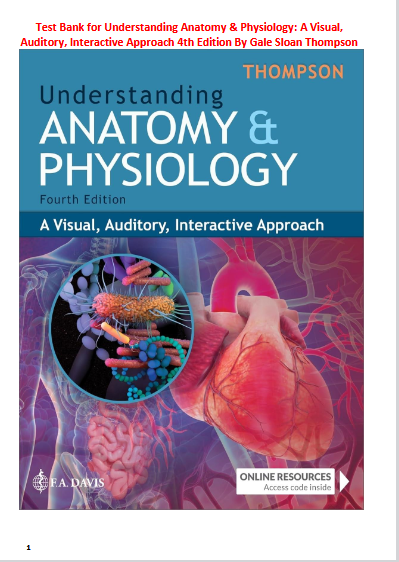
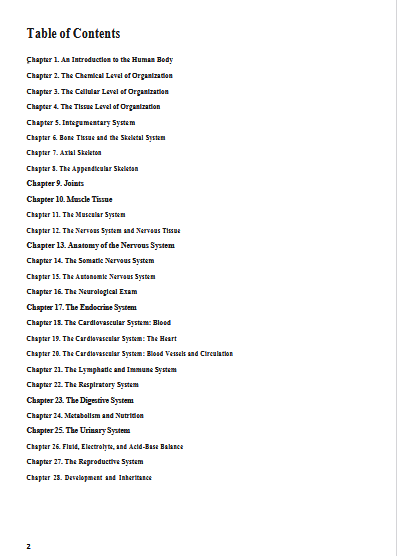
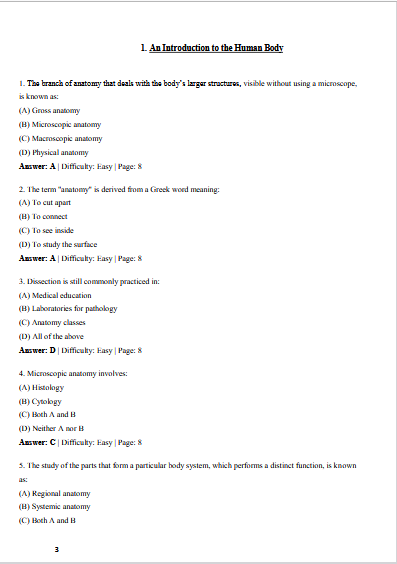
Anatomy and physiology can feel like drinking from a fire hose the first time you take it, hundreds of new terms, structures, and processes, all coming at once. Understanding Anatomy & Physiology was written to make that manageable by leaning on visual and interactive learning instead of dense, text-heavy explanations, and this test bank was built to match that same approachable style. It follows the chapter structure of the 4th edition, by Gale Sloan Thompson, so your practice tracks the same body-system organization the textbook uses, moving from foundational concepts through each major system.
Whether you’re in a nursing, allied health, or other health sciences program taking A&P for the first time, this resource is designed to help you build real understanding of how the body works, not just memorize a list of structures you’ll forget by finals.
What’s Covered
Practice sets follow the textbook’s organization, including:
- Basic chemistry, cells, and tissues as the building blocks of the body
- The integumentary system and how skin protects and regulates the body
- The skeletal system, bone structure, and joints
- The muscular system and how muscles produce movement
- The nervous system, including the brain, spinal cord, and nerve function
- The endocrine system and major hormone-producing glands
- The cardiovascular system, including the heart, blood vessels, and blood
- The lymphatic and immune systems
- The respiratory system and gas exchange
- The digestive system and nutrient processing
- The urinary system and fluid balance
- The reproductive system
Each chapter’s questions mix multiple-choice items with matching and application-based questions that connect structure to function, matching the format this textbook and its accompanying courses typically use.
Why Practice Questions Help Here
A&P exams tend to test whether you understand what a structure actually does, not just whether you can name it correctly on a diagram. A question might describe a symptom and ask which structure or system is most likely involved, or ask what happens if a specific process is disrupted. Practicing with well-written questions helps you:
- Connect a structure’s name to its actual function in the body, not just its label
- Build confidence linking normal anatomy and physiology to what happens when something goes wrong
- Get comfortable with questions that describe a scenario and ask you to identify the structure or process behind it
- Strengthen your recall of body systems before this material becomes background knowledge for later, more advanced courses
- Reduce exam anxiety by practicing the same connect-the-dots reasoning these exams consistently use
Many students say A&P is harder than it looks because there’s just so much new vocabulary that it’s easy to memorize terms without really understanding what they mean. Regular, chapter-based practice is a much better way to build real understanding than trying to cram surface-level definitions the night before an exam.
What Makes This Different
This test bank is built around full explanations, not shortcut answer keys. Every question includes a complete rationale that explains why the correct answer accurately reflects anatomy and physiology, and why each incorrect option describes a different structure, a different system, or a mismatched function. This mirrors how exams for this course are typically written, since wrong answers are often real structures or real processes, just not the one that fits the specific question.
Questions are grouped by chapter and body system, so you can focus your review exactly where you need it, whether that’s a single system like the nervous system before a quiz, or a full review before a comprehensive final. It works well as a companion to assigned readings, a self-check before lab practicals, or a structured review before exam day.
Sample Questions
Question 1
Which structure carries electrical impulses away from a neuron’s cell body toward other neurons or muscles?
A. Dendrite
B. Axon
C. Cell body
D. Myelin sheath
Correct Answer: B
Rationale: The axon is the long, slender projection of a neuron responsible for carrying electrical impulses away from the cell body toward the next neuron, muscle, or gland, making it the structure that transmits the signal outward. Dendrites do the opposite job, receiving signals and carrying them toward the cell body rather than away from it. The cell body houses the nucleus and organelles that support the neuron overall, but it doesn’t carry the impulse to its destination. The myelin sheath is a fatty insulating layer around the axon that speeds up conduction, but it isn’t the structure actually carrying the impulse.
Question 2
A patient has a blockage in a coronary artery, reducing blood flow to part of the heart muscle. What is this condition called?
A. Atherosclerosis of the aorta
B. Myocardial ischemia
C. Pulmonary embolism
D. Varicose veins
Correct Answer: B
Rationale: Myocardial ischemia specifically refers to reduced blood flow to the heart muscle itself, most often from a blockage in a coronary artery, which can cause chest pain and, if it continues, actual tissue damage. Atherosclerosis of the aorta describes plaque buildup in the aorta specifically, not the coronary arteries feeding the heart muscle. A pulmonary embolism involves a blockage in a pulmonary artery affecting the lungs, unrelated to the heart muscle itself. Varicose veins refer to enlarged, twisted veins typically found in the legs, a completely different venous condition with no connection to coronary blood flow.
Question 3
Which endocrine gland releases hormones that regulate the body’s overall metabolic rate?
A. Adrenal gland
B. Thyroid gland
C. Pancreas
D. Pituitary gland
Correct Answer: B
Rationale: The thyroid gland releases hormones, mainly thyroxine and triiodothyronine, that regulate the body’s overall metabolic rate, controlling how quickly cells use energy. The adrenal gland releases hormones like cortisol and epinephrine, which are more tied to stress response and blood pressure than baseline metabolic rate. The pancreas releases insulin and glucagon, which regulate blood glucose rather than overall metabolism. The pituitary gland does release hormones that stimulate other glands, including the thyroid, but it doesn’t directly control metabolic rate the way thyroid hormones themselves do.
Question 4
A patient’s chest X-ray shows fluid accumulation in the alveoli, making gas exchange difficult. Which structure is most directly affected?
A. Bronchi
B. Trachea
C. Alveoli
D. Larynx
Correct Answer: C
Rationale: The alveoli are the tiny air sacs where oxygen and carbon dioxide actually get exchanged between air and the bloodstream, so fluid building up there directly interferes with that gas exchange process. The bronchi are larger airways that carry air toward the lungs but aren’t where gas exchange happens. The trachea is the main airway leading down toward the bronchi, also not involved in gas exchange. The larynx is the voice box, sitting above the trachea, and plays no role in gas exchange at all.
Question 5
Which structure in the digestive system absorbs most nutrients from digested food into the bloodstream?
A. Stomach
B. Large intestine
C. Small intestine
D. Esophagus
Correct Answer: C
Rationale: The small intestine, with its huge surface area created by villi and microvilli, is where most nutrient absorption into the bloodstream happens after food has been broken down. The stomach mainly handles mechanical and chemical digestion, not the bulk of nutrient absorption. The large intestine mostly absorbs water and electrolytes and forms stool, rather than absorbing most nutrients. The esophagus just moves food from the mouth to the stomach and plays no role in digestion or absorption at all.
Frequently Asked Questions
Is this the publisher’s official test bank?
No, this is an independently written study resource built to help you review the material in the 4th edition of Understanding Anatomy & Physiology. It’s meant for self-study and isn’t distributed by the publisher.
Is this test bank helpful for nursing or allied health program prerequisites?
Yes, the questions reinforce foundational anatomy and physiology concepts that carry into nearly every later nursing and allied health course, so building a solid base here pays off well beyond this class.
Does it cover the whole textbook?
Yes, questions are organized by chapter and body system, following the 4th edition’s structure from basic cell biology through each major organ system.
What question formats are included?
Mostly multiple-choice, with some matching and application-based items connecting structure to function, matching the format commonly used in courses built around this textbook.
Are there explanations, or just answer letters?
Every question includes a full rationale explaining why the correct answer accurately reflects anatomy and physiology, and why the other options describe a different structure or process.
Who’s this best suited for?
Students taking an intro-level anatomy and physiology course, particularly those in nursing, allied health, or other health sciences programs using this specific textbook.
What’s the best way to use it?
Read the assigned chapter first, then work through the matching questions before checking answers. Review the rationales closely afterward, especially for anything missed, since understanding why a structure functions a certain way matters more than memorizing a name alone.
Can this replace reading the textbook?
No, it’s meant to work alongside it. The textbook builds your foundational understanding of body structures and their functions; the test bank gives you a way to practice applying and connecting that knowledge.
Is the content aligned specifically with the 4th edition?
Yes, it follows the topics, terminology, and chapter organization of the 4th edition.
Is this useful for last-minute exam review?
Yes, since it’s organized by chapter and body system, it’s easy to target a specific system, like the cardiovascular or nervous system, quickly rather than reviewing the entire book at once.

Mikel –
Good study materials supported my learning effectively
Mathivi –
High-quality resources
Chloebray –
Helpful resource for exam review
Tonny Jack –
Improved my confidence before exams.