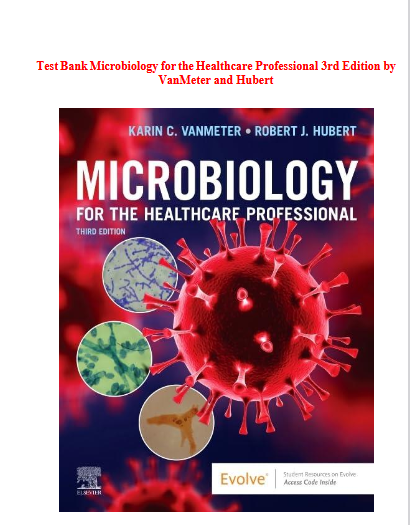
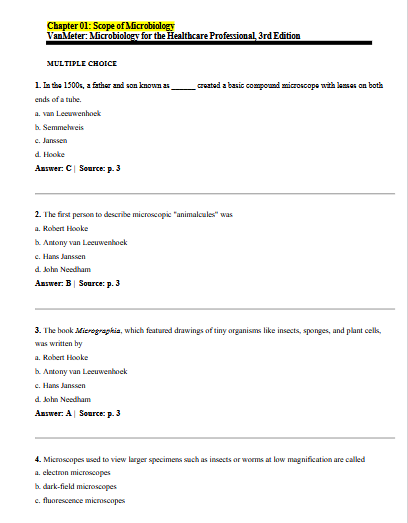
Germs are small, but the decisions they force on healthcare workers are not. Which mask do you wear? Can this instrument be reused? Should this patient be isolated? A microbiology course for health students is built around choices like these, and exams ask them as short patient stories, not as lists of facts.
This test bank was written to help you practice those choices. It follows the chapter order of Microbiology for the Healthcare Professional, 3rd Edition, by Karin C. VanMeter and Robert J. Hubert, so each study session matches what your class is covering.
If you are in nursing, medical assisting, respiratory therapy, surgical technology, or another allied health program, this resource gives you steady practice linking the science of microbes to everyday infection control.
Topics Covered
The question sets follow the textbook and include:
- The history of microbiology and the germ theory of disease
- Using the microscope, staining methods, and growing microbes in the lab
- The structure and growth of bacteria, viruses, fungi, and parasites
- Microbial genetics and how drug resistance spreads
- Physical and chemical ways to control microbes
- Antibiotics and other antimicrobial drugs, and how resistance develops
- Normal flora, how infection starts, and stages of disease
- The chain of infection and ways to break it
- Standard and transmission-based precautions
- Healthcare-associated infections and bloodborne pathogens
- Innate and adaptive immunity, vaccines, and immune disorders
- Infections of the skin, respiratory tract, gut, blood, and urinary and reproductive systems
- Epidemiology, outbreaks, and public health reporting
You will find multiple-choice, matching, and short case questions, the formats microbiology courses for health programs use most.
Why Practice Questions Help in This Course
Microbiology is full of look-alike terms and look-alike organisms. Disinfection and sterilization, droplet and airborne, colonization and infection: each pair is easy to mix up when you are tired. Practicing with questions helps you:
- Keep similar terms apart by using them in context
- Match an organism or disease to the right precaution
- Understand why a control method works, not just which one to pick
- Find the weak link in a chain of infection
- Get comfortable with how exam questions are worded
Students often say the course feels like memorizing a phone book at first. Short, regular practice by chapter turns that list into patterns you can use on the job.
What Makes This Test Bank Different
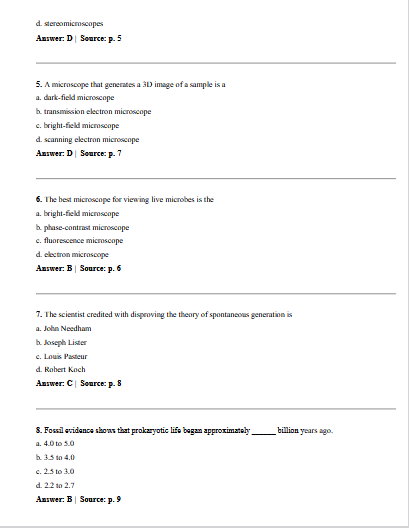
Every question includes a full rationale. You will see why the best answer is correct and why each other option falls short. In microbiology, wrong answers are usually true statements about a different organism or situation, so learning why they do not fit is a large part of learning the subject.
Questions are grouped by chapter and topic. Review one area, such as precautions, before a quiz, or work across several chapters before a final. Use it beside your reading, before clinical days, or as a review before a certification exam.
Sample Questions
Question 1
A patient with a severe Gram-negative bloodstream infection suddenly develops fever, low blood pressure, and a fast heart rate after antibiotics begin killing the bacteria. Which bacterial component is most responsible for this reaction?
A. Capsule
B. Endotoxin, the lipid A part of the outer membrane lipopolysaccharide
C. Flagella
D. Ribosomes
Correct Answer: B
Rationale: Gram-negative bacteria have an outer membrane containing lipopolysaccharide, and its lipid A portion is called endotoxin. When the cells die and break apart, endotoxin is released and strongly triggers the immune system, which can cause fever, a drop in blood pressure, and septic shock. A capsule helps bacteria avoid being eaten by immune cells but does not trigger this reaction. Flagella are for movement. Ribosomes make proteins and are the target of some antibiotics, but they are not the cause of this response.
Question 2
A nurse is about to suction a patient who is coughing heavily and may splatter secretions. Which protective equipment is most appropriate under standard precautions?
A. Gloves only
B. Gloves, a mask, and eye protection, with a gown if clothing may be soiled
C. A mask only
D. No protection, since the patient is not on isolation
Correct Answer: B
Rationale: Standard precautions apply to all patients. When a task may cause splashes or sprays of body fluids, the worker should protect the hands, the mouth and nose, and the eyes, and add a gown if clothing may be soiled. Gloves alone leave the face exposed. A mask alone leaves the eyes and hands exposed. Waiting for an isolation order is unsafe because many infected patients are not yet identified.
Question 3
A child is admitted with a fever, a rash, cough, and red eyes, and measles is suspected. Which isolation precaution should be used?
A. Contact precautions with a gown and gloves only
B. Droplet precautions with a surgical mask
C. Airborne precautions, with the patient in a negative-pressure room and staff wearing a fitted N95 respirator
D. Standard precautions only
Correct Answer: C
Rationale: The measles virus spreads through tiny particles that stay in the air for hours and travel beyond the patient’s room. Airborne precautions, including a negative-pressure room and an N95 respirator, are needed. Only staff with immunity should care for the patient when possible. Contact precautions address spread by touch. Droplet precautions address larger particles that travel short distances. Standard precautions alone are not enough for an airborne disease.
Question 4
A flexible endoscope that touches mucous membranes but does not enter sterile tissue must be reprocessed between patients. According to the Spaulding classification, what level of processing is needed?
A. Cleaning only
B. Low-level disinfection
C. High-level disinfection at a minimum
D. No processing if it looks clean
Correct Answer: C
Rationale: The Spaulding classification matches the level of processing to the risk. Items that contact intact skin are noncritical and need cleaning or low-level disinfection. Items that touch mucous membranes or non-intact skin are semicritical and need at least high-level disinfection. Items that enter sterile tissue or the bloodstream are critical and need sterilization. An endoscope that touches mucous membranes falls into the middle group. Looking clean says nothing about the microbes that remain.
Question 5
A newborn is protected against several infections for the first few months of life because of antibodies passed from the mother before birth. Which type of immunity is this?
A. Naturally acquired active immunity
B. Artificially acquired active immunity
C. Naturally acquired passive immunity
D. Artificially acquired passive immunity
Correct Answer: C
Rationale: IgG antibodies cross the placenta, and IgA passes in breast milk, giving the baby protection without the baby making its own antibodies. That is passive immunity, and because it happens naturally, it is naturally acquired passive immunity. It fades within months as the antibodies are used up. Active immunity involves the person’s own immune system making antibodies, either after infection (natural) or after vaccination (artificial). Artificial passive immunity is giving antibody products, such as immune globulin.
Frequently Asked Questions
Is this the same as the publisher’s official test bank?
No. This is an independently written study resource meant to help you review the topics in the 3rd edition of Microbiology for the Healthcare Professional. It is a self-study companion and is not distributed by the publisher.
Will it help in my clinical courses?
Yes. The questions focus on infection control choices, such as precautions, cleaning methods, and how germs spread, which you will use in clinical work.
Does it cover every chapter?
Yes. The questions follow the chapter order of the 3rd edition, from basic microbiology and lab methods through disease by body system and public health.
What kinds of questions are included?
Mostly multiple-choice, plus matching and short case questions.
Are there explanations?
Yes. Every question has a full rationale that explains why the best answer is correct and why the other options do not fit.
Who is it for?
Students in nursing and allied health programs that use this textbook, and anyone reviewing microbiology before an exam.
How should I use it?
Read the chapter first, then answer the questions before checking the answers. Study the rationales for anything you missed, since knowing why an answer is correct helps more than memorizing the letter.
Can it replace the textbook?
No. It works best alongside the textbook. The book teaches the material, and the test bank lets you practice applying it.
Is it matched to the 3rd edition?
Yes. It follows the topics and chapter structure of the 3rd edition.
Is it useful the night before an exam?
Yes. Because it is organized by chapter, you can quickly review one area, such as isolation precautions or immunity, without rereading the whole book.


Anadiaz –
Excellent resource with thorough coverage of topics. The explanations were clear and helped reinforce important reporting and identification procedures.
Maximeva –
A concise and effective study guide. The questions were relevant, and the clear answers helped me review key concepts quickly and confidently
Ann –
Exactly what I was looking for
Tjakes2 –
Good study material
Joe Terry –
Definitely useful for exam preparation
Ivvana –
Great resource for exam preparation
Zack Evans –
Helpful resource for studying efficiently.
Wangy –
Clear and well-organized practice questions.
Terry Ann –
Great resource for nursing exam preparation.
Maximevanmol –
Excellent study tool for nursing students.
Dominic –
Excellent tool for nursing students
Harrison –
Simple, clear, and very effective
Jane Kolesovay –
Great questions with detailed explanations
lammy –
Perfect tool for nursing students
Sabrinaaraya –
Boosted my confidence before exams
Vvero –
Excellent resource for nursing students
Harry Ginny –
Very helpful for exam preparation
Haley Jones –
Great variety of nursing questions.
lauren Robertson –
Useful resource for exam success.