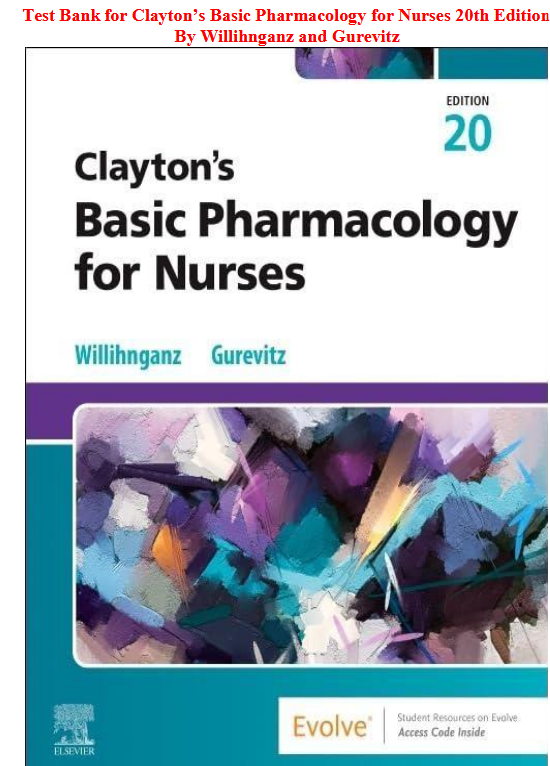
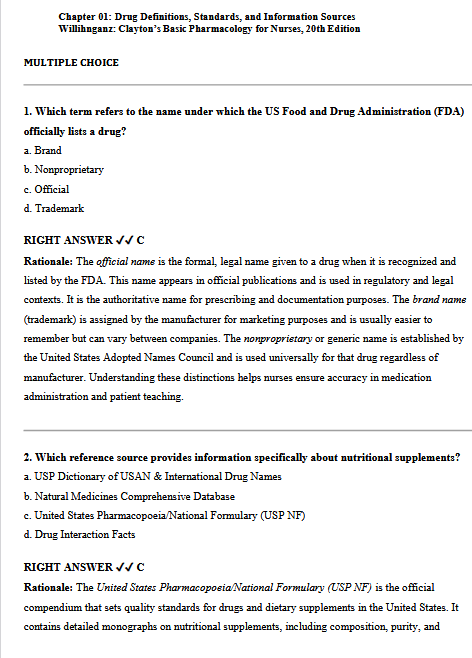
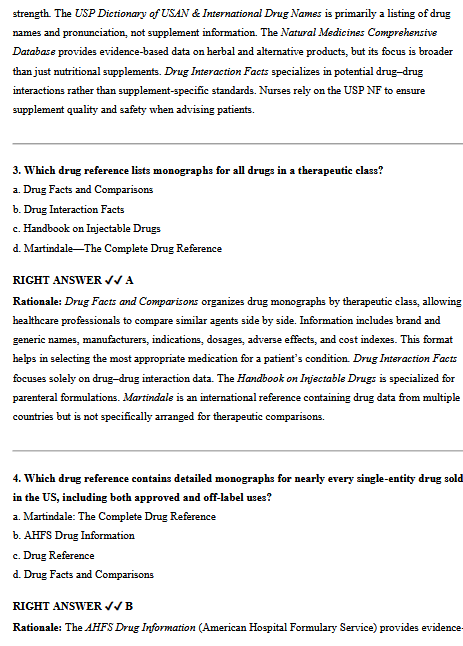
Nursing students rarely dread a course the way they dread pharmacology, and it’s not hard to see why. Hundreds of medications, dozens of drug classes, and an exam style that expects you to apply all of it to a specific patient in the span of a single question. This test bank exists to take some of the pressure off that process. It’s organized around the chapter sequence of Clayton’s Basic Pharmacology for Nurses, 20th Edition, by Michelle Willihnganz and Amy M. Karch, so your review lines up exactly with what you’re covering in class, week by week.
Whether this is your very first pharmacology class, you’re gearing up for a unit test, or you’re doing a final push before the NCLEX-RN, this resource is built around the clinical judgment pharmacology actually rewards, not just recognizing drug names on a flashcard.
What You’ll Find Inside
Practice questions are organized to mirror the textbook’s chapter layout, covering:
- The basics of how drugs move through and act on the body
- Applying the nursing process to safe medication administration
- Dosage calculations and administration across different routes
- Cardiovascular and renal drugs, including antihypertensives and diuretics
- Respiratory medications like bronchodilators and inhaled steroids
- Anti-infectives: antibiotics, antivirals, antifungals
- Both opioid and non-opioid pain management options
- Endocrine drugs, particularly insulin and thyroid medications
- Psychotropic drug classes and their monitoring requirements
- GI and musculoskeletal medications
- Patient teaching, drug interactions, and catching adverse reactions early
You’ll see a blend of multiple-choice, select-all-that-apply, and calculation-based questions throughout, matching the format most pharmacology instructors actually use on exams.
Why Bother With Practice Questions
Pharmacology exams almost never stop at “name the drug class.” They want to know what you’d actually do: what to check before giving a med, what to teach before a patient goes home, what finding means you should hold the next dose. Working through scenarios like this regularly helps you:
- Connect each drug class to its actual mechanism, instead of memorizing names as disconnected trivia
- Spot early toxicity signs before they turn into something dangerous
- Move faster through “what should the nurse do first” style questions
- Get genuinely comfortable with patient-teaching and safety-focused scenarios
- Show up to test day already familiar with the exact question format you’ll see
The consensus among most students isn’t that any single pharmacology topic is especially hard, it’s that there’s just so much of it. Chapter-by-chapter review, done consistently over time, tends to stick a lot better than trying to absorb the whole book the week before finals.
What Sets This Test Bank Apart
Every question comes with a real explanation attached, not just a letter you have to trust. You’ll see exactly why the correct answer is the safest, most appropriate choice, and why each other option is either unsafe, off-base, or just not the priority in that specific moment. That matters because pharmacology exams are built around answer choices that all sound plausible, not obviously wrong distractors.
Everything is sorted by chapter and drug class, so you can jump straight to what you need, whether that’s cramming one class before tomorrow’s quiz or working through the whole set before a comprehensive final. Use it while doing your assigned reading, right before administering meds in clinical, or as your final structured review before an exam.
Sample Questions
Question 1
A patient just received their first dose of an ACE inhibitor for hypertension. Which finding needs the nurse to call the provider immediately?
A. A mild headache
B. Swelling of the lips and tongue
C. A blood pressure of 118/76 mmHg
D. A dry cough that started a few days ago
Correct Answer: B
Rationale: Lip and tongue swelling points to angioedema, a rare but airway-threatening reaction tied to ACE inhibitors, and it needs immediate attention. A mild headache is a common, low-stakes side effect seen with a lot of antihypertensives. A reading of 118/76 mmHg is actually a good sign, the medication doing its job, not a red flag. A dry, lingering cough is a known ACE inhibitor side effect worth mentioning to the provider, but it doesn’t carry the same urgency as swelling near the airway.
Question 2
A patient on phenytoin for seizures is having drug levels checked. Which finding suggests toxicity rather than a normal response to treatment?
A. A phenytoin level sitting within the therapeutic range
B. Nystagmus, ataxia, and slurred speech
C. A modest decrease in seizure frequency
D. Some drowsiness on the first day
Correct Answer: B
Rationale: Nystagmus, ataxia, and slurred speech are the textbook signs of phenytoin toxicity, and they typically appear once serum levels climb past the therapeutic range, meaning the nurse should hold the next dose and get the provider involved. A therapeutic level is exactly what treatment is aiming for, not a warning sign. Fewer seizures means the drug is working as intended. First-day drowsiness is a normal adjustment period, not evidence of toxicity on its own.
Question 3
What’s the single most important teaching point for a patient starting an MAOI for depression?
A. “Any cheese or cured meat is totally fine to eat.”
B. “Steer clear of tyramine-heavy foods, like aged cheeses and cured meats.”
C. “You should feel the effects within a day or so.”
D. “No need to mention this to your other providers.”
Correct Answer: B
Rationale: MAOIs interact dangerously with tyramine, found in aged cheeses, cured meats, and various fermented foods, and that combination can set off a hypertensive crisis. This dietary teaching has to happen before therapy starts. Option A flatly contradicts that necessary restriction. Option C misrepresents how antidepressants actually work, MAOIs included take weeks to show a real effect. Option D is genuinely risky, since other prescribers need to know to avoid medications that could interact badly with an MAOI.
Question 4
A patient on heparin has a PTT well above the therapeutic range and shows signs of active bleeding. What medication should the nurse expect to give?
A. Vitamin K
B. Protamine sulfate
C. More heparin, to try and even things out
D. Aspirin
Correct Answer: B
Rationale: Protamine sulfate is heparin’s dedicated reversal agent, it binds and neutralizes heparin directly, making it the right call for heparin-related bleeding paired with an elevated PTT. Vitamin K reverses warfarin, not heparin, so it doesn’t apply here. More heparin would obviously make the bleeding worse. Aspirin is an antiplatelet, it would add to the bleeding risk instead of helping control it.
Question 5
A patient with asthma just got a short-acting beta agonist (SABA) inhaler for acute symptoms. Which comment shows they actually understand how to use it?
A. “I’ll use this at the same time every day, even without symptoms.”
B. “I’ll reach for it when I feel short of breath or start wheezing.”
C. “This should stop future asthma attacks from happening.”
D. “I only really need this once a month.”
Correct Answer: B
Rationale: SABAs are rescue inhalers, used as needed to relieve acute bronchospasm in the moment, not on a fixed daily schedule. Option A describes how a long-term controller medication gets used, not a rescue inhaler. Option C misunderstands the drug entirely, SABAs treat symptoms as they happen rather than preventing future attacks, which is the job of a controller medication. Option D also misses the point, since a rescue inhaler needs to be available and used whenever acute symptoms show up, not on some fixed monthly schedule.
Frequently Asked Questions
Is this the official publisher test bank?
No. This is an independently written study resource meant to help you review the content in the 20th edition of Clayton’s Basic Pharmacology for Nurses. It’s built for self-study and isn’t distributed by the publisher.
Will it actually help with NCLEX-RN prep?
The scenario-based format is close in style to licensure exam questions, leaning into medication safety, priority actions, and recognizing adverse effects, areas that show up consistently across pharmacology-related NCLEX content.
Does it cover the whole textbook?
Yes, questions are sorted by chapter and drug class, following the 20th edition’s structure from pharmacology basics through medications for every major body system.
What kinds of questions should I expect?
Mostly multiple-choice, plus some select-all-that-apply and calculation-based items, matching the formats most pharmacology courses actually use.
Do I get explanations, or just correct answers?
Every question comes with a full rationale explaining why the correct choice is the safest, most appropriate one, and why the alternatives don’t hold up.
Who is this meant for?
Nursing students working through a pharmacology course, plus anyone reviewing drug classes and safe administration practices ahead of the NCLEX-RN or a certification exam.
What’s the best way to actually use this?
Read the chapter, then attempt the matching questions before looking at answers. Go back through the rationales carefully, especially for anything missed, since understanding the reasoning sticks with you far longer than memorizing a letter.
Can this take the place of the textbook?
No, it’s built to work alongside it. The textbook gives you the understanding of drug classes and nursing considerations; the test bank is where you practice applying it.
Is it specific to the 20th edition?
Yes, it follows the topics, terminology, and chapter structure of the 20th edition exactly.
Good for a last-minute review push?
Yes, since it’s chapter-organized, you can zero in on one specific drug class quickly instead of rereading the entire textbook right before an exam.
Anita –
usefully study document
John –
Nice
sanaahamroun –
Good resource for learning
wesleymangels –
Really appreciate … Everything went perfectly
Paul –
Highly relevant and easy to follow, simplified key topics and is extremely helpful for last-minute revision.Very recommendable
Julius –
Very clearly extensive
nakiadraharris –
Very good
nakiadraharris –
great study material
tammikkaj –
Thanks for this useful study guide
tresheppard –
Perfect
Cess –
clear and well-structured explanation
Lucy –
This is actually what it says it is! very happy
Prateekjain –
Having such an organised and well written study a study pack
lernefix –
Very informative document
Kanee –
Easy to study it thanks alot
Megi –
Detailed explanation
Anadiaz –
Extremely helpful in preparing for my study thank you!
lauryd –
Good study material, am grateful
Maxim –
Excellent resource with thorough coverage of topics. The explanations were clear and helped reinforce important reporting and identification procedures
Maximel –
Nice, clear and well-organized
Damonlateasha –
Very well organized and easy to follow. The material matched what I was studying and helped me prepare effectively. Highly recommended
Mikell –
Highly recommend for nursing students
Tonnyjakes –
Great practice for NCLEX success.
Avans –
Excellent study material for nursing
Gladys –
Clear explanations and quality questions
Stacy –
Clear, concise, and very useful
kekuzn –
Perfect for focused nursing revision
Yames –
Convenient study resource for students.
Namis –
Helped improve my test-taking confidence.
Sammy –
Helpful preparation before nursing exams
Jack Blake –
Great resource for nursing students
Jakom –
Very helpful practice questions
Georges –
Very helpful for nursing exam prep
Nickey Will –
Great resource for practice questions