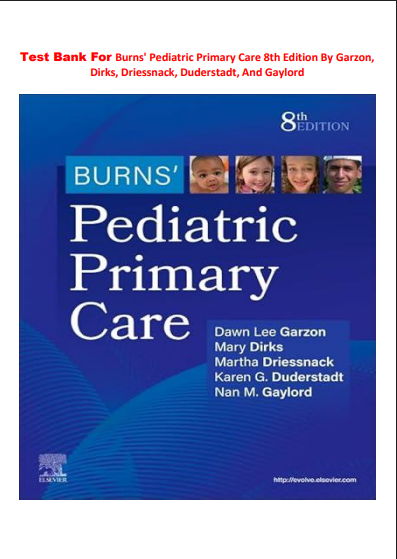
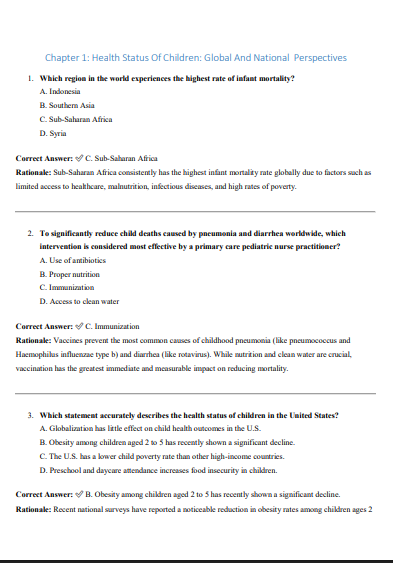
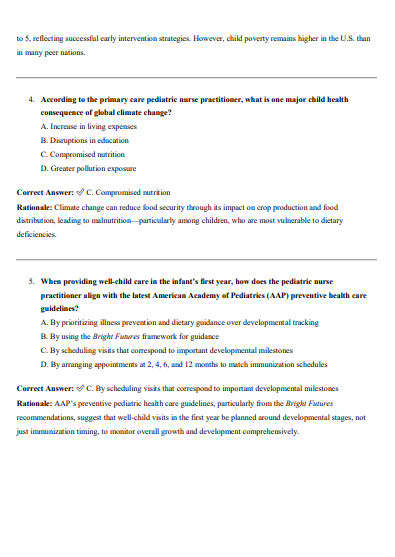
Pediatric primary care asks you to do many jobs at once. You watch growth and development, screen for problems early, treat common illnesses, and guide parents, all while remembering that the right answer changes with the child’s age. A fever in a three-week-old is an emergency. The same fever in a three-year-old may only need home care. This test bank was built to help you practice that kind of age-based judgment. It follows the chapter order of Burns’ Pediatric Primary Care, 8th Edition, by Dawn Lee Garzon, Nancy Barber Starr, Margaret Driessnack, Karen Duderstadt, and Mary Gaylord, so you can study each topic in the same sequence as your course.
If you are in a pediatric or family nurse practitioner program, preparing for a certification exam, or getting ready for clinical hours in a pediatric office, this resource gives you focused practice with the decisions primary care providers make every day.
Topics Covered
The question sets follow the textbook and include:
- Well-child care, growth monitoring, and developmental surveillance
- Developmental and behavioral screening tools, including autism screening
- Immunization schedules, catch-up plans, and common vaccine questions
- Nutrition, feeding, and healthy weight in infants, children, and teens
- Newborn and infant care, including early problems such as jaundice and feeding trouble
- Common skin conditions, such as eczema, diaper rash, and impetigo
- Eye, ear, nose, and throat problems, including ear infections and sore throats
- Respiratory conditions, including asthma and bronchiolitis
- Stomach and bowel problems, including vomiting, diarrhea, and constipation
- Urinary, genital, and reproductive health, including adolescent care
- Bone, joint, and sports-related concerns
- Mental health and behavior concerns, such as anxiety, depression, and ADHD
- Child safety, injury prevention, and recognizing abuse and neglect
You will find multiple-choice, select-all-that-apply, and short case questions, which match the way advanced practice courses and certification exams are usually written.
Why Practice Questions Help in This Course
Pediatric primary care questions often hide the key detail in the first line of the case, usually the child’s age. A treatment, a screening tool, or a warning sign may be right at one age and wrong at another. Practicing with realistic cases helps you:
- Match the screening test or tool to the correct age
- Choose first-line treatments and correct dosing approaches for common childhood illnesses
- Spot red flags that call for urgent referral instead of office care
- Think through each case from history to exam to plan
- Feel prepared for the case-based style used on certification exams
Many students say the hard part is not knowing the facts. It is remembering which fact applies to which age group while under time pressure. Repeated practice by chapter builds that habit.
What Makes This Test Bank Different
Every question includes a full rationale. You will see why the best answer fits the child in the case and why each other option falls short. Wrong answers on pediatric exams are usually real treatments or real conditions that simply fit a different age or a different situation. Learning why they do not fit is a big part of studying.
Questions are grouped by chapter and topic, so you can review one area, such as ear, nose, and throat problems, before a quiz, or work through several chapters before a final. Use it beside your reading, before clinical hours, or as a structured review before certification.
Sample Questions
Question 1
An 18-month-old with no drug allergies has a temperature of 39.5°C (103.1°F) and severe ear pain. The exam shows a bulging, red tympanic membrane. The child has not taken an antibiotic in the past month. What is the best first-line treatment?
A. Watchful waiting with no antibiotic
B. High-dose amoxicillin
C. Ciprofloxacin
D. Azithromycin as a single dose
Correct Answer: B
Rationale: This child has acute otitis media with severe symptoms, so antibiotics are indicated. High-dose amoxicillin, about 80 to 90 mg/kg/day, is the usual first choice because it covers the most common bacteria, including many penicillin-resistant strains of Streptococcus pneumoniae. Watchful waiting is only an option for milder illness, not for a child with high fever and severe pain. Ciprofloxacin is not a standard first-line drug for children with ear infections. Azithromycin is less effective against the common bacteria because of resistance and is kept for cases of true penicillin allergy.
Question 2
At a 12-month well-child visit, which screening test is recommended for all children?
A. Hemoglobin to check for anemia
B. Cholesterol panel
C. Bone density scan
D. Thyroid function test
Correct Answer: A
Rationale: Iron deficiency anemia is common at this age because growth is fast and many toddlers have a diet low in iron. Routine hemoglobin screening is recommended at about 12 months. Cholesterol screening is done later, usually once between ages 9 and 11 and again in late adolescence. Bone density scans are not part of routine pediatric screening. Thyroid function is checked through the newborn screening program, not repeated for every child at 12 months.
Question 3
A 3-week-old infant is brought in because of a rectal temperature of 38.4°C (101.1°F). The baby is feeding a little less than usual but is alert. What is the nurse practitioner’s best next step?
A. Give acetaminophen and have the parents call back in 24 hours
B. Reassure the parents that mild fever is common in newborns
C. Send the infant for immediate evaluation, including blood and urine tests and likely a lumbar puncture
D. Start oral antibiotics at home and recheck in 3 days
Correct Answer: C
Rationale: A fever of 38.0°C (100.4°F) or higher in an infant under 28 days is treated as an emergency because newborns can have serious bacterial infections, such as sepsis or meningitis, with very few outward signs. These infants need prompt evaluation, usually in a hospital, with blood, urine, and often spinal fluid testing, and they are commonly started on antibiotics. Giving acetaminophen and waiting could hide the fever and delay care. Reassurance is unsafe because a young infant’s immune system is immature. Starting oral antibiotics at home skips the needed testing and does not provide the level of monitoring this infant needs.
Question 4
A 7-year-old has a sore throat, fever, swollen tonsils with white patches, tender neck lymph nodes, and no cough. A rapid strep test is positive. What is the best treatment?
A. No antibiotic, since most sore throats are viral
B. Oral penicillin V or amoxicillin for 10 days
C. An antibiotic for 2 days only
D. Oral steroids alone
Correct Answer: B
Rationale: A positive test with a typical picture confirms group A streptococcal pharyngitis. Treatment with penicillin V or amoxicillin for 10 days shortens the illness, lowers spread, and prevents complications such as rheumatic fever. Withholding antibiotics would be appropriate only for viral causes, which this case is not. A 2-day course is too short to clear the bacteria and prevent complications. Steroids do not treat the infection.
Question 5
At an 18-month well-child visit, which tool is recommended for autism-specific screening?
A. M-CHAT-R/F
B. PHQ-A
C. Vanderbilt ADHD rating scale
D. CRAFFT questionnaire
Correct Answer: A
Rationale: The Modified Checklist for Autism in Toddlers, Revised with Follow-Up, is a parent-completed screen recommended at the 18- and 24-month visits. Early screening matters because early services improve outcomes. The PHQ-A screens teens for depression. The Vanderbilt scale is used to assess ADHD in school-age children. The CRAFFT questionnaire screens adolescents for substance use. None of these are meant for toddlers or for autism screening.
Frequently Asked Questions
Is this the same as the publisher’s official test bank?
No. This is an independently written study resource meant to help you review the topics in the 8th edition of Burns’ Pediatric Primary Care. It is a self-study companion and is not distributed by the publisher.
Will it help with pediatric NP certification exams?
The case-based style is similar to certification exam questions. It focuses on age-based screening, diagnosis, first-line treatment, and knowing when to refer.
Does it cover the whole textbook?
Yes. The questions follow the chapter order of the 8th edition, from well-child care and development through common conditions by body system and adolescent health.
What kinds of questions are included?
Mostly multiple-choice, plus select-all-that-apply and short case questions.
Are there explanations or only answers?
Every question includes a full rationale that explains why the correct answer fits the child in the case and why the other options do not.
Who is it for?
Students in pediatric and family nurse practitioner programs, and anyone reviewing pediatric primary care before a course exam or certification.
How should I use it?
Read the chapter first, then answer the questions without checking the answers. Review the rationales afterward, especially for questions you missed. Knowing why one choice is best is more useful than memorizing the letter.
Can it replace the textbook?
No. It works best alongside the textbook. The book teaches the material, and the test bank gives you practice applying it to cases.
Is it matched to the 8th edition?
Yes. It follows the topics and chapter structure of the 8th edition.
Is it useful before an exam?
Yes. Because it is organized by chapter, you can quickly target one area, such as screening tools or ear, nose, and throat problems, without rereading the whole book.

Annen –
Great questions and clear explanations
Zak Kim –
Perfect for nursing students
Joe Terry –
Great resource for exam practice
Joyce Silva G –
Makes nursing revision much easier.
Harry Jans –
Great platform for nursing revision
Nichola Sabraico –
Easy way to improve nursing knowledge
Zippy Ann –
Wonderful resource for nursing students.