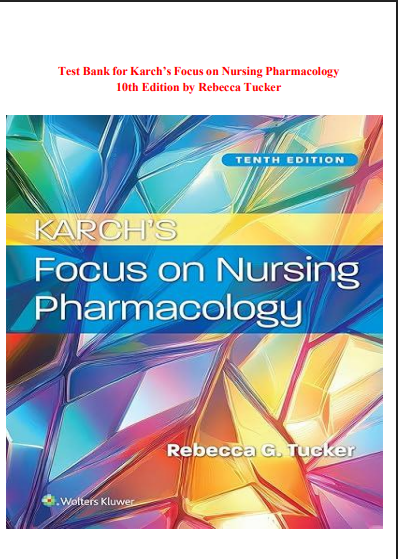
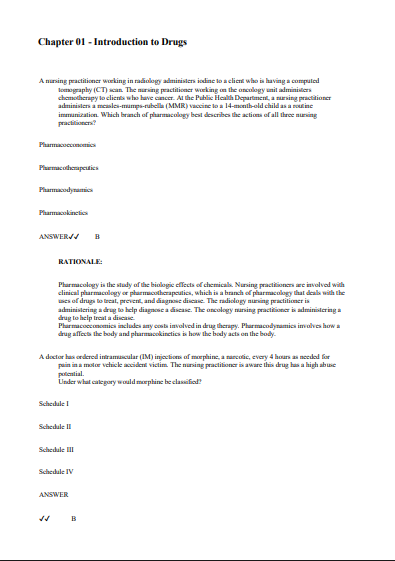
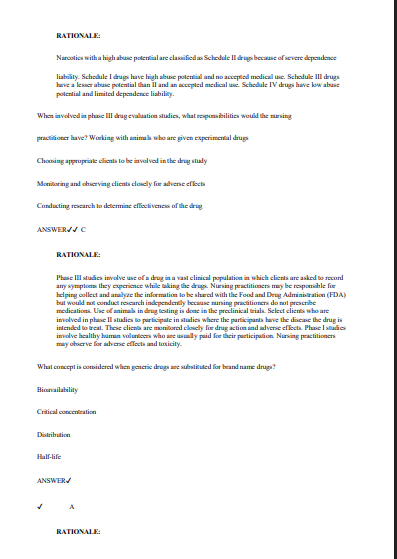
Many students start pharmacology by trying to memorize drugs one at a time, and it works for about two weeks. Then the classes pile up, the names start to sound alike, and the exam asks about a patient, not a flashcard. Karch’s Focus on Nursing Pharmacology helps by organizing drugs by body system and by what the nurse needs to assess, give, teach, and watch for. This test bank follows that structure. It tracks the chapters of the 10th edition, by Rebecca Tucker, so each practice session matches what your class is covering.
If you are in your first pharmacology course, getting ready for medication-heavy clinicals, or reviewing for the NCLEX, this resource gives you practice in the way exams actually ask about drugs: through safe nursing decisions.
Topics Covered
The question sets follow the textbook and include:
- How drugs enter, move through, and leave the body
- Safe medication administration and the nursing process
- Drugs for the autonomic nervous system
- Heart and blood pressure medications, including diuretics and anticoagulants
- Respiratory medications, such as bronchodilators and inhaled steroids
- Antibiotics, antivirals, and antifungals
- Pain medications, both opioid and non-opioid
- Diabetes and thyroid medications
- Drugs for mental health conditions and seizures
- Stomach, bowel, and muscle medications
- Safe use in children, pregnancy, and older adults
- Patient teaching, drug interactions, and early signs of adverse effects
Each chapter mixes multiple-choice, select-all-that-apply, and dosage-based questions, which are the formats most pharmacology courses use.
Why Practice Questions Help
Pharmacology exams usually ask what the nurse should do. They ask which lab to check before giving a drug, which symptom means a dose should be held, or which statement shows a patient understands the teaching. Practicing this way helps you:
- Link each drug class to what it does in the body and what the nurse must watch for
- Recognize warning signs of toxicity early
- Choose the safest nursing action when several choices seem reasonable
- Prepare patient teaching that is accurate and easy to follow
- Walk into the exam already familiar with the question style
Most students do not struggle with one hard concept. They struggle with the volume. Short, regular practice by chapter helps you hold more of it than a single long cram session.
What Makes This Test Bank Different
Every question includes a full rationale. You will see why the correct answer is the safest choice, and why each other option is unsafe, incorrect, or simply not the priority. Wrong answers in pharmacology are usually plausible, so understanding why they fail is a big part of learning.
Questions are grouped by chapter and body system. Review one drug class before a quiz, or work through several chapters before a final. It fits next to your reading, before a clinical day, or as a last review before an exam.
Sample Questions
Question 1
A patient taking digoxin for heart failure reports nausea, loss of appetite, and seeing yellow-green halos around lights. The patient’s potassium level is low. What should the nurse do first?
A. Give the next scheduled dose and recheck in the morning
B. Hold the dose and notify the provider
C. Tell the patient these are expected side effects
D. Encourage the patient to eat more potassium-rich foods and continue the medication
Correct Answer: B
Rationale: Nausea, appetite loss, and visual changes such as yellow-green halos are classic signs of digoxin toxicity, and low potassium makes toxicity more likely. The nurse should hold the dose, check the apical pulse, and notify the provider so a digoxin level and electrolytes can be checked. Giving the dose could make the toxicity worse. These symptoms are not harmless side effects. Diet changes alone are too slow and unsafe when toxicity is suspected.
Question 2
Which instruction should the nurse give a patient who has just been prescribed levothyroxine?
A. “Take it at bedtime with a full meal.”
B. “Take it in the morning on an empty stomach, 30 to 60 minutes before breakfast.”
C. “Take it only on days when you feel tired.”
D. “Stop it once your energy returns to normal.”
Correct Answer: B
Rationale: Levothyroxine is absorbed best on an empty stomach, so it should be taken at the same time each morning, 30 to 60 minutes before eating. Food, calcium, and iron can lower absorption. Taking it with a meal reduces its effect. Taking it only when tired and stopping when energy returns are both wrong, since thyroid replacement is usually lifelong and needs steady daily dosing.
Question 3
A patient taking a statin reports new, unexplained muscle pain and weakness, and has dark urine. What is the nurse’s best action?
A. Reassure the patient that muscle aches are normal and continue the drug
B. Report the symptoms to the provider right away
C. Tell the patient to increase exercise to strengthen the muscles
D. Tell the patient to take the medication with grapefruit juice
Correct Answer: B
Rationale: Unexplained muscle pain, weakness, and dark urine may signal rhabdomyolysis, a serious statin complication in which muscle breakdown can injure the kidneys. The provider should be told right away, and the drug may need to be stopped while a creatine kinase level is checked. Reassuring the patient could delay needed care. More exercise would not help and could make muscle injury worse. Grapefruit juice can raise the level of some statins and make side effects more likely.
Question 4
A patient is receiving IV gentamicin. Which finding should the nurse report to the provider immediately?
A. Mild redness at the IV site that resolves in an hour
B. Ringing in the ears and a decrease in urine output
C. A slightly dry mouth
D. A temperature of 37.0°C (98.6°F)
Correct Answer: B
Rationale: Gentamicin is an aminoglycoside, and these drugs can damage the ears and the kidneys. Ringing in the ears points to ototoxicity, and falling urine output points to nephrotoxicity. Both need quick reporting so the dose can be reviewed and levels checked. Brief redness at the IV site and a dry mouth are minor. A normal temperature is not a concern.
Question 5
A nurse is drawing up regular insulin and NPH insulin into one syringe. Which step is correct?
A. Draw up the NPH first, then the regular insulin
B. Draw up the regular insulin first, then the NPH
C. Mix the two vials together before drawing up either
D. Use two syringes only and never mix them
Correct Answer: B
Rationale: When mixing, the clear insulin (regular) is drawn up first, then the cloudy insulin (NPH). This prevents the longer-acting NPH from contaminating the regular insulin vial, which would change how fast it works. Drawing NPH first risks that contamination. Mixing the vials themselves is unsafe. While two separate injections are one option, mixing in one syringe is acceptable when done in the correct order.
Frequently Asked Questions
Is this the same as the publisher’s official test bank?
No. This is an independently written study resource meant to help you review the topics in the 10th edition of Karch’s Focus on Nursing Pharmacology. It is a self-study companion and is not distributed by the publisher.
Will it help with the NCLEX?
The scenario style is similar to licensure exam questions. It focuses on safe administration, priority actions, patient teaching, and spotting adverse effects.
Does it cover every chapter?
Yes. Questions follow the chapter and body-system order of the 10th edition.
What question types are included?
Mostly multiple-choice, plus select-all-that-apply and dosage-based questions.
Are there explanations?
Yes. Every question has a rationale that explains why the best answer is correct and why the others are not.
Who is it for?
Nursing students taking a pharmacology course, and anyone reviewing drug classes before an exam or the NCLEX.
How should I use it?
Read the chapter first, then try the questions before looking at the answers. Study the rationales for anything you missed. Understanding the reason behind an answer helps more than memorizing the letter.
Can it replace the textbook?
No. It works best next to the textbook. The book teaches the drug classes, and the test bank lets you practice applying that knowledge.
Is it matched to the 10th edition?
Yes. It follows the topics and chapter structure of the 10th edition.
Is it useful the night before an exam?
Yes. Because it is organized by chapter, you can quickly review one drug class or body system without rereading the whole book.

Annen Wags –
Clear questions and helpful explanations.
Huntersin –
Excellent support for nursing studies.
Zack Evans –
Helped make review more effective.
Jon Harry –
Great practice for nursing assessments.
Halima G B –
Makes exam preparation more manageable.
Cindy Bruns –
Very helpful and easy to use.
Johandhphs –
Great questions for nursing students
Cluster –
Excellent resource for nursing students
karen Koen –
Very helpful for exam preparation
Mary Evan –
Excellent resource for nursing exam preparation
Jack Blake H –
Very helpful and easy to understand
Harry G –
Useful questions with detailed explanations.
Jane S –
Fantastic support for nursing students
Zippy Ann –
Makes exam preparation simple and effective
Zack Evans –
Very informative and well organized.
Harry Jans –
Helpful tool for nursing exam practice