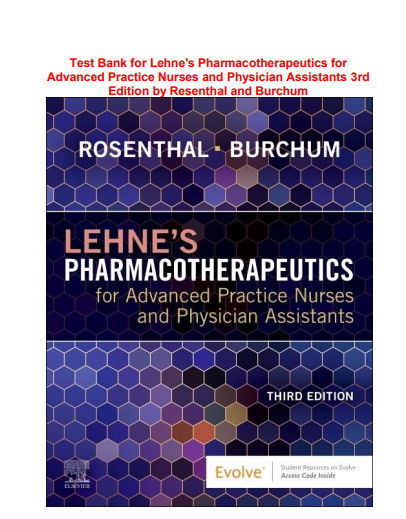
There’s a moment in every NP and PA program where pharmacology stops being about facts and starts being about judgment calls. You’re no longer just learning what a drug does, you’re deciding whether to prescribe it, for this patient, at this dose, given everything else on their chart. That’s a genuinely harder skill to test and to study for, and it’s exactly what this textbook is built around. This test bank follows the chapter structure of Lehne’s Pharmacotherapeutics for Advanced Practice Nurses and Physician Assistants, 3rd Edition, by Jacqueline Rosenthal and Laura Burchum, giving you practice with the same prescriber-level reasoning the book teaches.
Whether you’re mid-program in an NP or PA track, studying for a specialty certification, or brushing up before you start writing your own prescriptions in clinical, this resource is designed around the actual decision-making these courses and exams demand.
What’s Inside
Practice questions follow the textbook’s chapter sequence, covering:
- Pharmacokinetics and pharmacodynamics at the level a prescriber actually needs
- Adjusting drug therapy for renal function, hepatic function, age, and pregnancy
- Drug interactions, adverse effects, and the monitoring that goes along with prescribing decisions
- Cardiovascular pharmacotherapy: hypertension, heart failure, dyslipidemia
- Diabetes and other endocrine drug management
- Choosing antimicrobials responsibly, with stewardship principles built in
- Pain management, including when opioids are and aren’t appropriate
- Psychiatric drug therapy: antidepressants, antipsychotics, mood stabilizers
- Asthma and COPD drug management
- Prescribing considerations that shift across pediatric and geriatric populations
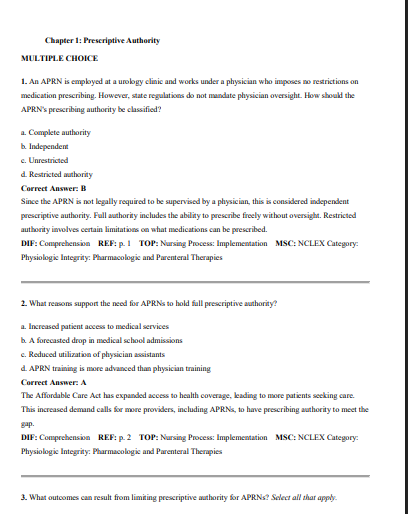
- The legal and ethical framework around prescriptive authority
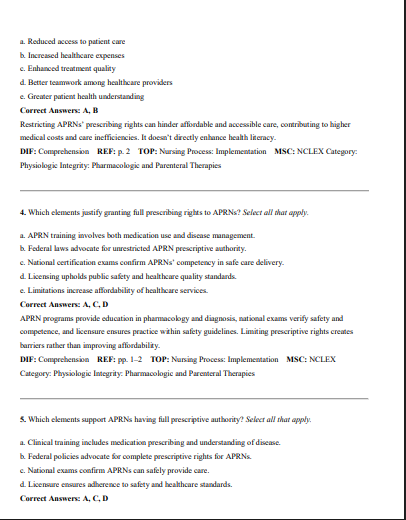
You’ll see a mix of multiple-choice, select-all-that-apply, and case-based questions, mirroring the format used in both coursework and certification exams built around this material.
Why Bother Practicing This Way
At this level, pharmacology questions almost never give you one obviously right answer surrounded by throwaway distractors. You’re usually choosing among several legitimate medications and figuring out which one actually fits this patient. Regular practice with scenario-based questions helps you:
- Factor in patient-specific variables, like kidney function or pregnancy, when picking a drug
- Catch dangerous interactions before they become a real clinical problem
- Get quicker at first-line versus second-line reasoning for chronic conditions
- Build comfort with the case-based format certification exams actually use
- Develop the exact kind of judgment this specialty is built around
If there’s one thing NP and PA students consistently say about this course, it’s that the hard part isn’t learning drug facts, it’s learning to weigh them against a specific patient’s full picture. That’s not something you build by rereading a chapter twice, it comes from working through cases repeatedly until the reasoning becomes automatic.
What Makes This Different
Every question comes with an actual explanation, not just a highlighted letter. You’ll see why the chosen medication or action fits this particular patient best, and why each other option, while often a real, valid drug, doesn’t fit quite as well here, whether that’s a contraindication, an interaction, or simply not being first-line. That’s intentional, since these exams are built exactly that way: multiple correct-sounding drugs, one correct answer for this specific case.
Questions are sorted by chapter and therapeutic area, so you can drill into exactly what you need, one drug class before a quiz, or the whole book before certification. Use it while reading, before clinical rotations, or as a structured pass in the final stretch before an exam.
Sample Questions
Question 1
A patient with type 2 diabetes and early diabetic nephropathy needs an antihypertensive. What’s the appropriate first-line choice?
A. Thiazide diuretic
B. Beta-blocker
C. ACE inhibitor
D. Calcium channel blocker
Correct Answer: C
Rationale: ACE inhibitors are first-line here specifically because they reduce intraglomerular pressure, offering renal protection beyond just lowering blood pressure, which matters given this patient’s early nephropathy. A thiazide or calcium channel blocker could reasonably lower blood pressure too, but neither offers that same kidney-specific benefit. A beta-blocker isn’t typically first-line for uncomplicated hypertension in the first place, and it wouldn’t address the renal protection this patient specifically needs.
Question 2
A patient on lithium starts a new antihypertensive. Which class should be avoided because it can push lithium into toxic range?
A. Calcium channel blockers
B. Thiazide diuretics
C. Beta-blockers
D. Alpha-1 blockers
Correct Answer: B
Rationale: Thiazides cause the kidneys to reabsorb more sodium, and lithium gets reabsorbed right along with it, raising serum lithium levels toward toxicity. It’s a well-documented interaction that needs to be screened for before starting a thiazide in anyone already on lithium. Calcium channel blockers, beta-blockers, and alpha-1 blockers don’t carry this same risk, making them the safer options here.
Question 3
A patient with depression has also lost a significant amount of weight unintentionally. Which antidepressant addresses both issues at once?
A. Fluoxetine
B. Mirtazapine
C. Bupropion
D. Sertraline
Correct Answer: B
Rationale: Mirtazapine’s well-known side effect of increased appetite and weight gain is actually useful here, given this patient needs to regain weight, not lose more. Fluoxetine and sertraline, both SSRIs, tend to be weight-neutral or mildly weight-reducing, not what this patient needs. Bupropion often causes weight loss or reduced appetite, making it a poor match for someone already underweight from their depression.
Question 4
A patient with CKD and an eGFR of 25 mL/min is on metformin for type 2 diabetes. What’s the correct move?
A. Keep metformin at the current dose since it’s renally protective
B. Discontinue metformin, since it’s contraindicated at this level of kidney function
C. Increase the dose for tighter glycemic control
D. Switch to a higher-dose sulfonylurea with no other adjustments
Correct Answer: B
Rationale: Once eGFR drops below roughly 30 mL/min, metformin becomes contraindicated because impaired clearance lets it accumulate, raising the risk of lactic acidosis, rare but potentially fatal. The right call is stopping it and considering an alternative. Keeping the dose the same, or increasing it, only raises that risk further. Simply swapping to a sulfonylurea without reassessing the whole regimen oversimplifies things, since sulfonylureas have their own renal dosing considerations too.
Question 5
A patient is starting warfarin. Reviewing their med list, which one raises the biggest concern for a bleeding interaction?
A. Occasional acetaminophen for headaches
B. Daily aspirin for cardiovascular protection
C. Occasional calcium carbonate for heartburn
D. A daily multivitamin
Correct Answer: B
Rationale: Daily aspirin’s antiplatelet effect stacked on top of warfarin’s anticoagulant effect significantly raises bleeding risk, a well-established, clinically important combination that needs close monitoring or reconsideration. Occasional acetaminophen carries a much smaller risk at typical doses, though heavy or sustained use can nudge INR slightly. Calcium carbonate and a standard multivitamin don’t carry any comparable bleeding risk alongside warfarin, leaving aspirin as the clear standout concern.
Frequently Asked Questions
Is this the publisher’s official test bank?
No. This is an independently written study resource meant to help you review the material in the 3rd edition of Lehne’s Pharmacotherapeutics for Advanced Practice Nurses and Physician Assistants. It’s built for self-study, not distributed by the publisher.
Does it actually prepare you for NP or PA certification exams?
The case-based, prescribing-focused format mirrors certification exam questions closely, especially around choosing appropriate therapy, catching interactions, and adjusting for patient-specific factors, all things certification exams lean on heavily.
Is the full book covered?
Yes, chapter by chapter, following the 3rd edition’s structure from foundational pharmacologic principles through medication management across body systems and populations.
What question types show up?
Mostly multiple-choice, plus select-all-that-apply and case-based items, matching how these courses and their exams are typically written.
Do I get explanations or just correct letters?
Full rationales throughout, explaining why the chosen answer is the best fit for that specific patient and why the alternatives, while sometimes reasonable drugs, don’t fit as well.
Who’s it meant for?
NP and PA students, and anyone reviewing prescribing-level pharmacology before a course exam or certification.
How should I actually use this?
Read the chapter, then work the matching questions cold before checking answers. Spend real time on the rationales, especially where you got it wrong, since understanding why one drug beats another sticks with you far longer than the letter does.
Can this stand in for the textbook?
No, it’s built to work alongside it. The book gives you the pharmacologic foundation; this gives you a place to actually practice applying it.
Is it specific to the 3rd edition?
Yes, matched to its topics, terminology, and chapter structure.
Good for a last-minute review push?
Yes, since it’s chapter-organized, you can zero in on one therapeutic area fast instead of rereading the whole book right before an exam.

Stevo –
Great revision material
Joy –
Nice one
Leen –
Awesome
Sofia –
Thanks for this. Its really helpful study tool
Leken –
Very comprehensive and clear
Valn –
Well organized, easy to read and understand.
anitamartin –
Good document
Ramnush –
Perfect
Mikell –
making learning effectively and easy thanks
Swagrid –
Excellent resource for exam preparation.
SimVault –
Clear explanations and quality questions
Annen –
Helped me pass with confidence
Joel –
Practical questions with clear answers
Joane –
Great investment for exam success
Wright –
Perfect for quick revision sessions
Kevintoonen –
Excellent resource for nursing students.
Dais350 –
Very helpful study material.
Maggy –
Covers important nursing topics well.
Namis –
Great resource for reinforcing knowledge
Annen Harry –
Excellent study tool for exams
Tonny Jakes1 –
Made studying much more manageable
Maggy James –
Useful practice for nursing tests
Wellbek J –
Helped me practice effectively
Tonny Peter6 –
Great resource for nursing students
Eva –
Very helpful for exam preparation
Fiona –
Is very helpful
lebogang Pretty –
Excellent study tool for nursing students.
Sharon@yahoo.com –
Helpful practice for difficult nursing topics.
Liz –
Excellent resource for nursing students.