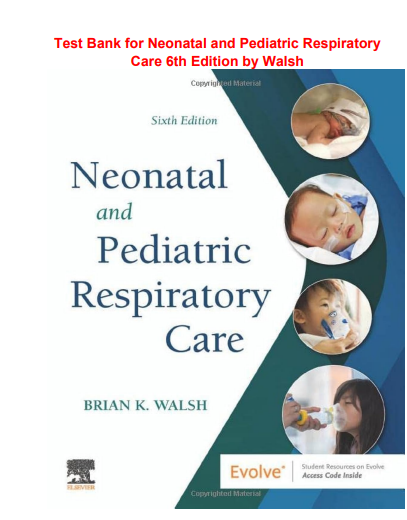
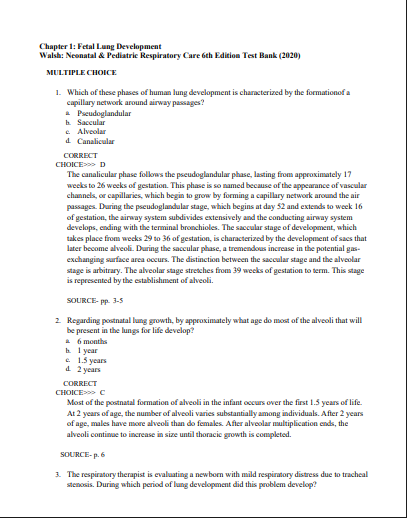
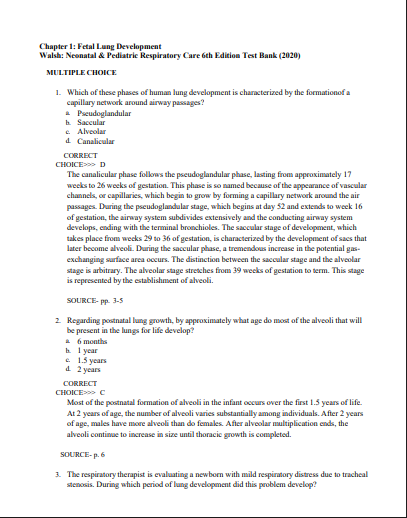
A newborn’s lungs don’t work like a child’s, and a child’s don’t work like an adult’s. Airway size, lung maturity, and disease presentation shift dramatically across these age groups, and that shift drives nearly every clinical call a respiratory therapist makes in a NICU or PICU. This test bank was built around that reality. It follows the chapter structure of Neonatal and Pediatric Respiratory Care, 6th Edition, by Brian K. Walsh, so your practice tracks the same age-specific organization the textbook uses.
Whether you’re working through a respiratory therapy program, prepping for a neonatal/pediatric specialty credential, or reviewing before NICU or PICU clinical time, this resource is built to strengthen the age-specific reasoning this population demands, rather than just stretching general adult respiratory concepts onto smaller patients.
What’s Covered
Practice sets follow the textbook’s chapter organization, including:
- Fetal lung development and the transition to breathing outside the womb
- Delivery room management and neonatal resuscitation basics
- Respiratory distress syndrome and surfactant therapy in premature infants
- Ventilation strategies tailored to neonatal and pediatric physiology
- Congenital respiratory anomalies
- Neonatal-specific conditions, including transient tachypnea and meconium aspiration syndrome
- Pediatric airway anatomy and how it changes assessment and treatment
- Common pediatric respiratory illnesses, like bronchiolitis, croup, and asthma
- Oxygen therapy and noninvasive support across neonatal and pediatric age ranges
- Monitoring approaches adjusted for neonatal and pediatric physiology
- Family-centered communication in NICU and PICU settings
Question formats mix multiple-choice, matching, and case-based items, matching how neonatal and pediatric respiratory care courses are typically taught and tested.
Why This Kind of Practice Helps
A lot of these exam questions test whether you understand how age changes the entire clinical picture. A finding that would be alarming in an adult might be totally normal in a newborn, and a ventilator setting fine for a child could be dangerous for a preemie. Working through practice questions helps you:
- Recognize how anatomical and physiological differences shift assessment findings by age
- Get comfortable with neonatal-specific concepts, like surfactant deficiency and the transition from fetal circulation
- Practice applying age-appropriate ventilator and oxygen therapy principles
- Learn to distinguish pediatric respiratory conditions that share overlapping symptoms
- Build the same case-based reasoning tested on specialty credentialing exams
Many students say this material is hard precisely because most general respiratory therapy training centers on adults, and neonatal/pediatric care requires almost a separate mental framework. Regular, chapter-based practice is one of the more effective ways to build that age-specific expertise before it matters in a real NICU or PICU.
What Makes This Different
Every question includes a full explanation, not a bare answer key. You’ll see why the correct answer reflects appropriate neonatal or pediatric-specific care, and why each incorrect option falls short, whether it applies an adult framework incorrectly, misses a key developmental difference, or just doesn’t fit the scenario. This mirrors how these exams are typically written, since wrong answers are often reasonable in a different age group but wrong for the patient in front of you.
Questions are grouped by chapter and clinical topic, so you can drill into exactly what you need, whether that’s meconium aspiration syndrome the night before a quiz or a full review before a credentialing exam. It works as a companion to assigned reading, prep before NICU or PICU rotations, or a structured review before test day.
Sample Questions
Question 1
A premature infant born at 28 weeks develops grunting, nasal flaring, and retractions shortly after birth. What’s the likely cause?
A. Transient tachypnea of the newborn
B. Respiratory distress syndrome
C. Meconium aspiration syndrome
D. Congenital diaphragmatic hernia
Correct Answer: B
Rationale: Respiratory distress syndrome comes from insufficient surfactant, common in premature infants since surfactant production typically matures later in gestation, leading to alveolar collapse and the classic grunting, flaring, and retractions as the infant struggles to keep the lungs open. Transient tachypnea shows up more in term or late preterm infants and relates to delayed clearance of fetal lung fluid, not surfactant deficiency. Meconium aspiration syndrome ties to meconium-stained fluid and typically affects term or post-term infants, not extremely premature ones. Congenital diaphragmatic hernia usually presents with a scaphoid abdomen and distress from birth due to abdominal contents in the chest, a distinct picture from surfactant deficiency.
Question 2
Why are young infants considered obligate nose breathers for their first few months?
A. Their tongues are proportionally smaller than adults’
B. Their airway anatomy and neurological development favor nasal breathing
C. Infants have a stronger gag reflex than adults
D. Infant lungs need higher oxygen concentrations than adult lungs
Correct Answer: B
Rationale: Young infants have airway anatomy, epiglottis and soft palate positioning included, along with neurological patterns that strongly favor nasal breathing over mouth breathing for the first several months of life, which is why nasal congestion alone can cause real respiratory distress in this age group. Infant tongues are actually proportionally larger, not smaller, relative to their oral cavity. A stronger gag reflex has nothing to do with breathing route preference. Oxygen requirement differences don’t explain the nasal breathing pattern either.
Question 3
A term infant delivered through thick meconium-stained fluid is limp and not breathing effectively at birth. What’s the correct first move per current neonatal resuscitation guidelines?
A. Dry and stimulate only, regardless of respiratory effort
B. Begin positive pressure ventilation promptly if breathing is ineffective
C. Delay intervention until meconium is suctioned below the vocal cords
D. Withhold all respiratory support until a full assessment is done
Correct Answer: B
Rationale: Current guidelines prioritize starting positive pressure ventilation quickly for an infant not breathing effectively, regardless of meconium exposure, since delaying ventilation to attempt suctioning tends to worsen outcomes. The emphasis has moved toward supporting oxygenation and ventilation fast rather than routine tracheal suctioning in a non-vigorous infant. Drying and stimulating alone isn’t enough for an infant with ineffective breathing. Delaying ventilation to suction reflects outdated practice. Withholding respiratory support entirely would let hypoxia worsen in a limp, non-breathing infant.
Question 4
A toddler has a barky cough, inspiratory stridor, and hoarseness that started suddenly overnight. What’s the likely diagnosis?
A. Epiglottitis
B. Croup (laryngotracheobronchitis)
C. Bronchiolitis
D. Foreign body aspiration
Correct Answer: B
Rationale: Croup classically shows up as a barky, seal-like cough with inspiratory stridor and hoarseness, often worsening at night, driven by viral inflammation narrowing the upper airway, matching this description almost exactly. Epiglottitis tends to present as a more acutely ill, toxic-appearing child with drooling and a preference for sitting upright, without the barky cough. Bronchiolitis hits the lower airway and shows wheezing and increased work of breathing rather than this stridor pattern. Foreign body aspiration usually has a sudden onset tied to a specific choking event, not a gradual nighttime worsening.
Question 5
What ventilator strategy is generally prioritized in neonates to reduce the risk of ventilator-induced lung injury?
A. Using the highest tolerated tidal volume to reduce breath count
B. Lower tidal volumes and gentle ventilation to protect immature lung tissue
C. Avoiding positive pressure ventilation entirely, regardless of status
D. Using standard adult ventilator settings
Correct Answer: B
Rationale: Neonatal lungs, especially in preemies, are highly vulnerable to injury from excess pressure and volume. Lower tidal volumes and gentler ventilation help avoid overdistension and lower the risk of complications like bronchopulmonary dysplasia, while still supporting adequate gas exchange. Using the highest tolerated tidal volume actually raises injury risk instead of lowering it. Avoiding positive pressure ventilation entirely is impractical and unsafe for neonates in respiratory failure. Adult ventilator settings don’t account for how different neonatal lung physiology actually is, and applying them could cause serious harm.
Frequently Asked Questions
Is this the publisher’s official test bank?
No, this is an independently written study resource built to help you review the material in the 6th edition of Neonatal and Pediatric Respiratory Care. It’s meant for self-study and isn’t distributed by the publisher.
Will this help with neonatal/pediatric specialty credentialing prep?
The case-based format mirrors specialty credentialing exam questions, focusing on age-specific assessment, appropriate intervention, and the key differences between neonatal, pediatric, and adult respiratory care.
Does it cover the whole book?
Yes, questions are organized by chapter and clinical topic, following the 6th edition’s structure from fetal lung development and delivery room management through pediatric-specific conditions.
What question types are included?
Mostly multiple-choice, with some matching and case-based items, matching the format common in neonatal and pediatric respiratory care coursework and specialty credentialing exams.
Are there explanations, or just answer letters?
Every question includes a full rationale explaining why the correct answer reflects appropriate age-specific care and why the other options don’t fit the scenario.
Who’s this built for?
Respiratory therapy students, especially those in NICU/PICU-focused coursework, and anyone prepping for a neonatal/pediatric specialty credential.
What’s the best way to use it?
Read the chapter first, then work through the matching questions before checking answers. Go through the rationales carefully afterward, since understanding how age-related differences change clinical decisions matters more than memorizing a letter.
Can this replace the textbook?
No, it’s meant to work alongside it. The textbook builds your foundational understanding of neonatal and pediatric respiratory physiology and care; the test bank gives you a way to practice applying that knowledge.
Does it match the 6th edition specifically?
Yes, it follows the topics, terminology, and chapter organization of the 6th edition.
Good for last-minute review?
Yes, since it’s organized by chapter, you can zero in on a specific condition or age group quickly instead of rereading the whole book before an exam.

Sipol –
great stuff
Melisa –
Good
Linn –
Nice study material
Maggie –
A must-have nursing study tool
Nakiteso –
Improved my test-taking skills.
Sade5k –
Great for nursing exam preparation.
Felixokema –
Clear, concise, and informative
linadahlia –
Makes studying much easier
Ann Peter –
Made studying much easier
Maggie –
Great tool for test preparation