Pathophysiology asks “why,” where earlier science courses asked “what.” Why does a failing liver cause a swollen belly? Why does a missed dialysis session put the heart at risk? Exams in this course give you a short story and expect you to explain the body’s side of it, so memorized symptom lists don’t help much.
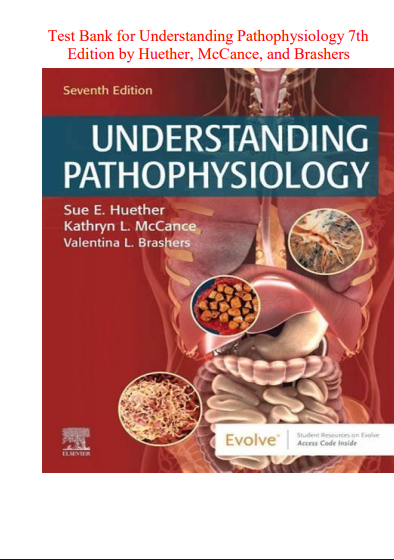
This test bank is built for that kind of thinking. It follows the chapter order of Understanding Pathophysiology, 7th Edition, by Sue E. Huether, Kathryn L. McCance, and Valentina L. Brashers, so each study session lines up with your class.
If you are in a nursing, PA, or other health science program, this resource gives you regular practice linking a cause to a mechanism and a mechanism to what the patient looks and feels like.
Topics Covered
The question sets follow the textbook and include:
- How cells work, get hurt, adapt, and die
- Genes, inheritance, and genetic disorders
- Fluid, electrolyte, and acid-base balance
- Immunity, allergy, autoimmune disease, and immune deficiency
- Infection, inflammation, and healing
- How cancer starts, grows, and spreads
- The body’s stress response
- Brain, spinal cord, and nerve disorders
- Heart and blood vessel disease
- Blood disorders and clotting problems
- Lung, kidney, and urinary problems
- Digestive, liver, and pancreas disorders
- Hormone and metabolic disorders
- Bone, muscle, and reproductive conditions
- Disease in infants, children, and older adults
You will find multiple-choice, matching, and short case questions, the formats most pathophysiology courses use.
Why Practice Questions Help in This Course
Reading a chapter lets you recognize facts. Answering questions makes you use them. Practice helps you:
- Follow a disease from the first change in the body to the signs a nurse sees
- Use lab values and vital signs as clues to what is going wrong
- Separate conditions that look alike but have different causes
- Spot the single detail in a case that points to the right answer
- Get used to exam wording before the real test
Understanding can’t be crammed the night before. Short practice sessions by chapter build it more steadily.
What Makes This Test Bank Different
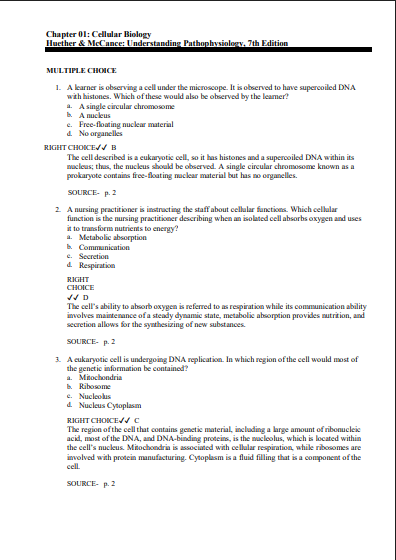
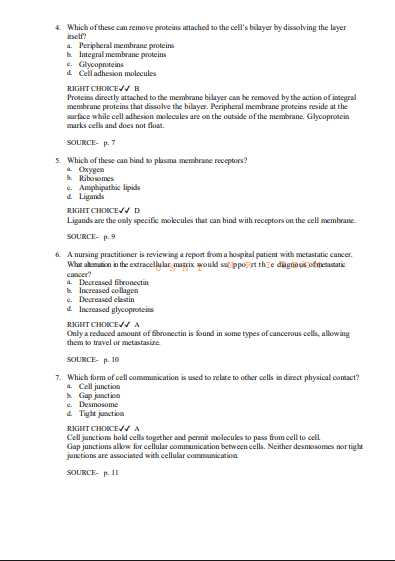
Every question has a full rationale. It explains the mechanism behind the correct answer and shows why each wrong choice doesn’t fit. In this subject, wrong answers are usually real diseases or real processes that simply belong to a different case, so seeing why they fail is a big part of the learning.
Questions are grouped by chapter and body system. You can review one topic, such as acid-base balance, before a quiz, or work across several chapters before a final.
Sample Questions
Question 1
A patient receives a unit of blood and, within minutes, develops fever, chills, flank pain, and red-brown urine. Which process best explains these findings?
A. Type I hypersensitivity, caused by IgE on mast cells
B. Type II hypersensitivity, caused by antibodies binding to antigens on donor red blood cells
C. Type III hypersensitivity, caused by immune complexes in small vessels
D. Type IV hypersensitivity, caused by T cells over 48 to 72 hours
Correct Answer: B
Rationale: This is an acute hemolytic transfusion reaction. The patient’s antibodies attack antigens on the donor red cells, which activates complement and destroys the cells. Hemoglobin is released into the blood and urine, causing the red-brown color, and the immune response causes fever, chills, and pain. Type I reactions, such as hives and wheezing, come from IgE and histamine. Type III reactions involve immune complexes and take longer to appear. Type IV reactions are delayed and driven by T cells, not antibodies.
Question 2
A patient with advanced cirrhosis has a swollen abdomen and puffy ankles. Which combination of changes best explains the fluid build-up?
A. High albumin and low pressure in the portal vein
B. Low albumin, which lowers the pull of fluid into blood vessels, and high pressure in the portal vein
C. High albumin and high clotting factors
D. Low pressure inside all blood vessels
Correct Answer: B
Rationale: The liver makes albumin, the protein that keeps fluid inside blood vessels. In cirrhosis, albumin falls, so less fluid is pulled back into the blood. Scar tissue also blocks blood flow through the liver, raising pressure in the portal vein, which pushes fluid out into the abdomen. Together these changes cause ascites and ankle swelling. High albumin would hold fluid in the vessels. Clotting factors are low, not high, in liver failure. Low pressure in the vessels would not push fluid outward.
Question 3
A patient with long-standing COPD has an arterial blood gas of pH 7.31, PaCO2 58 mm Hg, and HCO3 29 mEq/L. How should this be interpreted?
A. Metabolic acidosis with respiratory compensation
B. Respiratory acidosis, partially compensated by the kidneys
C. Respiratory alkalosis with metabolic compensation
D. Metabolic alkalosis, uncompensated
Correct Answer: B
Rationale: The pH is low, so the blood is acidic. The PaCO2 is high, which points to a lung cause because carbon dioxide is not being blown off. The bicarbonate is high because the kidneys are holding on to it to offset the acid. The pH has not returned to normal, so compensation is only partial. In metabolic acidosis, bicarbonate would be low. In alkalosis, the pH would be high.
Question 4
A patient with chronic myeloid leukemia has the Philadelphia chromosome. How does this change cause the cancer?
A. A swap between chromosomes 9 and 22 creates the BCR-ABL gene, which makes a tyrosine kinase that is always switched on
B. The gene that normally stops cell division is deleted
C. An extra copy of chromosome 21 is present in every cell
D. A virus inserts genes that block cell death
Correct Answer: A
Rationale: The Philadelphia chromosome comes from a translocation between chromosomes 9 and 22. It joins the BCR and ABL genes, and the combined gene makes a tyrosine kinase that sends constant “divide” signals to white blood cell precursors. Drugs that block this enzyme, called tyrosine kinase inhibitors, can control the disease. Deleting a tumor suppressor, an extra chromosome 21, and viral insertion describe other cancer mechanisms but not this one.
Question 5
A 28-year-old woman has drooping eyelids and double vision that get worse late in the day and improve with rest. Which mechanism is most likely?
A. Antibodies block acetylcholine receptors at the neuromuscular junction
B. Antibodies destroy the myelin in the brain and spinal cord
C. Neurons that make dopamine die in the brain
D. Motor neurons in the spinal cord die over time
Correct Answer: A
Rationale: This pattern fits myasthenia gravis. Autoantibodies attack the acetylcholine receptors on muscle, so nerve signals do not reach the muscle well. Muscles that are used a lot get weaker as the day goes on and recover with rest. Option B describes multiple sclerosis. Option C describes Parkinson disease, which causes tremor and slow movement. Option D describes ALS, which causes progressive weakness that does not improve with rest.
Frequently Asked Questions
Is this the same as the publisher’s official test bank?
No. This is an independently written study resource meant to help you review the 7th edition of Understanding Pathophysiology. It is a self-study companion and is not distributed by the publisher.
Will it help with the NCLEX or other licensure exams?
The mechanism-based case style is similar to the reasoning those exams use, especially when linking a disease process to what a nurse sees at the bedside.
Does it cover every chapter?
The questions are organized by chapter and body system, following the order of the 7th edition from cell biology and genetics through each major organ system.
What kinds of questions are included?
Mostly multiple-choice, with some matching and short case questions.
Are there explanations?
Yes. Every question has a rationale that explains the mechanism behind the correct answer and why the other options do not fit.
Who is it for?
Students in nursing, PA, and other health science programs that use this textbook, and anyone reviewing disease mechanisms before an exam.
How should I use it?
Read the chapter first, then try the questions without looking at the answers. Review the rationales afterward, especially for questions you missed. The reasoning matters more than the letter.
Can it replace the textbook?
No. It works best alongside the textbook. The book builds your understanding, and the test bank gives you practice applying it.
Is it matched to the 7th edition?
Yes. It follows the topics and chapter structure of the 7th edition.
Is it useful the night before an exam?
Yes. Because it is organized by chapter and body system, you can quickly review one area, such as fluid balance or immunity, without rereading the whole book.


Jean –
Awesome
Cails –
great thanks
Gabril –
nice document
Jimmy –
Excellent resource for nursing revision
Racheal –
Questions are relevant and practical
Bridget Williams –
Excellent study tool for exams.
Ann Joyce –
Very useful for test preparation.
Kelvin –
Helped me prepare confidently.
Jeff –
Excellent practice for nursing exams.
Ann Emi –
High-yield content that actually works.
Sharon Kelvin –
Unbeatable value for serious students.
Sharon Kelvin –
Reduced my exam stress significantly!
SimVault –
Made complex concepts super clear.
Joani –
Must-have resource for nursing majors
Pauline John –
Game changer for my study routine
Huntersink –
Incredibly helpful for quick exam review.
Paulinetops17 –
High yield material that really works
Joani8 –
Made studying so much less stressful
Martin Johnson –
Accurate practice questions with clear answers
Ovil christienaima –
Great variety of practice questions.
Pauline John7 –
Definitely improved my exam preparation
Vasdy John –
Well-organized and straightforward study resource
Ivannan –
Great supplement to my nursing coursework
leslie Salinas. –
Very helpful and easy to use
Albert John –
Great questions for nursing students.
Calbyr2 –
Excellent resource for exam preparation.
Brerna Dat –
Clear answers and useful explanations
Kanee –
Perfect tool for nursing revision
Njeri Evana –
Clear explanations and useful practice questions
Ivvana –
Perfect tool for nursing exam revision
Annen Berna –
Comprehensive and helpful nursing study resource.
Kabura –
Highly useful for nursing exam revision.