
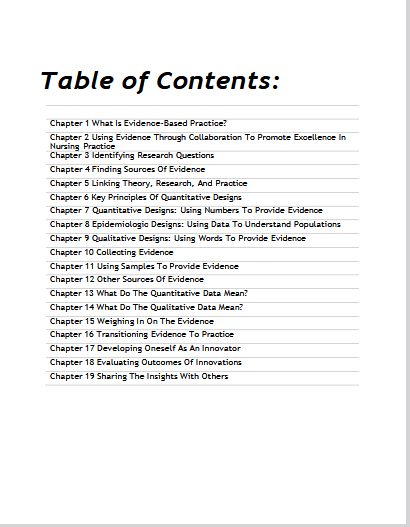

Research and evidence-based practice courses ask nursing students to build a skill most other classes don’t touch directly: reading a study critically enough to decide whether it should actually change how care is delivered. That’s a very different task than memorizing a disease process or a medication list, and it’s exactly why this content trips students up, even when they’re strong in clinical coursework. This test bank was built around that specific skill gap. It follows the chapter structure of Evidence-Based Practice for Nurses: Appraisal and Application of Research, 6th Edition, by Nola A. Schmidt and Janet M. Brown, so your practice tracks the same research-literacy progression the textbook builds, from understanding study design through actually appraising and applying evidence at the bedside.
Whether you’re in an undergraduate or RN-to-BSN research course, working through a DNP or graduate program, or reviewing before a certification exam that tests EBP concepts, this resource is designed to sharpen the critical appraisal skills these exams consistently test.
What’s Covered
Practice sets follow the textbook’s organization, including:
- Foundations of evidence-based practice and why it matters for nursing care
- Formulating clinical questions using the PICO(T) framework
- Searching the literature and identifying appropriate databases and sources
- Understanding quantitative research design, including experimental and observational studies
- Understanding qualitative research design and its role in evidence-based practice
- Critically appraising research studies for validity, reliability, and applicability
- Levels of evidence and evaluating the strength of a body of research
- Systematic reviews, meta-analyses, and clinical practice guidelines
- Statistical concepts relevant to interpreting research findings
- Translating evidence into practice and overcoming barriers to implementation
- Evaluating outcomes after implementing an evidence-based change
- Ethical considerations in nursing research
Each section mixes multiple-choice, matching, and applied-scenario questions, since these formats reflect how research and EBP courses are typically taught and tested.
Why Students Use a Test Bank Like This
EBP exams tend to hand you a snippet of a study, a sample size, a p-value, a study design, and ask you to judge its quality or decide whether it supports a specific practice change. That’s a different skill than reciting a definition of “randomized controlled trial.” Practicing with well-written questions helps you:
- Build confidence identifying study designs and matching them to appropriate research questions
- Practice interpreting statistical results, like p-values and confidence intervals, in context
- Get comfortable critically appraising a study’s strengths and limitations rather than accepting it at face value
- Strengthen your understanding of where different types of evidence fall in the hierarchy of evidence
- Reduce exam anxiety by practicing the same applied, appraisal-based reasoning these exams consistently use
Many students say this course is harder than expected because it requires a different kind of thinking than most nursing content, evaluative and skeptical rather than purely factual. Regular, chapter-based practice with realistic study scenarios is one of the more effective ways to build that critical appraisal skill before it’s tested for real.
What Makes This Test Bank Different
This test bank is built around full explanations, not shortcut answer keys. Every question includes a complete rationale that explains why the correct interpretation or appraisal judgment is accurate, and why each incorrect option reflects a misunderstanding of study design, a misinterpretation of statistical findings, or an inappropriate application of evidence. This mirrors how EBP exams are typically written, since incorrect choices often sound plausible but miss a specific methodological or statistical detail.
Questions are grouped by chapter and by research topic, so you can focus your review exactly where you need it, whether that’s a single area like levels of evidence before a quiz, or a full review before a comprehensive final. It works well as a companion to assigned readings, a self-check before a research critique assignment, or a structured review before exam day.
Sample Questions
Question 1
A nurse formulates a clinical question using the PICO format to compare two wound care approaches. Which component of PICO represents the specific outcome being measured?
A. Population
B. Intervention
C. Comparison
D. Outcome
Correct Answer: D
Rationale: In the PICO framework, “Outcome” refers to the specific result or measure being evaluated, such as wound healing time or infection rate, which is what determines whether the intervention was actually effective. Population refers to the specific patient group being studied, not the measured result. Intervention refers to the treatment or approach being tested, such as one type of wound dressing. Comparison refers to the alternative approach or standard of care the intervention is being measured against, distinct from the outcome itself, which is what’s actually being measured at the end of the study.
Question 2
A study randomly assigns participants to either a new medication or a placebo and follows both groups over time to measure outcomes. What type of study design does this represent?
A. Case-control study
B. Cohort study
C. Randomized controlled trial
D. Cross-sectional study
Correct Answer: C
Rationale: Random assignment of participants to an intervention group and a placebo or control group is the defining feature of a randomized controlled trial, considered one of the strongest study designs for establishing cause-and-effect relationships. A case-control study looks backward, comparing people who already have an outcome to those who don’t, without random assignment to a treatment. A cohort study follows a group over time based on exposure status, but participants aren’t randomly assigned to that exposure. A cross-sectional study collects data at a single point in time, rather than following participants forward after random assignment, which doesn’t match the design described here.
Question 3
A meta-analysis pools data from several randomized controlled trials examining the same intervention. Where does this type of evidence typically fall in the hierarchy of evidence?
A. Near the bottom, similar to expert opinion
B. Near the top, generally considered one of the strongest levels of evidence
C. Equivalent to a single case report
D. Not considered valid evidence for clinical decision-making
Correct Answer: B
Rationale: A meta-analysis of multiple randomized controlled trials sits near the top of most evidence hierarchies, since combining data from several well-designed studies increases statistical power and helps account for variation between individual studies, generally producing a more reliable estimate of an intervention’s effect. Placing it near the bottom alongside expert opinion misrepresents where this type of evidence actually falls, since expert opinion is typically considered one of the weaker forms of evidence. Comparing it to a single case report is also inaccurate, since a case report describes one patient’s experience and sits much lower on the hierarchy. Dismissing it as invalid for clinical decision-making contradicts its actual role, since meta-analyses of RCTs are frequently used to help shape clinical practice guidelines.
Question 4
A research study reports a p-value of 0.03 for the difference between two treatment groups. How should this finding be interpreted?
A. There is a 3% chance the treatment is effective
B. The result is statistically significant at the conventional 0.05 threshold, suggesting the difference is unlikely due to chance alone
C. The study has no clinical significance regardless of the p-value
D. The treatment caused a 3% improvement in outcomes
Correct Answer: B
Rationale: A p-value of 0.03 falls below the conventional 0.05 threshold commonly used in research, meaning the observed difference between groups is considered statistically significant, or unlikely to have occurred by chance alone, assuming the null hypothesis were true. Option A misinterprets what a p-value actually measures, since it doesn’t represent the probability that the treatment itself is effective. Option C confuses statistical significance with clinical significance, two related but distinct concepts, since a statistically significant result doesn’t automatically confirm meaningful clinical significance without looking at other factors like effect size. Option D also misinterprets the p-value, since it doesn’t directly indicate the magnitude of improvement, only the likelihood that the observed difference wasn’t due to random chance.
Question 5
A nurse manager wants to implement a new evidence-based protocol on their unit but faces resistance from staff who are comfortable with current practices. What is the most appropriate initial strategy to address this barrier?
A. Mandate immediate compliance without further discussion
B. Involve staff early in the process, provide education on the supporting evidence, and address specific concerns
C. Wait for staff to independently research and adopt the new protocol on their own
D. Abandon the evidence-based change since staff resistance exists
Correct Answer: B
Rationale: Involving staff early, providing clear education about the evidence supporting the change, and directly addressing specific concerns reflects an evidence-based approach to overcoming implementation barriers, since staff buy-in and understanding are strongly linked to successful, sustained practice change. Mandating compliance without discussion, as in option A, tends to increase resistance rather than reduce it and doesn’t address the underlying concerns driving that resistance. Waiting for staff to adopt the change independently, as in option C, is passive and unlikely to result in timely, consistent implementation. Abandoning the change altogether, as in option D, ignores the actual evidence supporting the protocol simply because of initial resistance, rather than working through that resistance using established implementation strategies.
Frequently Asked Questions
Is this the publisher’s official test bank?
No, this is an independently written study resource built to help you review the material in the 6th edition of Evidence-Based Practice for Nurses: Appraisal and Application of Research. It’s meant for self-study and isn’t distributed by the publisher.
Will this help with certification exams that test EBP content?
The applied, scenario-based format mirrors how research and evidence-based practice concepts are tested on many certification and licensure exams, with an emphasis on critically appraising studies rather than simply defining terms.
Does it cover the whole textbook?
Yes, questions are organized by chapter and research topic, following the 6th edition’s structure from foundational EBP concepts through study appraisal, statistics, and practice implementation.
What question formats are included?
Mostly multiple-choice, with some matching and applied-scenario items, matching the format common in research and EBP coursework and on exams that test these concepts.
Are there explanations, or just answer letters?
Every question includes a full rationale explaining why the correct interpretation or appraisal judgment is accurate, and why the other options reflect a misunderstanding of design, statistics, or evidence application.
Who’s this best suited for?
Nursing students in undergraduate, RN-to-BSN, or graduate research courses, plus anyone reviewing evidence-based practice and critical appraisal concepts ahead of an exam.
What’s the best way to use it?
Read the assigned chapter first, then work through the matching questions before checking answers. Go back through the rationales carefully afterward, since understanding why a study is strong or weak matters more than memorizing a definition alone.
Can this replace the textbook?
No, it’s meant to work alongside it. The textbook builds your foundational understanding of research design, appraisal, and application; the test bank gives you a way to practice applying that knowledge to realistic study scenarios.
Is it matched to the 6th edition specifically?
Yes, it follows the topics, terminology, and chapter organization of the 6th edition.
Good for last-minute review?
Yes, since it’s organized by chapter and topic, you can zero in on a specific area quickly, like levels of evidence or statistical interpretation, instead of reviewing the entire book at once.


Caleb –
Great study material
Sammy –
the material delivered exactly what i needed
nakiadraharris –
What i was looking for,thanks
Brenda –
Super organized and substantively correct with the lessons
Joan –
Very impressive
Mary –
Perfect
Bridget Williams –
Really improved my study routine
Ann Joyce –
Excellent resource for nursing students.
Tonnyjakes –
Helpful explanations made concepts clearer.