
Of all the skills tested in nursing school, prioritization and delegation are probably the two that feel the least like “studying” in the traditional sense. You cannot memorize your way through them the way you might memorize a lab value or a drug classification. Instead, you have to develop a kind of clinical instinct: which patient do you see first, what can safely be handed off to a nursing assistant, and what absolutely has to stay with the RN. That instinct only comes from repeated practice working through realistic scenarios, which is exactly the gap this test bank is built to fill.
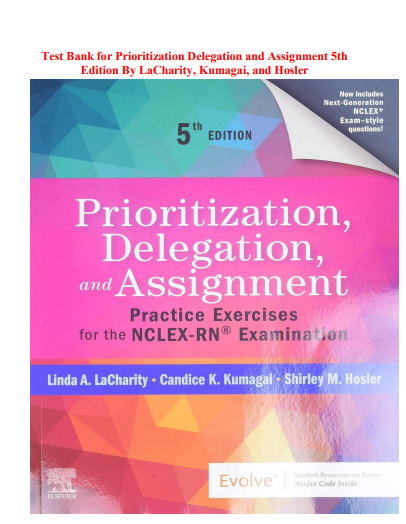
This resource is written to accompany the 5th edition of Prioritization, Delegation, and Assignment, a text used across nursing programs specifically because it isolates these two skills and drills them independently of any single body system or disease. The test bank follows that same approach, presenting patient care scenarios that force a choice between competing priorities or competing team members, then explaining exactly why one option outranks the others.
What This Test Bank Offers
Instead of testing whether you know a fact, this collection tests whether you can apply the ABCs, Maslow’s hierarchy, the nursing process, and delegation principles correctly under a time-pressured, multi-patient scenario. Every question is built around a realistic clinical situation involving more than one patient, more than one task, or more than one potential team member to hand a task to.
Question formats include:
- Multiple choice questions asking which patient or action takes priority
- Select-all-that-apply items identifying tasks appropriate for delegation
- Matching sets pairing tasks with the correct level of caregiver
- Short scenario-based questions covering an entire shift’s worth of competing demands
- Case studies requiring sequencing of multiple nursing actions
Every question is labeled by the underlying reasoning framework it tests, whether that is prioritization using the ABCs and Maslow’s hierarchy, or delegation using the five rights of delegation, so you can target your weakest reasoning pattern directly.
Topics Covered
The test bank spans the major skill areas found in the textbook, including:
- Prioritizing care using airway, breathing, and circulation
- Prioritizing care using Maslow’s hierarchy of needs
- Applying the nursing process to determine priority actions
- The five rights of delegation
- Determining appropriate tasks for RNs, LPNs/LVNs, and unlicensed assistive personnel
- Managing multiple patients across a single shift
- Responding to unexpected changes in patient condition
- Prioritizing within specific specialty areas, including medical-surgical, maternity, pediatric, mental health, and critical care scenarios
- Legal and ethical considerations in delegation
- Communication and handoff during care transitions
Because the scenarios are pulled from across nursing specialties rather than a single body system, the test bank works well as a standalone review tool for NCLEX-style prioritization and delegation questions, regardless of which specific course unit you happen to be in.
Why Use a Test Bank Alongside Your Textbook
Prioritization and delegation questions have a reputation for being some of the trickiest on any nursing exam, because there is often no clearly wrong answer among the choices, only a clearly better one. The only way to get comfortable with that kind of question is to practice it repeatedly, working through the reasoning each time instead of guessing. A test bank built entirely around this skill gives you concentrated repetition that a general medical-surgical or specialty textbook usually cannot provide, since prioritization and delegation questions there tend to be scattered rather than the primary focus. Reading the rationale after each question, especially when you get it wrong, is often more valuable than the question itself, because it reveals the reasoning framework you missed.
For instructors, this test bank offers a ready-made way to build dedicated prioritization and delegation quizzes that pull from multiple specialty areas at once, which can be difficult to assemble from scratch using a single specialty textbook.
Format and Delivery
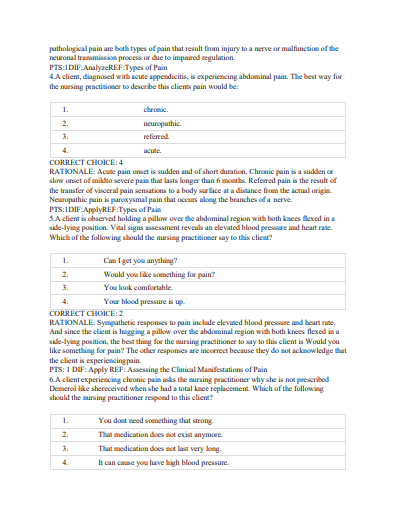
The test bank is delivered as an editable document, making it easy to import into a learning management system, print for timed practice sessions, or rearrange into shorter, focused quiz sets. Every question includes a verified correct answer and a written rationale explaining the reasoning framework behind that choice.
Five Sample Questions
Below are five original sample questions written in the style and difficulty level found throughout the full test bank, along with the correct answer and a rationale explaining why that answer is correct.
Question 1
The nurse is assigned to care for four patients at the start of a shift. Which patient should the nurse assess first?
A. A patient two days post-appendectomy requesting pain medication
B. A patient with a new onset of shortness of breath and confusion
C. A patient scheduled for discharge teaching later that morning
D. A patient asking for assistance getting to the bathroom
Correct Answer: B. A patient with a new onset of shortness of breath and confusion
Rationale: New shortness of breath combined with confusion suggests a possible airway or oxygenation problem, which takes priority under the ABC framework because it may indicate an acute, life-threatening change in condition. Pain requests, discharge teaching, and assistance to the bathroom are all valid needs, but none of them signal the kind of immediate physiological threat that a sudden respiratory and neurologic change does.
Question 2
Which task is most appropriate for the RN to delegate to unlicensed assistive personnel (UAP)?
A. Assessing a new patient’s pain level after surgery
B. Reinforcing discharge teaching for a patient with a new insulin regimen
C. Measuring and recording a stable patient’s vital signs
D. Administering a scheduled oral medication
Correct Answer: C. Measuring and recording a stable patient’s vital signs
Rationale: Taking vital signs on a stable patient is a routine, standardized task within the scope of practice for unlicensed assistive personnel, since it does not require nursing judgment to perform. Assessment, patient teaching, and medication administration all require nursing judgment or licensure and must remain with the RN or, in some cases, an LPN/LVN depending on state regulations, but are never appropriate to delegate to UAP.
Question 3
The nurse is preparing to make patient assignments for the shift. Which patient would be most appropriate to assign to a newly licensed RN who has been on the unit for two weeks?
A. A patient in active labor experiencing late decelerations
B. A patient requiring frequent neurological checks after a recent stroke
C. A stable patient who is one day post-op from an uncomplicated cholecystectomy
D. A patient in septic shock requiring vasopressor titration
Correct Answer: C. A stable patient who is one day post-op from an uncomplicated cholecystectomy
Rationale: Assignment decisions should match patient complexity to the experience level of the nurse. A stable, uncomplicated postoperative patient represents a lower-acuity, more predictable care situation appropriate for a newly licensed nurse still building clinical confidence. Late decelerations in labor, frequent neuro checks after a stroke, and vasopressor titration in septic shock all require a higher level of clinical judgment and experience, making them inappropriate assignments for a nurse this early in their practice.
Question 4
An LPN/LVN reports to the RN that a postoperative patient’s dressing is saturated with bright red drainage. What is the RN’s priority action?
A. Instruct the LPN/LVN to reinforce the dressing and continue monitoring independently
B. Assess the patient directly and notify the surgeon if bleeding continues
C. Wait until the next scheduled rounding time to evaluate the patient
D. Delegate the reassessment entirely to unlicensed assistive personnel
Correct Answer: B. Assess the patient directly and notify the surgeon if bleeding continues
Rationale: A saturated dressing with bright red drainage may indicate active postoperative bleeding, which requires direct RN assessment rather than being handled solely by the LPN/LVN or delegated further down to UAP. Simply instructing the LPN/LVN to reinforce the dressing without RN evaluation risks missing a serious complication, and waiting until a later rounding time delays necessary intervention for a potentially urgent situation.
Question 5
The RN is assigning tasks at the start of the shift. Which task should be assigned to the LPN/LVN rather than to unlicensed assistive personnel?
A. Assisting a patient with bathing and personal hygiene
B. Ambulating a stable patient in the hallway
C. Administering a scheduled subcutaneous medication
D. Collecting a patient’s meal tray after a meal
Correct Answer: C. Administering a scheduled subcutaneous medication
Rationale: Medication administration generally falls within the scope of practice for an LPN/LVN, depending on state regulations, but is outside the scope of unlicensed assistive personnel, who are not permitted to administer medications. Bathing, ambulation of a stable patient, and collecting a meal tray are all routine, non-judgment-based tasks appropriate for UAP to perform.
Frequently Asked Questions
1. Does this test bank match the exact chapter structure of the 5th edition?
Yes. Questions are organized around the same reasoning frameworks and specialty-based scenario categories used throughout the 5th edition of Prioritization, Delegation, and Assignment, making it easy to align practice with your current unit of study.
2. Is this the official instructor’s test bank distributed with the textbook?
No. This is an independently developed study and teaching resource written to align with the concepts covered in the textbook. It is intended as a supplementary resource, not a reproduction of publisher-issued instructor materials.
3. Does this test bank cover a specific specialty, or scenarios from across nursing practice?
It covers scenarios from across nursing practice, including medical-surgical, maternity, pediatric, mental health, and critical care situations, since prioritization and delegation reasoning applies across all of these areas.
4. Can instructors edit the questions before using them in a course?
Yes. The file is provided in an editable format, allowing instructors to adjust wording, change scenario details, or combine questions into custom quizzes and exams.
5. Is this suitable for self-study without an instructor?
Yes. Every question includes a verified answer and a written rationale explaining the reasoning framework used, so students can practice independently and build confidence with this question type.
6. Does the test bank cover the five rights of delegation specifically?
Yes. A dedicated portion of the test bank focuses on applying the five rights of delegation, right task, right circumstance, right person, right direction/communication, and right supervision, to realistic scenarios.
7. How difficult are the questions compared to a licensure-style exam?
The questions are written at a level consistent with NCLEX-style prioritization and delegation items, focusing on distinguishing between multiple reasonable-sounding options rather than simple recall.
8. Can this test bank be imported into a learning management system?
Yes. The clear question and answer formatting is designed to transfer easily into common learning management systems for online quizzes, homework assignments, and exam banks.




Tjakes9 –
Very on point and the rationales are great helps you understand the concept better
Swagridy –
Great material, very accurate and helpful. Highly recommend!