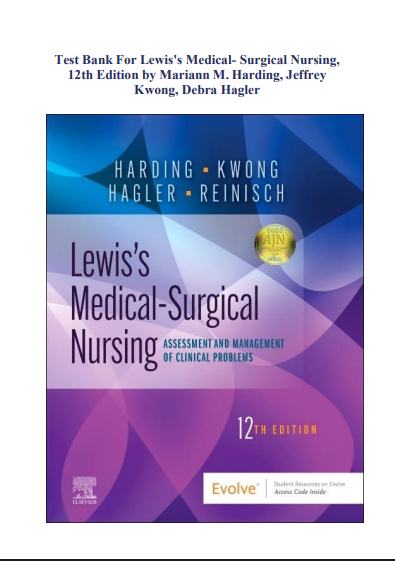
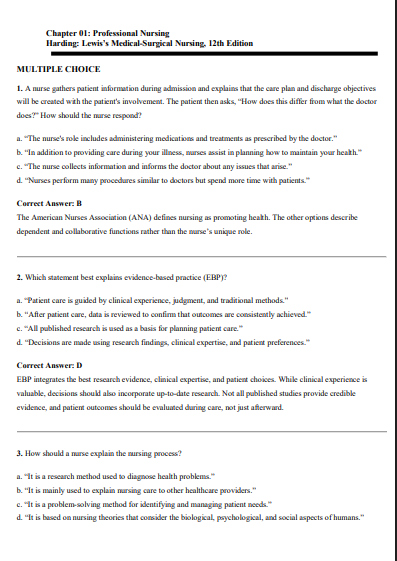

Medical-surgical nursing is often the course where everything a nursing student has learned so far finally has to come together. Anatomy, pathophysiology, pharmacology, and the nursing process all show up in a single patient scenario, and the exam questions are built to test whether you can pull all of that together under pressure, not just recall isolated facts about a disease. It is one thing to know what heart failure is, and a very different skill to recognize which finding in a busy patient assessment needs to be reported first.
This test bank is written to accompany the 12th edition of Lewis’s Medical-Surgical Nursing, a text long relied on in nursing programs for its comprehensive coverage of adult health conditions and its consistent use of the nursing process to organize patient care. The test bank mirrors that structure, pairing pathophysiology and assessment questions with prioritization and clinical judgment scenarios similar to what students encounter on both course exams and licensure-style questions.
What This Test Bank Offers
Rather than isolated disease facts, this collection is built around the kind of reasoning medical-surgical nursing exams actually test: recognizing early versus late signs of a condition, prioritizing which patient or finding needs immediate attention, selecting the correct nursing intervention, and understanding the rationale behind a specific treatment or medication. It is designed to help you think through a patient case the way an exam or a real clinical shift will require, not just recall a definition.
Question formats include:
- Multiple choice questions with four answer options
- Select-all-that-apply items in an NCLEX-style format
- True or false statements that test precise clinical understanding
- Fill-in-the-blank items for key terms and normal values
- Short case-based questions involving prioritization and clinical judgment
Every question is labeled by chapter and topic, so it is easy to focus review on a specific area, such as cardiovascular disorders, diabetes management, or postoperative care, without sorting through unrelated material.
Topics Covered
The test bank spans the major content areas found in the textbook, including:
- Foundations of medical-surgical nursing and the nursing process
- Fluid, electrolyte, and acid-base balance
- Perioperative nursing care
- Cardiovascular disorders, including heart failure and coronary artery disease
- Respiratory disorders, including COPD and pneumonia
- Hematologic and immune system disorders
- Gastrointestinal and hepatobiliary disorders
- Endocrine disorders, including diabetes mellitus and thyroid conditions
- Renal and urinary disorders
- Musculoskeletal and neurologic disorders
- Reproductive and integumentary disorders
- Oncology nursing care
- Emergency, critical care, and disaster nursing considerations
Because coverage spans the full text, the test bank works well for weekly unit quizzes as well as comprehensive final exam review.
Why Use a Test Bank Alongside Your Textbook
Medical-surgical content rewards active practice far more than passive reading, because the skill being tested is rarely “do you know this fact” and much more often “can you apply this fact correctly under pressure.” A test bank gives you repeated practice recognizing which finding matters most in a given scenario, which is exactly the muscle that needs strengthening before a proctored exam or a licensure-style test. Reviewing a detailed rationale after each question also helps reinforce the clinical reasoning behind a prioritization decision, not just the answer itself, which builds habits that carry directly into clinical practice.
For instructors, this test bank offers a practical, ready-made starting point for building quizzes, homework, or exams that already reflect the organization and clinical judgment emphasis of the assigned textbook, with full flexibility to edit or reorganize the material for a specific course.
Format and Delivery
The test bank is delivered as an editable document, making it simple to import into a learning management system, print for in-class testing, or rearrange into custom quizzes. Every question includes a verified correct answer and a written rationale, so it also functions well as an independent study tool.
Five Sample Questions
Below are five original sample questions written in the style and difficulty level found throughout the full test bank, along with the correct answer and a rationale explaining why that answer is correct.
Question 1
A nurse is caring for a patient with left-sided heart failure. Which assessment finding is most consistent with this diagnosis?
A. Peripheral edema and jugular vein distention
B. Crackles in the lungs and dyspnea
C. Ascites and hepatomegaly
D. Distended abdomen and weight gain from fluid retention
Correct Answer: B. Crackles in the lungs and dyspnea
Rationale: In left-sided heart failure, the left ventricle cannot pump effectively, causing blood to back up into the pulmonary circulation. This leads to fluid accumulation in the lungs, producing crackles and shortness of breath. Peripheral edema, jugular vein distention, ascites, and hepatomegaly are findings more consistent with right-sided heart failure, where blood backs up into the systemic venous circulation instead.
Question 2
A patient returns from surgery and is receiving intravenous fluids. Which finding should the nurse recognize as an early sign of fluid volume excess?
A. Decreased blood pressure
B. Crackles on lung auscultation
C. Dry mucous membranes
D. Decreased urine output with concentrated urine
Correct Answer: B. Crackles on lung auscultation
Rationale: Crackles heard on lung auscultation indicate fluid accumulating in the alveoli, an early and clinically significant sign of fluid volume excess, particularly in a postoperative patient receiving intravenous fluids. Decreased blood pressure, dry mucous membranes, and concentrated urine with decreased output are findings more consistent with fluid volume deficit, not excess.
Question 3
A patient with type 2 diabetes has a blood glucose of 58 mg/dL and reports feeling shaky and anxious. What is the nurse’s priority action?
A. Administer the patient’s scheduled dose of oral hypoglycemic medication
B. Provide 15 to 20 grams of a fast-acting carbohydrate
C. Encourage the patient to rest and recheck glucose in one hour
D. Withhold all further food and fluids until the provider is notified
Correct Answer: B. Provide 15 to 20 grams of a fast-acting carbohydrate
Rationale: A blood glucose of 58 mg/dL with symptoms of shakiness and anxiety indicates hypoglycemia, which requires prompt treatment with a fast-acting carbohydrate source to raise blood glucose quickly and prevent progression to a more severe hypoglycemic event. Administering a hypoglycemic medication would worsen the low blood glucose, simply resting without treating the low glucose delays necessary correction, and withholding food and fluids removes the very intervention the patient needs most.
Question 4
A patient is 6 hours postoperative following abdominal surgery and reports sudden, sharp pain along with a sensation of “something giving way” at the incision site. On inspection, the nurse notes the incision has separated with visible protrusion of abdominal organs. What is the nurse’s priority action?
A. Apply a dry sterile dressing and notify the surgeon later during rounds
B. Cover the area with a sterile saline-soaked dressing and notify the surgeon immediately
C. Attempt to gently push the protruding tissue back into place
D. Apply firm pressure directly to the exposed organs to control bleeding
Correct Answer: B. Cover the area with a sterile saline-soaked dressing and notify the surgeon immediately
Rationale: These findings describe wound evisceration, a surgical emergency. The priority action is to cover the exposed organs with a sterile saline-soaked dressing to keep the tissue moist and reduce the risk of further injury or drying, while notifying the surgeon immediately for emergency intervention. Attempting to push the tissue back in or applying firm pressure directly to exposed organs risks causing further tissue damage and infection, and any delay in notifying the surgeon increases the risk of serious complications.
Question 5
Which laboratory finding would the nurse expect in a patient experiencing an acute exacerbation of chronic kidney disease?
A. Decreased serum creatinine and blood urea nitrogen
B. Elevated serum creatinine and blood urea nitrogen
C. Decreased serum potassium
D. Elevated serum calcium
Correct Answer: B. Elevated serum creatinine and blood urea nitrogen
Rationale: As kidney function declines, the kidneys become less able to filter and excrete waste products, causing serum creatinine and blood urea nitrogen to rise above normal levels. Chronic kidney disease is more commonly associated with elevated, not decreased, potassium levels due to impaired excretion, and calcium levels typically decrease rather than increase due to disruptions in vitamin D activation and phosphate balance, making elevated creatinine and BUN the expected and defining laboratory findings in this scenario.
Frequently Asked Questions
1. Does this test bank match the exact chapter structure of the 12th edition?
Yes. Questions are organized to follow the chapter order and major topic divisions of the 12th edition of Lewis’s Medical-Surgical Nursing, making it easy to align practice questions with your current unit of study.
2. Is this the official instructor’s test bank distributed with the textbook?
No. This is an independently developed study and teaching resource written to align with the concepts covered in the textbook. It is intended as a supplementary resource, not a reproduction of publisher-issued instructor materials.
3. Does the test bank focus on prioritization and clinical judgment, or mostly on disease facts?
Both. The collection blends foundational pathophysiology and assessment questions with prioritization, delegation, and clinical judgment scenarios similar in style to licensure-focused nursing exams.
4. Can instructors edit the questions before using them in a course?
Yes. The file is provided in an editable format, allowing instructors to adjust wording, change answer choices, or combine questions from different chapters into custom quizzes and exams.
5. Is this suitable for self-study without an instructor?
Yes. Every question includes a verified answer and a written rationale, so students can use the material independently to check their understanding and pinpoint areas that need further review.
6. Does the test bank cover surgical and emergency nursing topics, or only chronic disease management?
Both. The test bank includes perioperative and postoperative care, along with emergency and critical care scenarios, in addition to chronic disease management across body systems.
7. How difficult are the questions compared to a nursing school exam?
The questions are written at a level consistent with an undergraduate medical-surgical nursing course, blending recall-based questions with clinical judgment, prioritization, and case-based scenarios similar to those found on program exams.
8. Can this test bank be imported into a learning management system?
Yes. The clear question and answer formatting is designed to transfer easily into common learning management systems for online quizzes, homework assignments, and exam banks.


Anne –
excellent. i love the update
Mikel –
I feel these are great study questions