If you have worked as an LPN, you already know how to care for patients. Bridge exams test something different: how an RN thinks. You are asked to look at the whole picture, decide what matters most, and know which tasks you can hand to someone else. Many experienced LPNs are surprised that they miss questions on topics they handle every day, because the exam asks for the RN’s decision, not just the correct task.
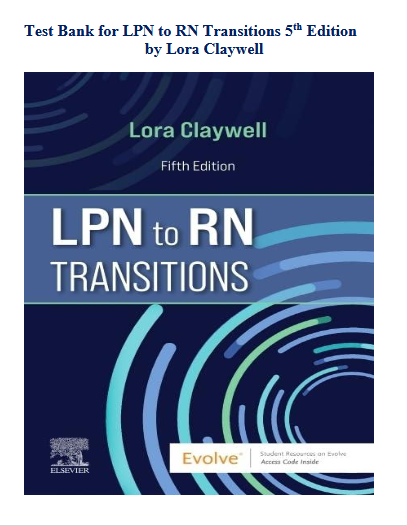
This test bank was built to practice that shift. It follows the chapter order of LPN to RN Transitions, 5th Edition, by Lora Claywell, so each study session matches what your bridge course is covering.
If you are in an LPN-to-RN program, getting ready for a unit exam, or starting NCLEX-RN review, this resource gives you steady practice with the decisions the RN role requires.
Topics Covered
The question sets follow the textbook and include:
- Moving from the LPN role to the RN role and what changes
- Differences in scope of practice between LPNs and RNs
- The nursing process and how RNs use it to plan care
- Critical thinking and clinical judgment
- Setting priorities with several patients at once
- Delegating and supervising LPNs and nursing assistants
- Legal duties, accountability, and avoiding negligence
- Ethics and patient rights
- Communication, teamwork, and handling conflict
- Leadership, time management, and managing change
- Cultural awareness and patient teaching
- Preparing for licensure and planning your career
You will find multiple-choice, select-all-that-apply, and prioritization questions, the same formats used in bridge courses and on the NCLEX-RN.
Why Practice Questions Help in a Bridge Program
Bridge students often know the skills but are unsure how exams phrase the RN’s role. A question may describe four patients and ask who to see first, or list tasks and ask which one can be delegated. Practicing with scenarios helps you:
- Tell which tasks stay with the RN and which can be assigned
- Put the most urgent patient first, using airway, breathing, and circulation
- Think about the whole plan of care, not only the task in front of you
- Understand your legal duties when you delegate
- Get used to how NCLEX-style questions are worded
Many bridge students say the hardest change is letting go of a task-based view. Working through questions by chapter helps you build the habit of thinking like an RN.
What Makes This Test Bank Different
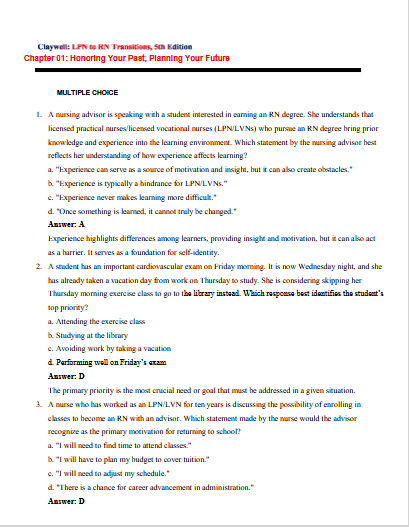
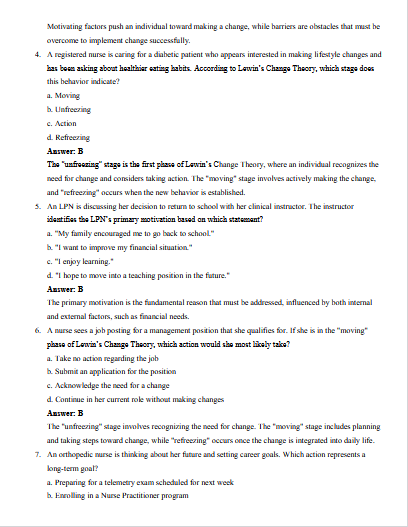
Every question includes a full rationale. You will see why the best answer is right and why each other option is wrong, unsafe, or outside the RN’s best action. On bridge exams, the wrong answers are often things an LPN would correctly do, but they are not the best RN choice for that situation. Seeing that difference is a large part of learning.
Questions are grouped by chapter and topic. Review one area, such as delegation, before a quiz, or work through several chapters before a final. Use it beside your reading, before clinical, or as a structured review before the NCLEX-RN.
Sample Questions
Question 1
The RN is assigning care to an LPN. Which patient is the most appropriate assignment?
A. A newly admitted patient who needs an admission assessment and plan of care
B. A stable patient on postoperative day 3 who needs a dressing change and scheduled oral medications
C. A patient who needs first-time teaching about starting insulin
D. A patient who is reporting new chest pain and sweating
Correct Answer: B
Rationale: A stable patient with predictable needs, such as a routine dressing change and scheduled oral medications, fits within the LPN’s scope and is appropriate to assign. Admission assessments and care plans involve analysis and judgment that belong to the RN. Initial teaching about a new, complex treatment also needs the RN’s assessment of what the patient knows and understands. A patient with new chest pain is unstable and needs the RN’s immediate assessment.
Question 2
An RN begins a shift with four patients. Which patient should the RN see first?
A. A patient with a pain rating of 6 out of 10 who is due for scheduled medication
B. A patient who has new wheezing and an oxygen saturation of 88 percent
C. A patient who needs help with a bath
D. A patient who has questions about discharge instructions
Correct Answer: B
Rationale: New wheezing with a low oxygen level is a problem with breathing, which comes first when setting priorities. The patient may be heading toward respiratory failure, so the RN must assess right away. Pain that is due for medication matters but is not immediately life-threatening. A bath and discharge questions are important but can wait until the unstable patient is safe.
Question 3
Which action must the RN keep and not delegate to an LPN?
A. Taking vital signs on a stable patient
B. Giving a scheduled oral medication to a stable patient
C. Evaluating the patient’s response to treatment and revising the plan of care
D. Reinforcing teaching that the RN has already provided
Correct Answer: C
Rationale: Evaluating outcomes and changing the plan of care require analysis and clinical judgment, which are part of the RN’s scope. The LPN can collect data and report findings to help with this process. Taking vital signs on a stable patient, giving routine oral medications, and reinforcing teaching that the RN has already done are tasks that can usually be delegated, depending on the state practice act and facility policy.
Question 4
A nurse who worked as an LPN for ten years starts a new RN job and says, “I feel like I know nothing. Maybe I was not ready for this.” What is the best response?
A. “You should probably go back to your LPN position.”
B. “These feelings are common during role transition. Let’s find a mentor and set small goals.”
C. “You will be fine, so there is no need to worry.”
D. “Everyone else on the unit feels confident, so you will need to catch up quickly.”
Correct Answer: B
Rationale: Role transition takes time, and doubt and stress are common even for experienced nurses. Naming the feeling as normal and offering practical support, such as a mentor and small goals, helps build confidence. Suggesting a return to the old role gives up too soon. Telling the nurse not to worry brushes aside real feelings. Saying everyone else is confident is untrue and adds pressure.
Question 5
An RN delegates a task to an LPN, and the LPN makes an error. Which statement about accountability is correct?
A. The RN is no longer responsible once the task is delegated
B. The LPN is responsible for own actions, and the RN is accountable for delegating appropriately and supervising
C. Only the facility is responsible
D. Only the patient’s provider is responsible
Correct Answer: B
Rationale: Each nurse is accountable for his or her own practice. The LPN answers for how the task is performed, and the RN answers for choosing the right task and person, giving clear directions, and checking the outcome. Delegating a task does not end the RN’s duty to supervise. Facilities and providers also have roles, but they do not replace the nurses’ own accountability.
Frequently Asked Questions
Is this the same as the publisher’s official test bank?
No. This is an independently written study resource meant to help you review the topics in the 5th edition of LPN to RN Transitions. It is a self-study companion and is not distributed by the publisher.
Will it help me prepare for the NCLEX-RN?
Yes. The scenario style is similar to the NCLEX, especially for delegation, prioritization, and legal and ethical questions.
Does it cover every chapter?
Yes. The questions follow the chapter order of the 5th edition, from role transition and scope of practice through leadership and career planning.
What kinds of questions are included?
Mostly multiple-choice, plus select-all-that-apply and prioritization questions.
Are there explanations?
Yes. Every question has a full rationale that explains why the best answer is correct and why the others are not.
Who is it for?
LPNs in bridge programs, and anyone reviewing RN scope of practice, delegation, and priority setting before an exam.
How should I use it?
Read the chapter first, then try the questions before looking at the answers. Study the rationales for anything you missed. Understanding why an answer is best helps more than memorizing the letter.
Can it replace the textbook?
No. It works best alongside the textbook. The book teaches the RN role, and the test bank gives you practice applying it.
Is it matched to the 5th edition?
Yes. It follows the topics and chapter structure of the 5th edition.
Is it useful before an exam?
Yes. Because it is organized by chapter, you can quickly review one area, such as delegation or prioritization, without rereading the whole book.


Swagrid –
Great value for nursing preparation.
Tonnyjakes17 –
Reliable, thorough, and easy.
Mikel –
Perfect for daily practice sessions
Shyks Ann –
Exactly what I needed to pass
Maxy –
Helped me understand complex concepts fast.
Merinra Jesh –
Outstanding practice test bank for prep.
pstrebler –
Comprehensive questions that match actual exams.
Muya D –
Easy to use and understand.
Stacy Wanjiku –
Helpful explanations with practice questions.
Huntersin7 –
Very helpful for exam preparation.
Anadiaz –
Questions closely matched course topics.
Zack Evans –
Well-organized questions and useful explanations.
SimVault –
Helpful for reviewing challenging nursing concepts.
Joe Terry –
Helps build confidence before exams
Joyce Silva –
Well organized and easy to navigate
Harry G –
Boosts confidence before nursing exams
Peter –
Very useful for exam practice
Alex H –
Quality questions with helpful answers