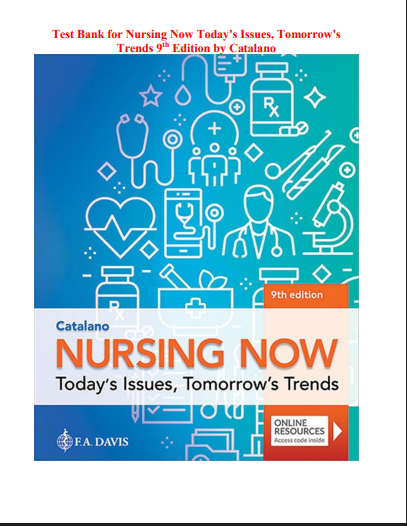
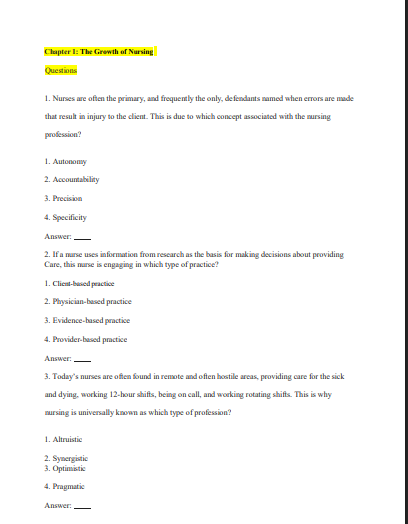
Nursing school teaches you how to care for patients, but it does not always spend enough time on the profession itself, the history that shaped it, the issues currently reshaping it, and the trends that will define your career for decades to come. That is exactly the gap Nursing Now: Today’s Issues, Tomorrow’s Trends is written to fill, and this test bank was built to reinforce it. It follows the chapter structure of the 9th edition, by Joseph T. Catalano, so you can review the professional, legal, ethical, and workforce issues shaping nursing today the same organized way the textbook presents them.
Whether you are in an issues and trends course, preparing for the professional practice portion of the NCLEX-RN, or reviewing before graduation, this resource is designed to help you think critically about the profession itself, not just clinical skills, which is exactly what this course and its exams are built to test.
What This Test Bank Covers
The question sets are organized to match the topics found throughout the textbook, including:
- The history and evolution of nursing as a profession
- Nursing education pathways and the ongoing debate around entry-level requirements
- Licensure, credentialing, and regulation of nursing practice
- Legal issues in nursing, including malpractice, negligence, and scope of practice
- Ethical principles and ethical decision-making frameworks in nursing
- Nursing theory and its application to professional practice
- Workforce issues, including staffing, burnout, and the nursing shortage
- Political activism and the nurse’s role in health policy
- Technology, informatics, and their growing role in nursing practice
- Cultural competence and diversity considerations in the profession
- Career development, leadership, and the future direction of nursing
Each section includes a mix of multiple-choice, select-all-that-apply, and scenario-based questions, since these formats reflect how issues and trends courses and licensure-style exams are typically structured.
Why Students Use a Test Bank Like This
Issues and trends exams often ask you to apply a concept, like an ethical principle or a legal standard, to a specific professional scenario, rather than just define the term. A question might describe a workplace situation involving short staffing, a documentation error, or an ethical dilemma, and ask what principle or legal standard applies. Practicing with well-written questions helps you:
- Apply ethical frameworks, like autonomy, beneficence, and justice, to realistic nursing scenarios
- Build confidence distinguishing between legal concepts like negligence, malpractice, and battery
- Practice recognizing appropriate professional responses to workplace and staffing issues
- Get comfortable with questions connecting nursing history and theory to current practice
- Reduce exam anxiety by practicing the same applied, scenario-based reasoning used on licensure exams
Many students say this course feels different from clinical coursework because it is more conceptual and professionally focused, covering the “why” behind nursing practice standards rather than a specific disease or skill. Regular, chapter-based practice is one of the most effective ways to translate those broader professional concepts into the kind of applied reasoning these exams actually test.
What Makes This Test Bank Different
This test bank is built around complete explanations, not shortcut answer keys. Every question includes a full rationale that explains why the correct answer best reflects the relevant ethical principle, legal standard, or professional practice concept, and why each incorrect option falls short, whether because it describes a different concept, misapplies a legal term, or does not reflect current professional standards. This mirrors how issues and trends exams are typically written, since incorrect choices are often related concepts, not obviously wrong answers.
Questions are grouped by chapter and by professional topic, so you can focus your review exactly where you need it, whether that is a single topic like nursing ethics before a quiz, or a full review before a comprehensive exam. It works well as a companion to assigned readings, a self-check before class discussions, or a structured review before exam day.
Sample Questions
Question 1
A nurse administers the wrong dose of a medication due to a documentation error, resulting in patient harm. Which legal term best describes this situation?
A. Assault
B. Negligence
C. Battery
D. Defamation
Correct Answer: B
Rationale: Negligence refers to a failure to act with the level of care a reasonably prudent nurse would provide under similar circumstances, resulting in harm to the patient. A medication error caused by a documentation mistake that leads to patient harm fits this definition, since it reflects a deviation from the expected standard of care rather than an intentional act. Assault involves creating fear of harmful contact, which does not apply to this scenario. Battery involves unauthorized physical contact, which is also not the issue here, since the medication was given in the course of intended treatment, not without consent. Defamation involves harming someone’s reputation through false statements, which is unrelated to a medication administration error.
Question 2
A nurse is caring for a terminally ill patient who has clearly expressed a wish to stop receiving further treatment. The patient’s family insists that treatment continue. Which ethical principle most directly supports honoring the patient’s wishes?
A. Beneficence
B. Autonomy
C. Justice
D. Nonmaleficence
Correct Answer: B
Rationale: Autonomy refers to a patient’s right to make informed decisions about their own care, including the right to refuse treatment, even when family members disagree. Respecting the patient’s clearly expressed wishes reflects this principle directly. Beneficence refers to acting in the patient’s best interest, which could be interpreted differently by different parties, but does not override the patient’s own right to decide. Justice relates to fairness in the distribution of healthcare resources, which is not the central issue in this scenario. Nonmaleficence refers to avoiding harm, which is relevant to care decisions broadly, but the principle most directly supporting the patient’s right to make this specific decision is autonomy.
Question 3
Which factor has been most closely linked to the ongoing nursing shortage described in current workforce literature?
A. An oversupply of nursing school graduates each year
B. An aging nursing workforce combined with high rates of burnout and attrition
C. A decrease in overall demand for nursing services
D. A surplus of nursing faculty available to teach new students
Correct Answer: B
Rationale: The nursing shortage is closely tied to an aging workforce approaching retirement, combined with high rates of burnout and turnover among practicing nurses, which together reduce the overall supply of available nurses even as demand for care continues to grow. This combination of factors creates ongoing workforce strain across many healthcare settings. An oversupply of graduates does not reflect current workforce trends, since nursing programs often face limited capacity rather than producing an excess of graduates. A decrease in demand for nursing services is inaccurate, since demand for nursing care continues to rise, particularly with an aging patient population. A surplus of nursing faculty is also inaccurate, since faculty shortages are frequently cited as a limiting factor in expanding nursing education capacity.
Question 4
A nurse manager is deciding how to allocate limited staffing resources across several understaffed units during a particularly busy shift. Which ethical principle is most relevant to this decision?
A. Autonomy
B. Justice
C. Veracity
D. Fidelity
Correct Answer: B
Rationale: Justice refers to the fair and equitable distribution of resources, which directly applies to a situation involving the allocation of limited staffing across multiple units with competing needs. This principle guides decisions about how to distribute scarce resources as fairly as possible. Autonomy relates to an individual patient’s right to make decisions about their own care, which is not the central issue in a staffing allocation decision. Veracity refers to truthfulness in communication, which is not directly relevant to this scenario. Fidelity refers to keeping promises and being loyal to professional commitments, which, while relevant to nursing practice broadly, does not capture the resource-distribution nature of this specific decision.
Question 5
Which statement best reflects the current role of nursing informatics in professional practice?
A. Nursing informatics is primarily concerned with billing and insurance processes only
B. Nursing informatics integrates nursing science with information technology to improve patient care and data management
C. Nursing informatics has largely been replaced by administrative staff in most healthcare settings
D. Nursing informatics applies only to nurses working exclusively in research roles
Correct Answer: B
Rationale: Nursing informatics combines nursing knowledge and clinical expertise with information technology and data management skills to improve patient care, documentation accuracy, and healthcare decision-making across a wide range of settings. This growing specialty plays an increasingly central role in modern nursing practice. Option A is too narrow, since nursing informatics extends well beyond billing and insurance functions into clinical decision support, electronic health records, and quality improvement. Option C is inaccurate, since nursing informatics roles have expanded rather than being replaced by administrative staff. Option D is also inaccurate, since nursing informatics principles apply broadly across clinical, administrative, and educational nursing roles, not just research positions.
Frequently Asked Questions
Is this test bank the same as the official instructor materials from the publisher?
This test bank is an independently prepared study resource built to help students review the topics covered in the 9th edition of Nursing Now: Today’s Issues, Tomorrow’s Trends. It is intended as a self-study companion and is not distributed by the publisher.
Is this test bank helpful for NCLEX-RN preparation?
The questions are written in an applied, scenario-based style similar to licensure-exam questions, with an emphasis on legal concepts, ethical principles, and professional practice issues, all of which are tested within the professional practice portion of the NCLEX-RN.
Does it cover every chapter of the textbook?
Yes, the questions are organized by chapter and professional topic, following the general topic order of the 9th edition, from the history of nursing through current workforce and technology trends.
What question formats are included?
Most questions are multiple-choice, with some select-all-that-apply and scenario-based items, since these formats are common in issues and trends courses and on licensure-style exams.
Do the answers include explanations, or just the correct letter?
Yes, every question includes a full rationale explaining why the correct answer best reflects the relevant ethical principle, legal standard, or professional practice concept, and why the other options are a weaker match.
Who is this test bank best suited for?
It is designed for nursing students taking an issues and trends course, as well as anyone reviewing professional, legal, and ethical concepts ahead of a course exam or the NCLEX-RN.
How should I use this resource while studying?
A common approach is to read the assigned chapter first, then work through the related questions without checking the answers right away. Afterward, review the rationales closely, especially for missed questions, since understanding which principle or legal concept applies to a given scenario matters more than memorizing the correct letter alone.
Can this replace reading the textbook?
No. This resource works best alongside the textbook, not instead of it. The textbook builds your foundational understanding of nursing’s professional, legal, and ethical landscape, while the test bank helps you practice applying that knowledge to realistic scenarios.
Is the content aligned specifically with the 9th edition?
Yes, the material follows the topics, terminology, and chapter organization used in the 9th edition of the textbook.
Is this useful for last-minute exam review?
Yes, many students use it as a focused review tool in the days before an exam, since the chapter-based organization makes it easy to target specific professional topics quickly, rather than reviewing the entire book at once.
Pauline –
Excellent resource for nursing students.
Anne –
Very helpful for exam preparation.