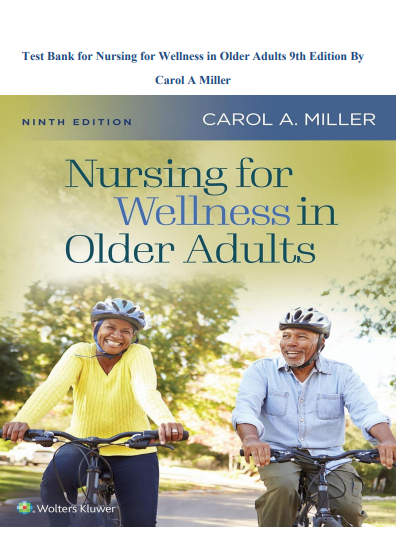
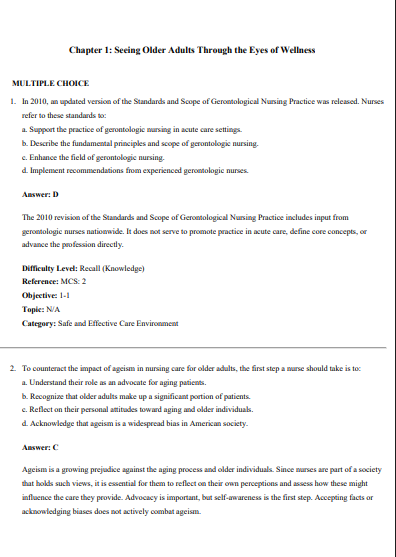
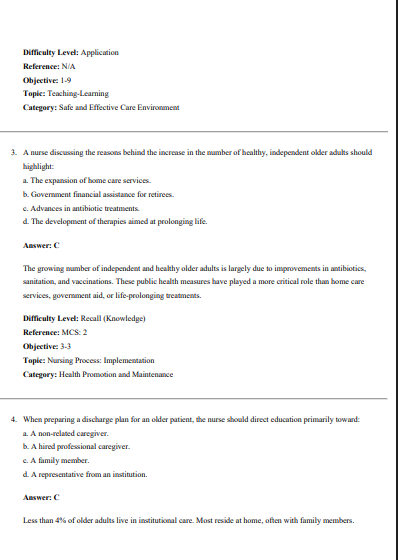
Older adults are not simply younger patients with more health problems. Their bodies change in predictable ways, their illnesses often look different, and their goals are often about staying independent, not just treating disease. Nursing for Wellness in Older Adults is built around that idea. This test bank was made to give you practice thinking the same way. It follows the chapter order of the 9th edition by Carol A. Miller, so each study session matches what your course is covering.
If you are in a gerontological nursing course, getting ready for clinical in a long-term care or community setting, or reviewing for the NCLEX-RN, this resource gives you steady practice telling normal aging from real problems and choosing nursing actions that protect function and dignity.
Topics Covered
The question sets follow the textbook and include:
- The wellness approach and common beliefs about aging
- Normal age-related changes in each body system
- Assessing function, including daily living skills and safety
- Hearing, vision, and other sensory changes
- Memory, delirium, dementia, and depression
- Medication use, side effects, and safety in older adults
- Nutrition, fluids, and bowel and bladder problems
- Skin, sleep, and pain
- Heart, lung, bone, and joint conditions common with aging
- Falls, mobility, and preventing injury
- Sexuality, relationships, and spiritual needs
- Abuse, neglect, and financial exploitation
- Advance directives, palliative care, and end-of-life care
- Care across settings, from home to hospital to long-term care
You will find multiple-choice, select-all-that-apply, and short scenario questions, which are the formats most gerontology courses and licensure exams use.
Why Practice Questions Help in This Course
Gerontology exams love to test whether you can tell what is normal from what is not. A slower reaction time may come with age, but sudden confusion is never normal. Practicing with scenarios helps you:
- Tell expected age changes from warning signs
- Notice that illness in older adults can look quiet or unusual
- Choose actions that keep the person as independent as possible
- Think about safety, especially with falls and medications
- Feel comfortable with the way exam questions are written
Many students say this course feels different from other nursing courses because there is often no single “disease” to focus on. Short, regular practice by chapter helps you build the habit of looking at the whole person.
What Makes This Test Bank Different
Every question includes a full rationale. You will see why the best answer is correct and why each other option falls short. On gerontology exams, wrong answers often sound kind or cautious but take away independence or miss a danger sign. Understanding why they fail is a large part of learning.
Questions are grouped by chapter and topic. Review one area, such as sensory changes, before a quiz, or work across several chapters before a final. Use it beside your reading, before clinical, or as a structured review before an exam.
Sample Questions
Question 1
A 72-year-old patient says she now has to hold her newspaper at arm’s length to read it, but her distance vision is fine. What is the nurse’s best understanding of this finding?
A. It is presbyopia, a normal age-related loss of near focusing ability
B. It is a sign of advanced glaucoma
C. It is macular degeneration
D. It is a sign of a stroke
Correct Answer: A
Rationale: Presbyopia happens because the lens of the eye becomes stiffer with age and cannot change shape well enough to focus on close objects. Nearly everyone develops it by middle age, and reading glasses or bifocals usually fix it. Glaucoma gradually damages side vision and often has no early symptoms. Macular degeneration affects central vision, so straight lines may look wavy. A stroke causes a sudden change in vision, often with other signs such as weakness or trouble speaking.
Question 2
A patient with advanced dementia cannot say whether he is in pain. He is moaning, tense, and pulling away when his leg is moved. What should the nurse do?
A. Assume he has no pain because he did not report any
B. Use a behavior-based pain scale, such as PAINAD, and treat based on the findings
C. Wait until he can describe the pain with words
D. Give a sedative to calm him
Correct Answer: B
Rationale: People with advanced dementia often cannot use number scales, so pain must be judged from behavior. Tools such as PAINAD look at breathing, noise, face, body language, and how easily the person can be comforted. Pain that is found should be treated, usually starting with the right pain medication and comfort measures. Assuming no pain leaves the patient suffering. Waiting for words may never work. A sedative hides distress without treating its cause.
Question 3
A 78-year-old man whose wife died six months ago has stopped eating well, avoids his friends, and says, “I am just a burden to everyone.” What should the nurse do first?
A. Tell him that his family loves him and wants him to stay positive
B. Ask him directly whether he has thoughts of ending his life
C. Explain that grief is normal and will pass with time
D. Encourage him to join a social group and review his progress next month
Correct Answer: B
Rationale: Withdrawal, poor appetite, and feeling like a burden are warning signs of depression, and older men have one of the highest suicide rates. Asking directly about suicidal thoughts does not plant the idea and is the safest first step. The answer guides what must happen next, such as close supervision and a referral. Reassurance and telling him grief will pass skip the safety question. A group and a plan to check later do not address a possible immediate risk.
Question 4
A patient reports a sudden, strong urge to urinate and often cannot reach the toilet in time. There is no leaking with coughing or laughing. What nursing intervention is most appropriate?
A. Restrict fluids after noon
B. Use a scheduled toileting plan and bladder training
C. Place the patient on a bladder catheter long term
D. Tell the patient that leaking is normal and cannot be treated
Correct Answer: B
Rationale: This pattern is urge incontinence, caused by a bladder that contracts before it is full. Scheduled toileting, in which the patient goes at set times, and bladder training, which slowly lengthens the time between visits, are first-line treatments. Cutting back on fluids makes urine more concentrated, which can irritate the bladder, and does not solve the problem. A long-term catheter raises the risk of infection and should not be used for incontinence alone. Incontinence is common in older adults but it is not normal and it can often be improved.
Question 5
A nurse is helping a resident with moderate dementia get dressed. Which approach is best?
A. Give a long list of instructions all at once so the task is finished faster
B. Approach from the front, speak calmly, and give one simple step at a time
C. Argue with the resident about the date so that he stays oriented
D. Dress the resident quickly without explaining
Correct Answer: B
Rationale: People with dementia understand better when the setting is calm and requests are short and clear. Approaching from the front prevents startling the person, and giving one step at a time, such as “Put your arm in here,” helps the person succeed and keeps independence as long as possible. Long lists overwhelm the person. Arguing over facts causes distress and rarely helps. Dressing without explanation is disrespectful and can cause fear and resistance.
Frequently Asked Questions
Is this the same as the publisher’s official test bank?
No. This is an independently written study resource meant to help you review the topics in the 9th edition of Nursing for Wellness in Older Adults. It is a self-study companion and is not distributed by the publisher.
Will it help me prepare for the NCLEX-RN?
Yes. The scenario style is similar to licensure exam questions and focuses on safety, priorities, and recognizing changes in older adults.
Does it cover every chapter?
Yes. The questions follow the chapter order of the 9th edition, from the wellness approach and normal aging through common problems and end-of-life care.
What kinds of questions are included?
Mostly multiple-choice, plus select-all-that-apply and short scenario questions.
Are there explanations?
Yes. Every question has a full rationale that explains why the best answer is correct and why the other options are not.
Who is it for?
Nursing students in a gerontology course, and anyone reviewing older adult care before an exam or certification.
How should I use it?
Read the chapter first, then try the questions before looking at the answers. Study the rationales for anything you missed, since knowing why an answer is best helps more than memorizing the letter.
Can it replace the textbook?
No. It works best alongside the textbook. The book teaches the concepts of wellness and aging, and the test bank gives you practice applying them.
Is it matched to the 9th edition?
Yes. It follows the topics and chapter structure of the 9th edition.
Is it useful the night before an exam?
Yes. Because it is organized by chapter, you can quickly review one area, such as dementia care or medication safety, without rereading the whole book.


Annie –
Good study material
James –
PERFECT
Liamm –
Great quality
vvidi –
It helped me to understand the assessment
Swagrid –
Excellent resource for exam preparation
Johy –
Clear explanations and accurate answers
Ray –
Helped me study with confidence
Ann Joyce M –
Questions closely match nursing topics.
Tonny –
Made studying much more manageable.
Anadiaz Cate –
Makes reviewing challenging topics more manageable
Annen M –
Useful resource for consistent nursing practice
Joyce Silva –
Useful for testing nursing knowledge
Terrysnyder –
Great preparation tool for exams
Ann Han –
Great practice questions for nurses
Ton –
Makes exam preparation much easier
Swagrid Gladys –
Excellent resource for nursing exam preparation
Paul –
Very helpful and easy to understand
Gladys –
Great questions for nursing students
Williams Kevin –
Improved my confidence before exams
Annen Berna –
Useful questions covering important nursing topics.
Hunter –
Makes exam preparation more manageable