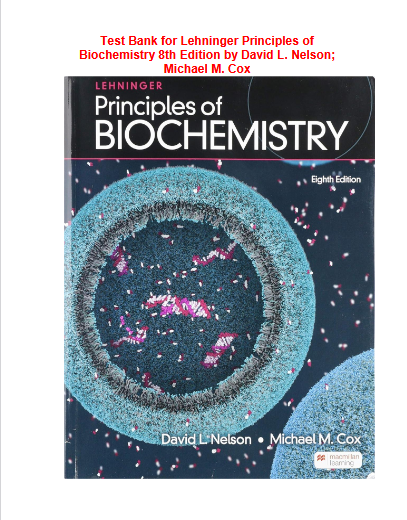
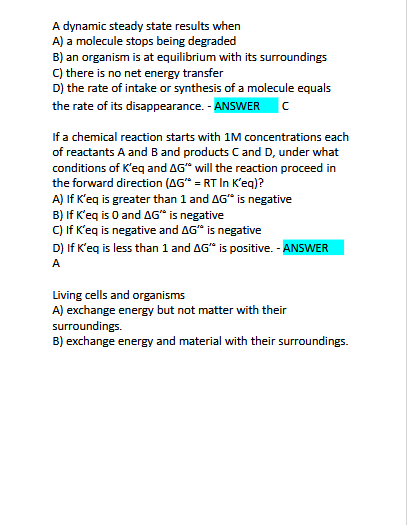
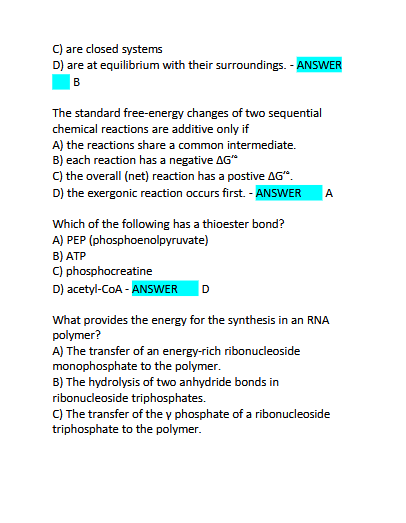
Biochemistry sits at an awkward crossroads for a lot of students, part memorization, part chemistry logic, part tracing a multi-step pathway without losing your place. It’s entirely possible to understand every individual step of glycolysis and still get lost trying to answer a question about the pathway as a whole. This test bank was built with that exact problem in mind. It follows the chapter structure of Lehninger Principles of Biochemistry, 8th Edition, by David L. Nelson and Michael M. Cox, so your practice tracks structure, function, and metabolism the same organized way the textbook builds each concept.
Whether you’re a biochemistry major, a pre-med or pre-health student, or working through this as part of a broader life sciences program, this resource is built to strengthen the structure-to-function reasoning biochemistry exams almost always test.
What’s Covered
Practice sets follow the textbook’s organization, including:
- Foundations of biochemistry, including water, pH, and weak interactions in biological systems
- Amino acid structure, protein structure, and protein function
- Enzyme kinetics, catalysis, and enzyme regulation
- Carbohydrate structure and metabolism, including glycolysis and gluconeogenesis
- The citric acid cycle and oxidative phosphorylation
- Lipid structure, lipid metabolism, and membrane biology
- Amino acid metabolism and the urea cycle
- Nucleotide structure, DNA replication, and repair
- RNA transcription, translation, and gene expression regulation
- Signal transduction and cellular communication
- Integration and regulation of metabolism across tissues
Question formats mix multiple-choice, matching, and pathway-based items, reflecting how biochemistry courses using this text are typically taught and tested.
Why Practice Questions Help Here
Biochemistry exams rarely just ask you to name a molecule. They tend to ask what happens if a specific enzyme gets inhibited, why a mutation changes protein function, or how energy actually flows through a pathway under certain conditions. Working through practice questions helps you:
- Build confidence tracing metabolic pathways step by step instead of memorizing them as disconnected diagrams
- Practice predicting downstream effects of enzyme inhibition, mutation, or regulatory changes
- Strengthen your grasp of how molecular structure actually determines biological function
- Get comfortable with questions that combine structure, mechanism, and regulation in a single scenario
- Reduce exam anxiety by practicing the same integrative, multi-step reasoning biochemistry exams consistently require
Many students say biochemistry is hard not because any single concept is impossible, but because the subject demands holding several related ideas in your head at once, structure, mechanism, and regulation, simultaneously. Regular, chapter-based practice is one of the more effective ways to build that integrated understanding before it’s tested for real.
What Makes This Test Bank Different
This test bank is built around full conceptual explanations, not shortcut answer keys. Every question includes a complete rationale that walks through the underlying chemistry or biology behind the correct answer, and explains why each incorrect option reflects a common misunderstanding, an incomplete mechanism, or a mismatched pathway. This mirrors how biochemistry exams are typically written, since wrong answers are usually built around a real but misapplied concept, not something obviously unrelated.
Questions are grouped by chapter and biochemical topic, so you can focus your review exactly where you need it, whether that’s a single pathway like glycolysis before a quiz or a full review before a comprehensive final. It works well as a companion to assigned readings, a self-check before problem sets, or a structured review before exam day.
Sample Questions
Question 1
An enzyme’s active site is altered by a mutation that changes the shape of the substrate-binding pocket, but the enzyme still binds its normal substrate with reduced efficiency. What type of inhibition does this scenario most closely resemble in terms of its effect on enzyme kinetics?
A. Competitive inhibition
B. Noncompetitive inhibition
C. This scenario doesn’t resemble a type of enzyme inhibition
D. Allosteric activation
Correct Answer: C
Rationale: This scenario describes a structural mutation affecting the enzyme itself, not an external inhibitor binding to it, so it doesn’t actually represent a classic inhibition mechanism. Competitive and noncompetitive inhibition both involve an inhibitor molecule interacting with the enzyme, whether at the active site or elsewhere, which is different from an inherent structural change caused by mutation. Allosteric activation describes an increase in enzyme activity through a regulatory site, also not what’s described here, since the mutation reduces function rather than enhancing it. Telling apart an inhibitor-based mechanism from a structural mutation is an important distinction when interpreting enzyme kinetics questions like this one.
Question 2
During glycolysis, which molecule represents the net investment of ATP before any ATP is produced by the pathway?
A. Glucose is phosphorylated using ATP in the early steps of glycolysis
B. Pyruvate is formed using ATP in the final step
C. NADH is produced using ATP early in the pathway
D. Fructose-1,6-bisphosphate is broken down using ATP
Correct Answer: A
Rationale: In the early, energy-investment phase of glycolysis, ATP gets used to phosphorylate glucose and later fructose-6-phosphate, prepping these molecules for the energy-releasing steps that come later. This investment happens before any ATP is actually generated in the pathway’s final steps. Option B is off, since pyruvate formation belongs to the energy-yielding phase, where ATP gets produced, not consumed. Option C isn’t accurate, since NADH gets generated using energy from a different reaction, not directly from ATP. Option D describes a cleavage step that doesn’t itself consume ATP, since that investment happens earlier, during the phosphorylation steps.
Question 3
Which structural feature allows hemoglobin to exhibit cooperative binding of oxygen?
A. Hemoglobin has only one binding site for oxygen
B. Conformational changes in one subunit affect oxygen affinity in the other subunits
C. Each hemoglobin subunit functions completely independently of the others
D. Hemoglobin cannot change shape once oxygen binds
Correct Answer: B
Rationale: Hemoglobin’s cooperative binding happens because it’s a multi-subunit protein, and when oxygen binds one subunit, it triggers a conformational change that boosts oxygen affinity in the remaining subunits. This structural communication between subunits is the whole basis of hemoglobin’s sigmoidal oxygen-binding curve. Option A is wrong, since hemoglobin actually has four oxygen-binding sites, one per subunit, not just one. Option C describes the opposite of cooperative behavior, since truly independent subunits wouldn’t influence each other’s binding affinity at all. Option D is inaccurate, since hemoglobin’s ability to change shape upon binding oxygen is exactly what makes cooperative binding possible in the first place.
Question 4
A cell has abundant ATP and NADH, and citrate levels are high. How would this most likely affect the activity of phosphofructokinase-1 (PFK-1), a key regulatory enzyme in glycolysis?
A. PFK-1 activity would increase, speeding up glycolysis
B. PFK-1 activity would decrease, slowing down glycolysis
C. PFK-1 activity would remain unaffected by ATP, NADH, or citrate levels
D. PFK-1 would be permanently and irreversibly inactivated
Correct Answer: B
Rationale: PFK-1 is allosterically inhibited by high ATP and citrate levels, both of which signal that the cell already has plenty of energy and biosynthetic building blocks on hand. This feedback inhibition slows glycolysis when energy is abundant, preventing the cell from breaking down glucose it doesn’t currently need. Option A describes the opposite of the expected response under these conditions. Option C is off, since PFK-1 is actually one of the most tightly regulated enzymes in glycolysis and is highly sensitive to exactly these signals. Option D is inaccurate, since allosteric inhibition is a reversible regulatory mechanism, not a permanent shutdown of the enzyme.
Question 5
Which statement correctly describes the relationship between the citric acid cycle and oxidative phosphorylation?
A. The citric acid cycle directly produces the majority of the cell’s ATP through substrate-level phosphorylation alone
B. The citric acid cycle generates electron carriers that are later used by the electron transport chain to drive ATP synthesis
C. Oxidative phosphorylation occurs independently of any products generated by the citric acid cycle
D. The citric acid cycle and oxidative phosphorylation both occur in the cytoplasm using the same enzymes
Correct Answer: B
Rationale: The citric acid cycle generates electron carriers, mainly NADH and FADH2, which hand off electrons to the electron transport chain. That electron transfer drives the proton gradient ATP synthase uses to produce the bulk of the cell’s ATP through oxidative phosphorylation. Option A is off, since most ATP actually gets generated later through oxidative phosphorylation, not directly through the citric acid cycle’s own substrate-level phosphorylation steps. Option C is inaccurate, since oxidative phosphorylation directly depends on the electron carriers the citric acid cycle supplies. Option D is incorrect, since the citric acid cycle happens in the mitochondrial matrix while oxidative phosphorylation happens across the inner mitochondrial membrane, involving entirely different sets of enzymes and protein complexes.
Frequently Asked Questions
Is this the publisher’s official test bank?
No, this is an independently written study resource built to help you review the material in the 8th edition of Lehninger Principles of Biochemistry. It’s meant for self-study and isn’t distributed by the publisher.
Will this help with MCAT or other standardized exam prep?
The applied, concept-based format reinforces the same reasoning skills tested on standardized science exams, particularly questions involving metabolic pathways, enzyme regulation, and molecular structure.
Does it cover the whole textbook?
Yes, questions are organized by chapter and biochemical topic, following the 8th edition’s structure from foundational chemistry concepts through metabolism, gene expression, and cellular regulation.
What question formats are included?
Mostly multiple-choice, with some matching and pathway-based items, matching the format common in biochemistry courses using this text and reflecting how exams typically test metabolic reasoning.
Are there explanations, or just answer letters?
Every question includes a full rationale explaining the biochemical reasoning behind the correct answer and why each incorrect option reflects a common misconception or incomplete mechanism.
Who’s this best suited for?
Biochemistry majors, pre-health students, and anyone taking a biochemistry course built around this textbook, plus students reviewing core metabolic and molecular concepts ahead of an exam.
What’s the best way to use it?
Read the assigned chapter first, then work through the matching questions before checking answers. Review the rationales closely afterward, since understanding the mechanism behind an answer matters more than memorizing the correct letter alone.
Can this replace reading the textbook?
No, it’s meant to work alongside it. The textbook builds your foundational understanding of biochemical structures, pathways, and regulation; the test bank gives you a way to practice applying that knowledge to exam-style questions.
Is the content aligned specifically with the 8th edition?
Yes, it follows the topics, terminology, and chapter organization of the 8th edition.
Is this useful for last-minute exam review?
Yes, since it’s organized by chapter and topic, it’s easy to target a specific pathway or concept quickly rather than reviewing the entire book at once.



Julie41 –
I haven’t read it all the way through yet, but the structure and the way are really great!
assuahkabenla –
Nice to practice with
Zackk –
It has everything i need
Frank –
Great resource for nursing students
Trev –
Easy to understand and use
Johnk –
Excellent nursing questions and answers
Ann –
Really improved my exam preparation
Carrick Tony –
Super helpful for nursing exam prep.
Alexander Belinda –
Great questions for practicing daily.
Viarose –
Good variety of nursing practice questions.
Susan Conroy –
Very helpful for exam preparation.
Frank Palmon –
Great questions and detailed answers.