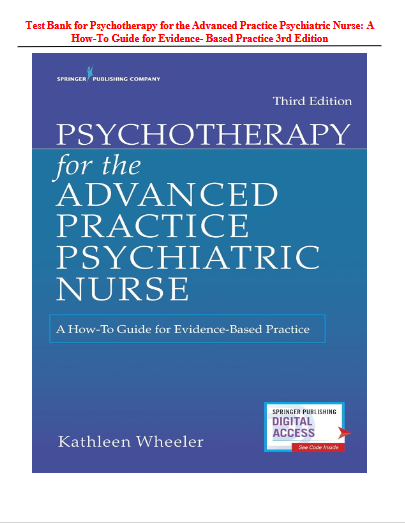

Most nursing exams ask what you know. Psychotherapy courses for psychiatric nurse practitioners also ask what you would say and do in the room. You have to recognize which approach fits which patient, notice when a session is going off track, and choose a response that protects both the patient and the therapeutic relationship. This test bank was built to give you practice with that kind of judgment. It follows the chapter order of Psychotherapy for the Advanced Practice Psychiatric Nurse: A How-To Guide for Evidence-Based Practice, 3rd Edition, edited by Kathleen Wheeler, so you can study each therapy model in the same sequence as your course.
If you are in a PMHNP program, getting ready for supervised practicum hours, or reviewing for certification, this resource gives you steady practice with the decisions a psychotherapist makes in real sessions.
Topics Covered
The question sets follow the textbook and include:
- Core skills of psychotherapy, including building and protecting the therapeutic alliance
- Assessment, case formulation, and treatment planning
- Cognitive behavioral therapy, including thought records and behavioral experiments
- Behavioral activation and exposure-based treatments
- Interpersonal therapy and its focus areas
- Psychodynamic and supportive approaches
- Dialectical behavior therapy skills
- Motivational interviewing and working with ambivalence
- Trauma-focused treatments
- Group therapy and group leadership
- Family and couples work in psychiatric practice
- Combining psychotherapy with medication management
- Culture, ethics, boundaries, and documentation
- Measuring progress and using evidence to guide treatment
You will find multiple-choice, select-all-that-apply, and short case questions, which reflect how advanced practice psychotherapy courses and certification exams are written.
Why Practice Questions Help in This Course
Psychotherapy is hard to test with facts alone. Exams describe a moment in a session and ask which technique is being used, which one fits next, or why a response might harm the alliance. Practicing with cases helps you:
- Recognize a therapy technique when you see it in a short patient exchange
- Match a treatment model to the patient’s diagnosis, goals, and readiness
- Respond to resistance, silence, and strong emotion without becoming defensive
- Decide when a problem calls for therapy, medication, or both
- Keep ethical boundaries clear in everyday situations
Many students say they understand each model on its own but mix them up when a case blends features. Practicing by chapter helps you keep the models distinct.
What Makes This Test Bank Different
Every question includes a detailed rationale. You will see why the best answer fits the patient in the case and why each other option falls short. Wrong answers in psychotherapy questions are usually real techniques that belong to a different model or a different moment. Understanding why they do not fit is a large part of learning.
Questions are grouped by chapter and approach, so you can review one model, such as exposure therapy, before a quiz, or work across several before a final. Use it beside your reading, before practicum, or as a structured review before certification.
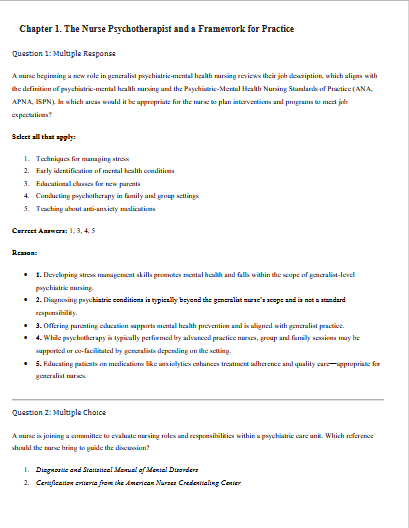
Sample Questions
Question 1
During a cognitive behavioral therapy session, a patient says, “If I don’t get every detail of this report right, I might as well have failed completely.” Which cognitive distortion is shown?
A. Mind reading
B. All-or-nothing thinking
C. Emotional reasoning
D. Personalization
Correct Answer: B
Rationale: All-or-nothing thinking sees outcomes in two extremes, perfect or total failure, with no middle ground. The patient’s statement treats any small flaw as complete failure. In CBT, the therapist would help the patient test this thought and find a more balanced view. Mind reading means assuming you know what others think. Emotional reasoning means taking a feeling as proof that something is true. Personalization means blaming yourself for events that are not your fault. None of those fit this statement.
Question 2
A patient with major depression has stopped seeing friends, stopped exercising, and spends most days in bed. The patient says, “I’ll do things again when I feel better.” Which approach is most consistent with behavioral activation?
A. Wait until the patient’s motivation returns before planning activities
B. Schedule small, specific, achievable activities and track the effect on mood
C. Spend the next several sessions exploring childhood memories
D. Advise more rest until energy improves
Correct Answer: B
Rationale: Behavioral activation is built on the idea that withdrawal keeps depression going, and that action can come before motivation. The therapist and patient plan small, realistic activities, such as a ten-minute walk, and then review how mood changed. This breaks the cycle of inactivity and low mood. Waiting for motivation to return keeps the patient stuck in the same pattern. Exploring childhood is part of other approaches and does not address current behavior. More rest strengthens the cycle of withdrawal.
Question 3
A 62-year-old patient whose spouse died eight months ago reports intense sadness, withdrawal from friends, and an inability to resume normal routines. In interpersonal therapy, which problem area best fits this case?
A. Role dispute
B. Role transition
C. Grief
D. Interpersonal deficits
Correct Answer: C
Rationale: Interpersonal therapy focuses on one problem area at a time. When a death is followed by prolonged distress and impaired functioning, the focus is grief. Treatment helps the patient mourn the loss, talk about the relationship, and slowly rebuild social ties and new interests. Role dispute involves conflict with a significant person who is alive. Role transition involves a change in life status, such as retirement or divorce. Interpersonal deficits describe long-standing difficulty forming and keeping relationships, which is not the main issue here.
Question 4
In the fourth session, a patient arrives 20 minutes late and says, “I don’t really think this is helping.” What is the nurse practitioner’s best response?
A. “We have already covered a lot of ground, so it is important that you stay committed.”
B. Move on to the planned agenda and ignore the comment
C. “I’m glad you told me. Can we talk about what has felt unhelpful so far?”
D. “If it is not helping, we can stop therapy today.”
Correct Answer: C
Rationale: A comment like this may signal a rupture in the therapeutic alliance. The best response is to welcome the feedback, stay calm, and invite the patient to explain. Talking openly about the rupture often strengthens the relationship and improves the work. Pressuring the patient to stay committed sounds defensive and can increase distance. Ignoring the comment leaves the problem untouched. Offering to end therapy without exploring the concern gives up too soon and may reflect the patient’s fear of being a burden.
Question 5
In a therapy group, one member talks for most of the session and others have started to look away. What should the group leader do?
A. Let the member continue, since the member is doing the most work
B. Acknowledge the member’s contribution, then invite other members to share
C. Point out in front of the group that the member is being selfish
D. Ask the member to leave the group
Correct Answer: B
Rationale: A group leader is responsible for making sure all members have a chance to take part. Acknowledging the member’s contribution respects the person while gently redirecting the group. Allowing the monopolizing to continue lets other members become silent and frustrated. Calling the member selfish shames the person and may harm trust within the group. Removing the member is too extreme for a behavior that can usually be handled with redirection and clear group norms.
Frequently Asked Questions
Is this the same as the publisher’s official test bank?
No. This is an independently written study resource meant to help you review the topics in the 3rd edition of Psychotherapy for the Advanced Practice Psychiatric Nurse. It is a self-study companion and is not distributed by the publisher.
Will it help with PMHNP certification?
The case-based style is similar to certification exam questions. It focuses on recognizing techniques, choosing an approach for a given patient, and handling alliance and ethics issues.
Does it cover every chapter?
Yes. The questions follow the chapter order of the 3rd edition, from core psychotherapy skills through the major treatment models and special topics.
What kinds of questions are included?
Mostly multiple-choice, plus select-all-that-apply and short case questions.
Are there explanations?
Yes. Every question includes a detailed rationale explaining why the best answer fits the case and why the other options do not.
Who is it for?
PMHNP students working through psychotherapy coursework, and anyone reviewing therapy models before a course exam or certification.
How should I use it?
Read the chapter, then answer the questions before checking the answers. Study the rationales for anything you missed. Understanding why a technique fits a situation helps more than memorizing the letter.
Can it replace the textbook?
No. It works best alongside the textbook. The book teaches the models, and the test bank lets you practice applying them.
Is it matched to the 3rd edition?
Yes. It follows the topics and chapter structure of the 3rd edition.
Is it useful the night before an exam?
Yes. Because it is organized by chapter and approach, you can quickly review one model, such as CBT or group therapy, without rereading the whole book.




Omqe –
I recommend it to other buyers. Very helpful. Thank you!
Swahy –
Very brief, direct notes from the lessons that have no extra structure nice test bank
Maximevanmol –
Highly relevant and easy to follow, simplified key topics and is extremely helpful for last-minute revision. Very recommendable
Swagri –
Wow this is an amazing document
Mik –
Helped reinforce key nursing concepts.
Nico –
Outstanding test bank for success.
Shelly –
Simple, effective, and highly recommended
Anita –
Clear questions with helpful answers.
Maxim –
Convenient and effective study resource
Kevin Race –
Great practice for nursing exams.
Viarose –
Clear, concise, and easy to use
Maggie Harry –
Passed on my first try!
Ivy –
Highly accurate questions and detailed answers.
Zack Evans –
Convenient for quick study sessions.
Kanee –
Helpful tool for exam revision.
Kate Hans –
Well-designed questions with clear answers
Kate Hans –
Well-designed questions with clear answers.
Joe Terry –
Very effective for nursing exam revision
Pauline Joel –
Excellent practice questions for students
Swagridy Gladys –
Very useful for reviewing key concepts
Hannah –
Easy to use and understand
Frank Palmon –
Great study resource for nurses